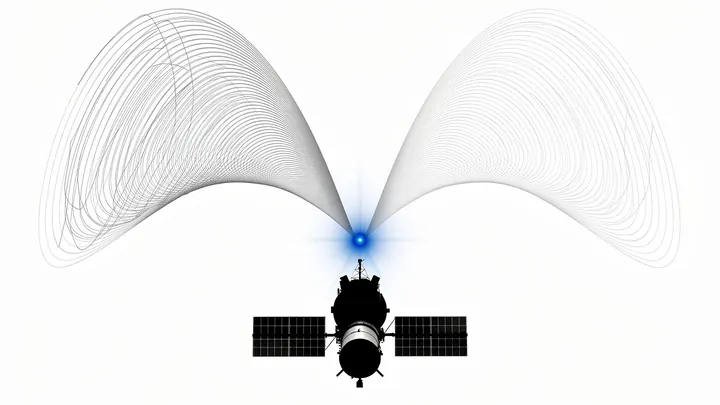
The Hubble Space Telescope is a large camera orbiting Earth. It looks at stars and galaxies without the interference of our atmosphere, so the images are incredibly clear, as if we are in space ourselves.
History
The concept of a space telescope had been discussed since the 1940s, but full design began in the 1970s. Launch took place on April 24, 1990; spherical aberration of the primary mirror was soon discovered and corrected by servicing mission STS-61 in 1993. A total of five servicing missions were conducted (the last in 2009), upgrading instruments. The telescope is named after Edwin Hubble, whose work on redshift and Hubble's law laid the foundations of modern cosmology.
How it works
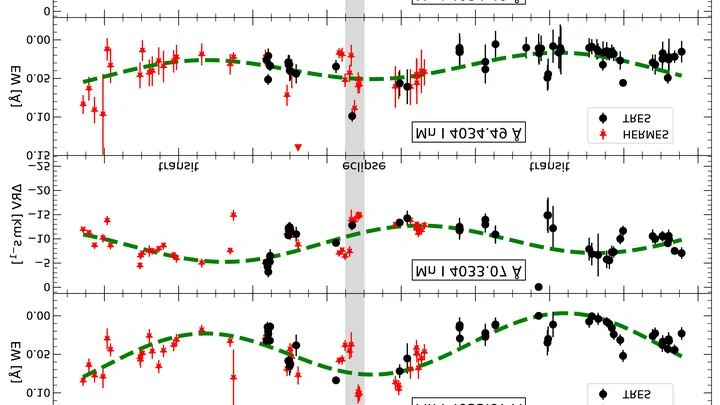
The Ritchey–Chrétien telescope collects light with a primary hyperbolic mirror and directs it to a secondary mirror, then to instruments. Stabilization is achieved with gyroscopes and magnetometers, precise pointing with guide star sensors. Scientific instruments include the Wide Field Camera 3, Cosmic Origins Spectrograph, and others. Data are transmitted via radio link through TDRS satellites. Hubble's law (v = H₀d) was empirically refined thanks to Hubble's observations of distant supernovae, leading to the discovery of accelerated expansion of the Universe. Gravitational lensing captured by the telescope has allowed mapping of dark matter in galaxy clusters. Transit spectroscopy of exoplanet atmospheres has revealed lines of water, methane, and other molecules.
Fun fact
Hubble doesn't take pictures in color like our cameras; it captures light at specific wavelengths in black and white. Then scientists colorize the images so we can see space in all its glory.
A network of radio telescopes scattered across the planet catches the whisper of a distant black hole. Each antenna records a signal, but how do you combine these recordings if the clocks at the stations tick at different rates and the atmosphere distorts incoming waves?
In the heart of an old city stands a clock tower whose hands have never been adjusted since it was built. By how far it runs slow, you can calculate how much time has stretched since then. In space, the role of such towers is played by relic galaxies — dense stellar systems that formed in the first few billion years and have since neither merged with neighbors nor given birth to new stars.
A lamp is hidden behind a large aquarium filled with water. You see not one light source but several reflections and refractions — the water bends the path of the rays.
Six runners sprint down the track, and officials time their speed without noticing a tailwind. The wind blows at their backs, and the stopwatches show a better result than the truth. Roughly this is how six megamasers — natural cosmic lasers in distant galaxies — misled astronomers measuring the expansion rate of the universe.
Six runners sprint down the track, and officials time their speed without noticing a tailwind. The wind blows at their backs, and the stopwatches show a better result than the truth. Roughly this is how six megamasers — natural cosmic lasers in distant galaxies — misled astronomers measuring the expansion rate of the universe.
Betelgeuse, the red supergiant familiar from Orion's shoulder, keeps surprising us. After the mysterious Great Dimming of 2019–2020, when the star suddenly dimmed, it didn't just recover; it changed its ways.
Measuring distances in the universe is no easy task. Almost all methods rely on light, which can be absorbed by dust, scattered, or distorted along the way. It's like trying to spot a distant lighthouse through fog and haze. Neutrinos are a different story. These ghostly particles pass through anything without noticing obstacles.
In a distant galaxy about 290 million light-years away, the object HLX-1 lies hidden. It once flared brighter than hundreds of billions of suns, but now it has quieted down. From 2018 to 2022, the Hubble, Chandra, and Swift space telescopes tracked its fading.
Edge of the spotlight. Remove the dazzling light of the central star, and a theater of shadows emerges. The James Webb coronagraph, like a dense curtain, hid the star TW Hydrae — and on a stage 120 astronomical units long (four times the distance to Neptune), its protoplanetary disk came alive.
Tabby's Star, a beacon in the cosmic sea, has baffled astronomers since 2015. Its light flickered not in the rhythm of planets, but as if scattered by a storm — deep dips, sharp spikes. But amid this chaos, a smooth, nearly perfect dip was found. The eye of the storm.
The standard model of cosmology, based on the field equations proposed by Einstein, describes the Universe as a cocktail of dark matter (discovered thanks to Vera Rubin) and dark energy in roughly a 1:3 ratio.
For almost a century, seismology has been the planet’s chief X-ray, probing the interior through elastic waves. But neutrinos, ghost particles predicted by Wolfgang Pauli, offer a different perspective.
The standard cosmological model ΛCDM, where dark matter and dark energy act as the chief architects of the cosmos, has predicted astronomical data with Swiss-watch precision for decades. Its foundation was laid by three geniuses.
The cosmological orchestra doesn't tune to a single tuning fork. There are two groups of instruments: one listens to the hum of the young universe — the cosmic microwave background, while the other reads notes from mature galaxies and supernovae.
The universe as painted in Einstein’s textbooks is a smooth four-dimensional canvas. But string theory adds a frame of extra dimensions — invisible, yet tangible to gravity. Imagine our universe as a membrane that trembles under the pressure of hidden layers.
The early universe underwent a rapid expansion — inflation. In a tiny fraction of a second, minuscule quantum jitters were stretched to galactic scales and became the seeds of all large-scale structure.
The planet WASP-121 b is a gas giant, heated to 2500°C. It always faces its star with one side, like a globe frozen under a lamp. But as it passes in front of the star's disk, its rotation reveals different facets to us — as if that globe were slowly turned, letting us peer into every corner.
A giant baby planet is still pulling in leftover building material from its surrounding cloud. That's the scene the Hubble Space Telescope captured when it aimed its cameras at an object catalogued as SR 12 c. This companion planet orbits a young star at a wide distance — farther out than Neptune is from the Sun.
Cosmology resembles a courtroom where two witnesses give irreconcilable testimonies. The first — the analysis of the cosmic microwave background by the Planck satellite — claims: the expansion of the universe proceeds at 67 (km/s)/Mpc.
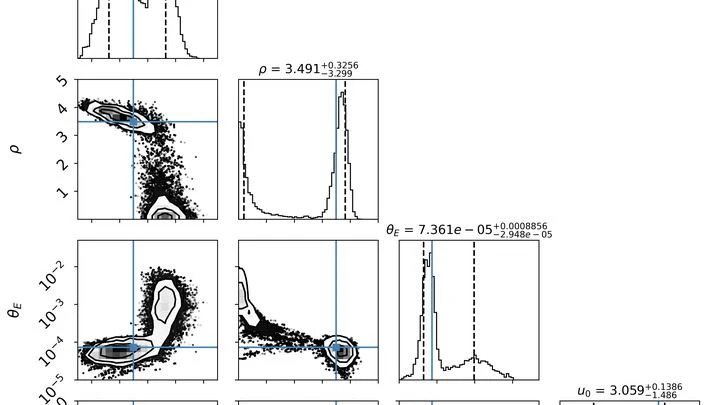
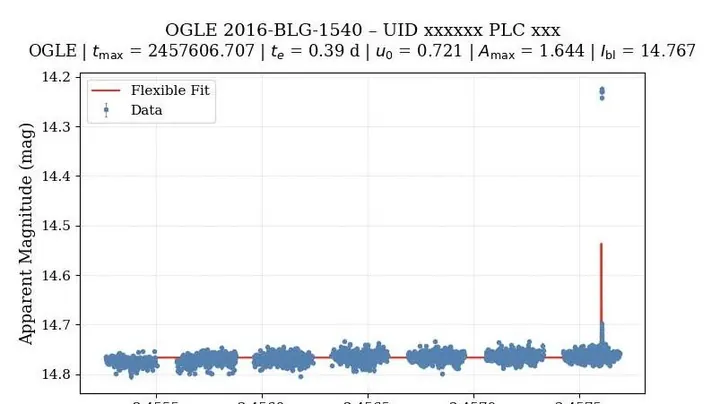
A spotlight shines through a dark hall. Between the lamp and the wall, an invisible lens drifts by, and the spot of light briefly brightens and shifts. That is exactly what the DECam telescope, aimed at the Large Magellanic Cloud, a satellite galaxy of our Milky Way, was watching for five consecutive nights.
A research probe is planned for the nearest black hole — a region of spacetime whose gravity traps even light. After a hundred years of flight, the spacecraft will enter orbit around the mysterious object to answer a key question: are we looking at a black hole or a neutron star — the ultra-dense remnant of a massive star, compressed to nuclear…
The cosmological dispute resembles two craftsmen measuring the same room with different tape measures. One, looking at distant galaxies, gets one number. The other, peering into the ancient glow (the cosmic microwave background, the cooled light of the Big Bang) gets another, smaller number.
Cosmologists have measured how fast distant galaxies are receding in different parts of the sky. To do this, they used two kinds of "cosmic rulers": galaxy clusters and a certain type of supernova explosion. Both methods showed the same thing: in one direction, the Universe is expanding slightly faster than in the opposite direction.
The Universe is expanding, but at what speed? Astronomers have been arguing for decades about the precise value of the Hubble constant. Two classic methods give slightly different results. Now there's a third — using mysterious radio bursts.
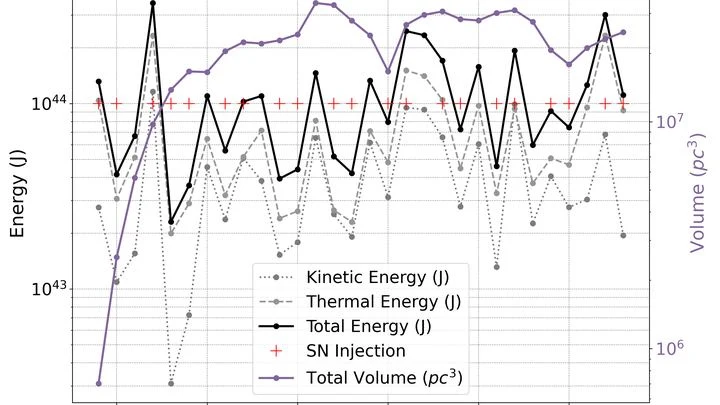
Superbubbles are cosmic giants, akin to soap bubbles, but instead of soap film, they contain rarefied interstellar gas, and they're inflated not by a breath but by a series of supernova explosions. In computer simulations, they behave like living things: they grow, cool, and move. But until now, we couldn't precisely trace their boundaries.
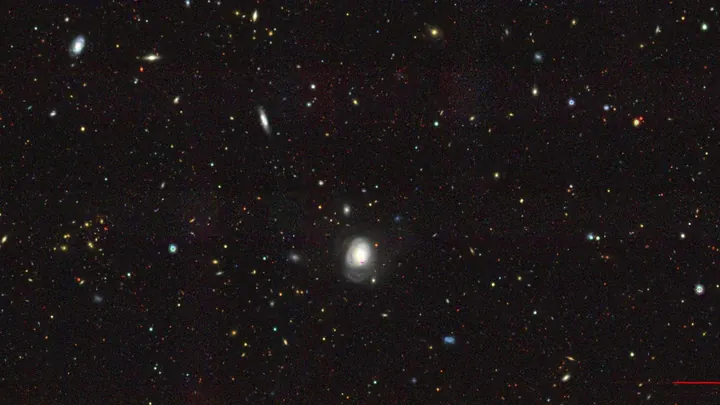
If you look at a map of distant galaxies, it is not perfectly uniform: on one side of the sky there are slightly more, on the other — slightly fewer. This lopsidedness has been noticed in several sky surveys, and it does not look like a random fluke. Usually, it is explained by the fact that our Galaxy itself is flying somewhere, making distant objects appear shifted.
Three and a half parsecs from the Sun, among the dim stars of the southern sky, hides a world that astronomers have been trying to see for thirty years. Epsilon Indi Ab is a gas giant, cold as a winter night: its temperature is about 275 kelvins, just above the freezing point of water.
For a long time, astrophysics was dominated by the belief that giant jets of radio emission, radio outbursts blasting from central regions, were the exclusive privilege of elliptical galaxies. It was thought that only their calm, featureless internal environment could allow such colossal fountains of energy, powered by supermassive black holes, to form.
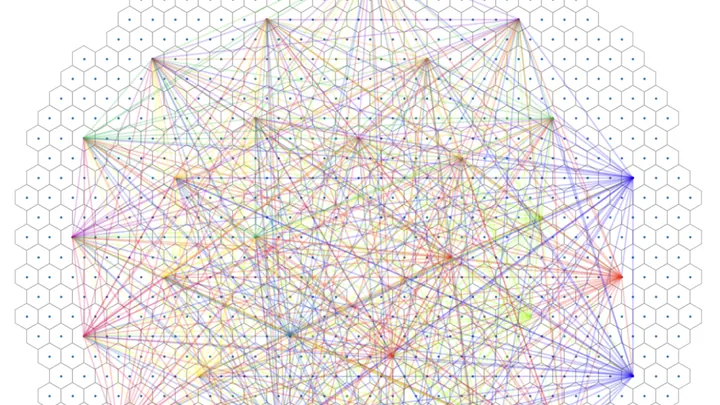
Light from a star travels for millions of years, yet in a telescope it still appears as a point: it's just too far away. To see a star's surface, you need an instrument the size of a city. In Chile, such a giant is already under construction: ELT with a 39-meter mirror made of 798 hexagonal segments.
At the center of our Galaxy lurks the supermassive black hole Sagittarius A* — a heavyweight that holds stars in its grip. Astronomers dream of finding pulsars near it: these cosmic lighthouses emit radio pulses with the precision of atomic clocks.
In distant galaxies, old stars swell and redden. Among them are two groups that act like lighthouses: some have just ignited helium burning, while others are already burning carbon and oxygen.
Light from a streetlamp passing through blinds flickers: the stripes shift, and brightness rises and falls. From that rhythm, you can guess how wide the lamp is. The new method for measuring stars works similarly: instead of capturing a sharp image, astronomers monitor the "twinkling" of light collected by two or more telescopes simultaneously.
The merger of two neutron stars is like a strike on a gong: a ripple in space, a gravitational wave, spreads through the universe. Detectors on Earth catch this ripple and, from its strength, calculate the distance to the source.
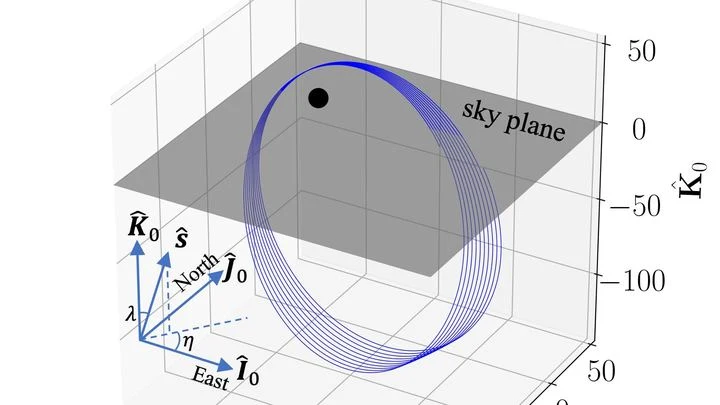
Two black holes circle each other, and their dance isn't always a smooth waltz. If the holes spin on their own axes, their orbit can start to tumble, like a top that's been pushed and wobbles on its side while still spinning.
A black hole merger gives birth to a gravitational wave. Sometimes the wave’s path is blocked by a galaxy or a clump of dark matter, predicted by Zwicky and discovered by Rubin.
Betelgeuse is a giant star ready to explode as a supernova. But it may not be alone: a small companion star, Sivarkha, circles in a tight orbit. Every 2000 days, it plunges through Betelgeuse’s outer layers, like a boat cutting through water, leaving waves of superheated gas.
Picture a star waltzing with an invisible partner: its rhythmic wobble, caused by the gravitational pull of a companion, is picked up by instruments, yet the partner itself eludes detection. Usually, such wobbles are the result of a Doppler shift, a change in the frequency of light due to the star's motion, that betrays the presence of a planet.
Type Ia supernovae are the 'standard candles' of cosmology: their peak luminosity is nearly identical, allowing distances to be determined from apparent brightness — the fainter the object, the farther away it is.
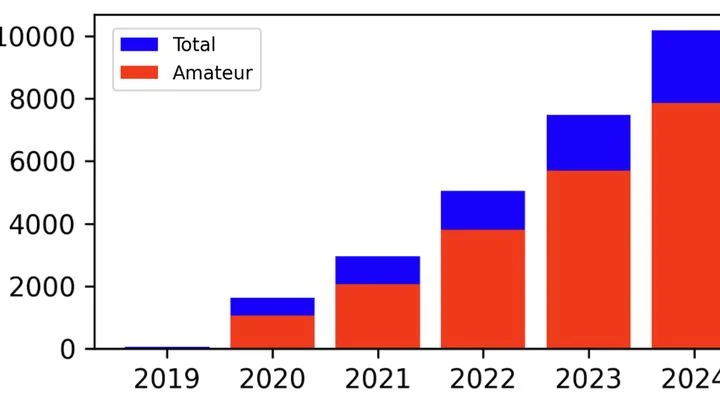
A bus schedule drifts: if you don't check it, you'll miss your ride. Planets around other stars have the same problem – their crossings of the star's disk gradually shift. The ExoClock project pooled 30,000 observations from Earth and space to refine the schedule for 620 distant worlds. For 45% of the planets, transits were found to be off by hours.