Dancing Clouds: Measuring the Transverse Motion of Gas in L1688 ✛
Context
This work stands apart: the nearest neighbors in the archive study dancing galaxies, fast interlopers, infalling clouds, and star formation with Gaia data, but no one has measured the transverse motion of the gas itself in molecular clouds. Detailed maps of stellar populations and gas structure already exist around L1688, yet the three-dimensional kinematics of the gas remained incomplete due to the missing transverse component. This work fills that gap by directly measuring the proper motion of the interstellar medium in a nearby cloud for the first time.
Methods
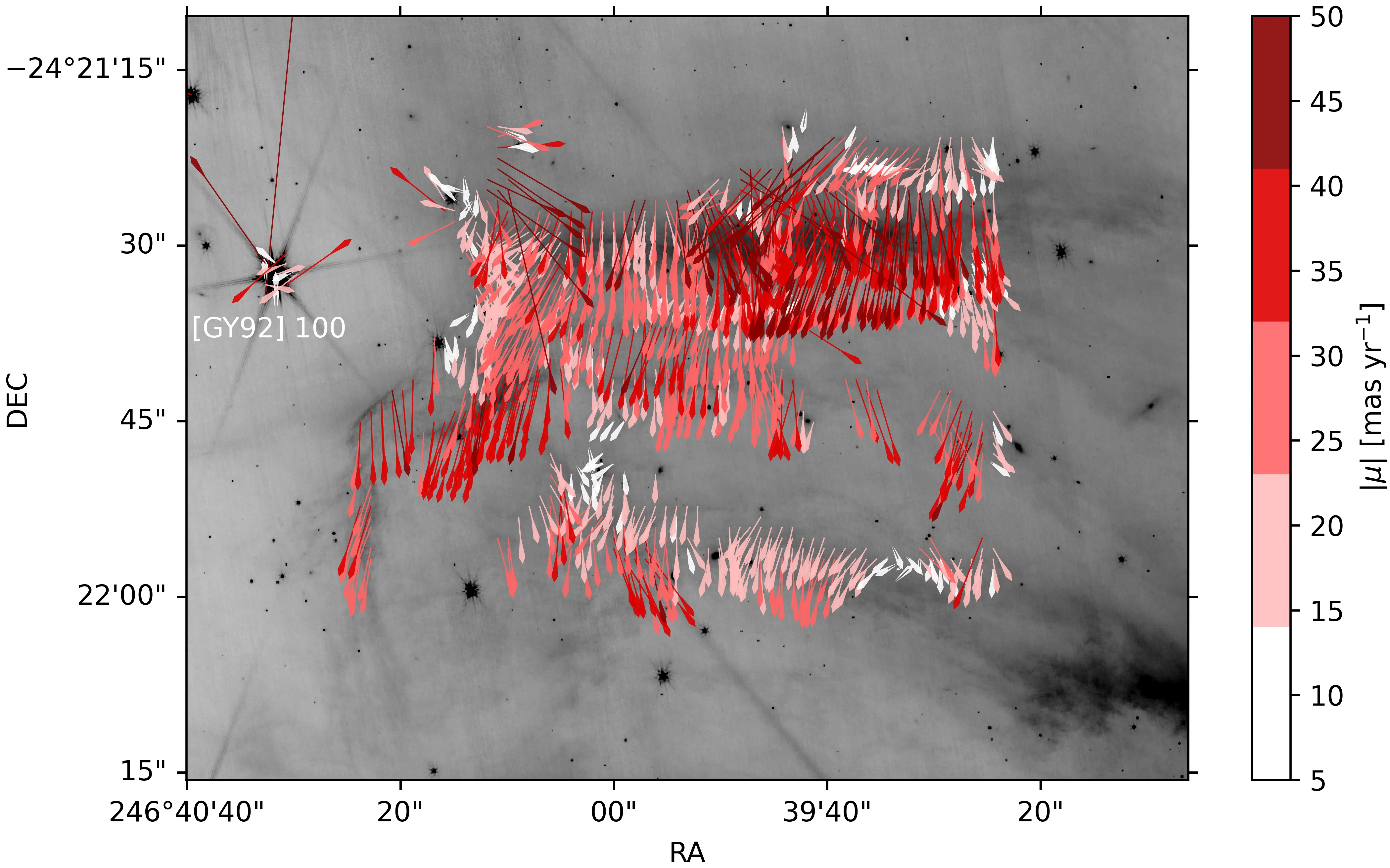
Archival HST/WFC3 (F160W, 2016) and JWST/NIRCam (F200W, 2023) images of the same region in L1688 were used, providing a time baseline of 6.5 years. Astrometric calibration was performed using distant galaxies in the field, with a median offset of (−52.4, +109.6) mas. Gas displacement was measured using intensity-based image registration with SimpleITK: a sliding window of 60×60 pixels scanned the region with a step of 10 pixels, aligning images by a correlation criterion. Stars were masked to avoid biasing the registration. A parallax correction was computed by simulating the cloud's orbit at a known distance of 140 pc, yielding (−1.4, +0.3) mas/yr.
Results
A field of gas proper motions was obtained in the region between GSS 37 and Oph S1. The median proper motion of the cloud is (µα*, µδ) = (−3.0±1.1, −24.1±1.7) mas/yr. This differs from the motion of the young Upper Scorpius population by 3±1 km/s, which is statistically significant. The difference with Oph S1 is 1.7±1.1 km/s. A sharp gradient of ~10 mas/yr over 40″ is found in the Oph ISM 1 structure, corresponding to ~240 km/s/pc, but this is likely a systematic effect due to different filters. The thin shell structure Oph ISM 6 has a proper motion of (−12.3±0.9, −23.8±0.7) mas/yr, but due to the diffraction spike from GSS 37 this measurement is unreliable; morphology and better alignment in the median field suggest an origin from Oph S1.
Implications
Unlike neighboring studies that examined stars or used line-of-sight velocities, this work provides the first direct transverse motion of the gas itself. It is the first test of the assumption of kinematic coupling between YSOs and the ISM using transverse velocities, and it shows a discrepancy. The work demonstrates that archival and future high-resolution infrared observations can measure transverse motions of the interstellar medium in nearby clouds, opening a new window into ISM dynamics.
Future development
The topic could be advanced by adding a third epoch of observations in the same or overlapping filter to check systematics and improve accuracy. Integral field spectroscopy would provide line-of-sight velocities of individual substructures and enable a full three-dimensional kinematic picture. Comparing ISM and YSO motions in other star-forming regions would provide a statistical sample to test the general assumption of coupling.
Impact
The results will impact studies of interstellar medium dynamics, stellar feedback, and star formation processes.
Next steps
Obtain additional HST/JWST observation epochs for L1688 and perform similar measurements in other nearby clouds.
Key open problems
This work directly addresses the unresolved problem of the kinematic coupling between young stars and their parent gas: how well do YSO motions trace the ISM? It also touches on the role of feedback from massive stars and supernovae in the dynamics of molecular clouds, which is important for understanding the evolution of star-forming regions.
The knowledge machine's view
This section is addressed to the author of the paper and their colleagues. Neighbouring works were found by meaning-based search across our archive, not by word overlap. We do not review: we show the field around the work.
What the work does
In the HURACAN study, the transverse motion of gas in the molecular cloud L1688 has been directly measured for the first time using archival HST and JWST images with a time baseline of 6.5 years. Intensity-based image registration using distant galaxies yielded a proper-motion field for the gas with a median of (−3.0, −24.1) mas/yr, which differs from the motion of young stars in Upper Scorpius by 3±1 km/s.
Where its strength is
The strength of this work lies in the direct measurement of the transverse component of interstellar medium motion, allowing for the first time a test of the kinematic connection between gas and stars in a star-forming region. The intensity registration technique applied to infrared archival data opens the door to similar studies of other nearby clouds.
Where it could go next
- It might be interesting to compare the derived velocity field with maps of turbulence and gas structure in molecular clouds to see how transverse motions fit into the overall chaotic dynamics. There is an archive analysis of a work where chaos is found in the thick of stellar filaments, which could provide context for interpreting gradients.based on: Chaos Reigns in the Thick of Stellar Filaments arXiv:2604.04501
- One could also look at the connection between the measured transverse motion and the processes by which stars blow out gas: the archive contains a study on how stars expel gas from galaxies, and although the scales differ, the mechanisms of stellar wind interaction with the environment may be analogous in the L1688 cloud.based on: Galactic Wind: How Stars Blow Gas Out of a Galaxy arXiv:2603.01882
- The derived proper-motion field could be compared with Gaia data for young stars in the same cloud to refine the relative motion of gas and stars and test the hypothesis about the origin of structures like Oph ISM 6. The archive includes studies using Gaia to examine stellar populations and cloud structure, for example, an analysis of vortices in a planetary cradle.based on: Whirlpools in the Cradle of Planets arXiv:2603.29147
Worth trying
- Apply the same intensity registration method to other nearby molecular clouds with archival HST/JWST data to build statistics on the discrepancies between gas and stellar motions.
- Use multi-wavelength data (e.g., CO lines) to combine radial and transverse velocities and construct a full three-dimensional picture of gas motion.
- Investigate how the choice of filters and registration windows affects systematics by simulating synthetic images with a known displacement field.
Why this may matter
Directly measuring the transverse kinematics of gas enables tests of fundamental assumptions about the link between the interstellar medium and star formation, and also provides a way to calibrate cloud dynamics models, which is important for understanding the evolution of molecular clouds and the formation of stars.
Nearby works in our archive
- Galactic Wind: How Stars Blow Gas Out of a Galaxysimilarity 0.53
- Whirlpools in the Cradle of Planetssimilarity 0.52
- The Milky Way's Rotation Curve: The Dark Halo Puzzlesimilarity 0.51
- How Dancing Galaxies Reveal Their Massessimilarity 0.51
- Chaos Reigns in the Thick of Stellar Filamentssimilarity 0.51
- An Invisible Intruder Smashed Into the Milky Way: The Impact Scar Found in Starssimilarity 0.50
The archive is sparse around this work: the closest review is only 0.53, against a usual 0.64. It looks like few have drilled nearby.
The proper motion of the L1688 cloud is about 24 milliarcseconds per year, which is like the thickness of a human hair seen from a distance of 400 meters, observed over a year.
Key numbers
- ISM proper motion: (−3.0, −24.1) mas/yr
- velocity difference between ISM and young stars: 3±1 km/s
- observation time baseline: 6.5 years
- distance to L1688: 140 pc
- proper motion gradient in Oph ISM 1: ~240 km/s/pc