Through the Fog: How Free Electrons Blur Ancient Light ✛
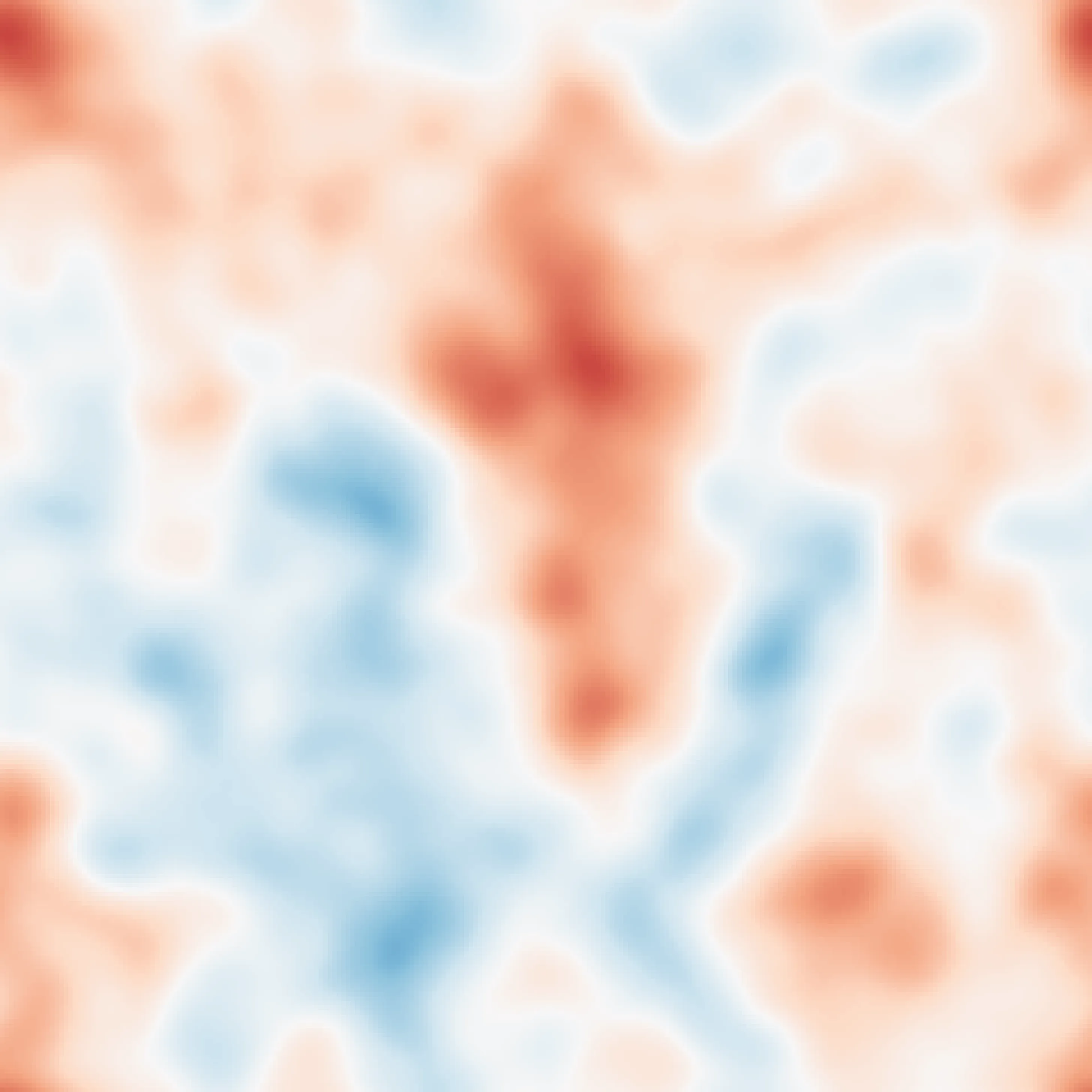
Imagine looking at a distant mountain range through morning fog. The peaks' outlines are blurred, and if the fog is patchy, some slopes fade more than others. That's roughly how astronomers see the ancient light of the universe, which has been traveling to us for 13.8 billion years.
This light was born when the universe was just 380,000 years old, long before the first stars. Since then, it has been flying through space, encountering clouds of free electrons, particles that have broken away from atoms. Each electron slightly scatters the light, like a fog droplet scattering a flashlight beam. As a result, the sky picture a telescope sees is a bit more blurred than it originally was. Physicists call this anisotropic screening.
But there is a second, even subtler effect. Some hypothetical fields that might exist in the universe could slightly rotate the plane of oscillation of a light wave. This is like if the fog not only blurred the mountains but also made them slightly change color in different places. This phenomenon is called cosmic birefringence.
To catch both effects, the team used data from the sixth release of the ACT telescope, located in the Atacama Desert at an altitude of 5190 meters. The telescope covered 23% of the sky with a resolution of 1.4 arcminutes, which is like spotting a coin from a distance of several kilometers. The data were split into four independent parts and compared with each other so that instrument noise would not produce a false signal.
The result: neither blurring nor rotation was detected. For blurring, an upper limit of Aτ < 450 was set, which is about a hundred times weaker than predictions from reionization models. For rotation, the limit is ACB < 0.15, which constrains the interaction strength of hypothetical fields with photons. The fog turned out to be too transparent for current instruments to notice.
But the search method itself proved valuable. For the first time, small-scale data from a ground-based telescope were applied to blurring, and it turned out that interference from distant galaxies is not just noise but a systematic error that must be accounted for. The next generation of telescopes, such as the Simons Observatory, will be able to use light polarization to bypass this problem. And then, perhaps, the fog will finally reveal its outline.
The ACT telescope is located in the Atacama Desert at an altitude of 5190 meters, making it one of the highest observatories in the world. The indigenous Lican Antay communities have observed the sky from these same locations for centuries.