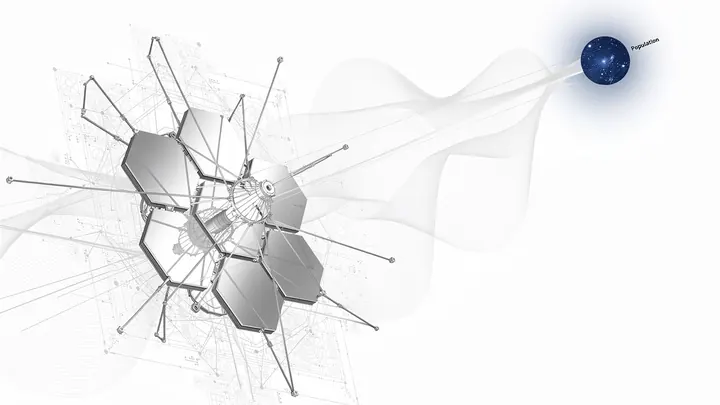
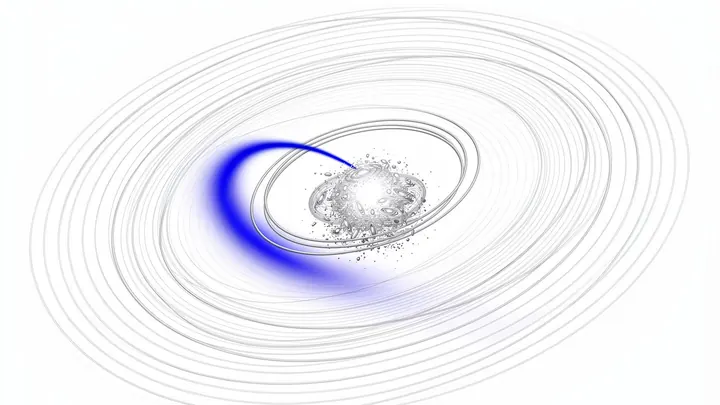
Reionization is the last global transition in the history of the Universe, stretching from redshifts z ≈ 15 to z ≈ 6 (about 400–1000 million years after the Big Bang). Starting in a completely neutral medium left over from the recombination epoch (z ~ 1100), the process was driven by ultraviolet radiation from the first light sources—massive Population III stars, dwarf galaxies, and possibly accreting black holes. Ionized bubbles, growing and merging, filled almost the entire volume by z ≈ 6. The main evidence for reionization comes from polarization data of the cosmic microwave background (optical depth τ ≈ 0.054) and the nearly complete absorption of quasar radiation beyond redshift 6 (the Gunn–Peterson effect).
History
The idea of secondary ionization of the Universe naturally follows from the hot Big Bang theory (G. Lemaître, 1927) and the discovery of the cosmic microwave background (A. Penzias and R. Wilson, 1965). A breakthrough observational result was obtained in 2001: in the spectra of distant quasars (z > 6) from the Sloan survey, the Gunn–Peterson effect was detected—almost complete absorption due to neutral hydrogen. The WMAP (2003) and Planck (2013) missions measured the Thomson optical depth, refining it from 0.17 to ~0.054. Hubble and later James Webb have been directly searching for reionization-era galaxies, gradually refining the picture.
How it works
At the heart is photoionization: H + γ → p + e. The ionization front is initially rarefied, but as density increases and recombinations become important, it becomes dense. Global dynamics are described by the equation for the ionized fraction Q: dQ/dt = (ṅ_ion / ⟨n_H⟩) – Q/t_rec, where ṅ_ion is the emission rate of ionizing photons, ⟨n_H⟩ is the mean hydrogen density, t_rec is the characteristic recombination time. The observed optical depth τ = c σ_T ∫ n_e(z) (1+z)⁻¹ H(z)⁻¹ dz determines the mean-weighted moment of reionization. Radio astronomy at the 21 cm line (projects LOFAR, HERA, Square Kilometre Array) promises to build a detailed 3D map of the process.
In practice
Reionization marks the era of the first stars and galaxies. Studying it helps refine the timeline of the early Universe and understand which objects were the main sources of ionizing radiation.
Fun fact
The James Webb Space Telescope can see the most distant galaxies whose light was emitted during the reionization epoch. It is now finding increasingly earlier objects, pushing back the boundary of the known 'dark ages'.
A transparent film of bismuth tungstate sits on a substrate and does not conduct electricity. Three minutes in a cloud of nitrogen plasma, and it turns black, with resistance dropping by a factor of a billion.
Imagine looking at a distant mountain range through morning fog. The peaks' outlines are blurred, and if the fog is patchy, some slopes fade more than others. That's roughly how astronomers see the ancient light of the universe, which has been traveling to us for 13.8 billion years.
This light was born when the universe was just 380,000 years old, long before the first stars.
In a distant galaxy, light from hot gas should reveal its composition. The James Webb Telescope split that light into a spectrum, and astronomers saw: oxygen lines too weak.
An interpreter gets distracted by every rustle in the hall, and a one-hour meeting stretches into two. A neutron star compresses a solar mass into a sphere the size of a city, and the matter in its core is denser than an atomic nucleus. Physicists cannot probe its structure in the lab: the required pressures are unattainable.
When a laser beam hits a gas, it tears electrons from atoms and accelerates them to nearly the speed of light. As these electrons fly through the plasma, they emit X-rays, like a glowing trail from a fast particle. In the new work, physicists made a single laser pulse create not one but two such trails in succession.
In dark interstellar clouds where new stars are born, chemistry starts with a tiny particle — the trihydrogen ion (H₃⁺). It collides with other atoms and sets off a cascade of reactions that build ever more complex molecules. For a long time, it was thought that the main reaction producing it, H₂⁺ colliding with H₂, only happens in the gas phase.
In dark interstellar clouds where new stars are born, chemistry starts with a tiny particle — the trihydrogen ion (H₃⁺). It collides with other atoms and sets off a cascade of reactions that build ever more complex molecules. For a long time, it was thought that the main reaction producing it, H₂⁺ colliding with H₂, only happens in the gas phase.
Cosmologists are facing a curious situation: two reliable tools draw slightly different maps of the same universe. One tool is the map of ancient light (the cosmic microwave background), and the other is the map of galaxy distribution. They broadly agree, but in details they diverge.
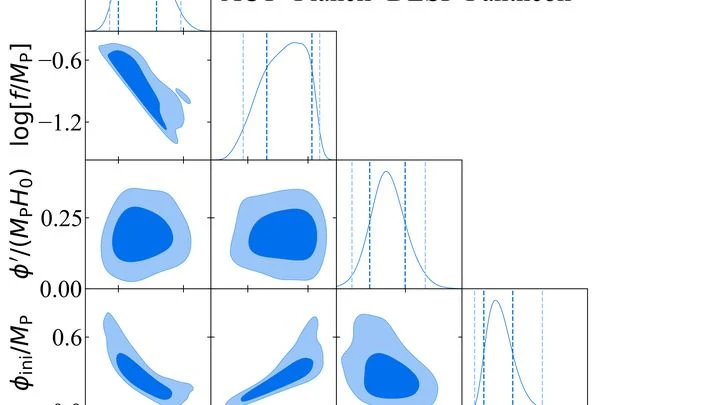
The early Universe was like a tightly coiled spring. In the first moments, it expanded at an unimaginable rate — a phase called inflation. Usually, this is attributed to a special field, but there's another idea: spacetime itself twists like a spring, and this twisting (in physics, torsion) becomes the engine of expansion.
The universe right after the Big Bang was like a boiling cauldron: bubbles of a new state of matter were bursting and growing everywhere. These were first-order phase transitions — exactly like water boiling, only at temperatures reaching trillions of degrees.
Light from quasar J0744+2052 traveled to us for almost 12 billion years. Along the way, it bumped into hydrogen clouds that snatched individual lines from the spectrum — like a comb sifting through delicate frequencies. Astronomers call this pattern the Lyman-alpha forest in spectroscopy.
Light from quasar J0744+2052 traveled to us for almost 12 billion years. Along the way, it bumped into hydrogen clouds that snatched individual lines from the spectrum — like a comb sifting through delicate frequencies. Astronomers call this pattern the Lyman-alpha forest in spectroscopy.
For thirteen billion years, light battled through cosmic emptiness. It bent around massive galaxy clusters that, as Einstein predicted, acted as giant lenses — amplifying and distorting the distant glow. In 2023, the NIRSpec instrument on the James Webb Space Telescope captured this light and spread it into spectra.
A waterfall that doesn't heat up from the fall but freezes — that's roughly how gas behaves as it flows onto a neutron star in an X-ray pulsar when the star shines dimly. Usually, infalling matter is heated to a white-hot glow, but new work shows the opposite.
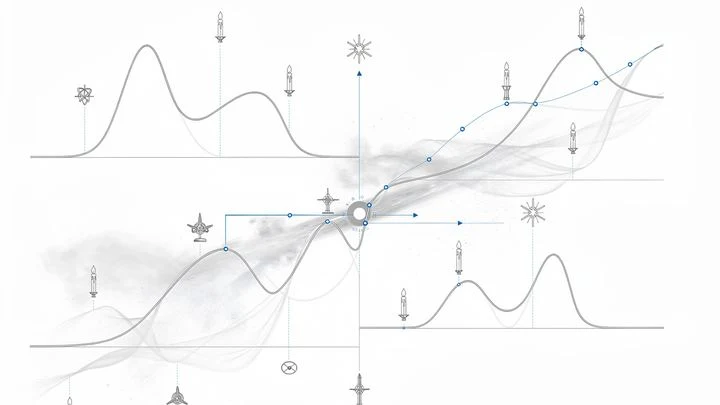
Since Saul Perlmutter and his colleagues discovered the accelerated expansion of the universe, physicists have been scratching their heads over the nature of dark energy.
In 1981, Alan Guth proposed a scenario of cosmological inflation — a lightning-fast expansion of space that stretched quantum fluctuations to the scale of entire galaxies. Since then, cosmologists, like archaeologists, have been excavating this event from the structures of the Universe.
In the first moments after the Big Bang, the universe underwent a rapid expansion — inflation. Like a balloon inflated not uniformly but with tiny pulsations, it stretched billions of times over a fraction of a second. These pulsations froze into density ripples, from which galaxies later grew.
The cosmic microwave background is not just a faint glow with a temperature of 2.7 K. It's a snapshot of the Universe 380,000 years after the Big Bang, when the primordial plasma finally became transparent to light. But for theoretical physicists, what came before is far more interesting.
Within a field of view the size of a grain of sand held up to the eye, hundreds of galaxies lie hidden, smeared into arcs by the massive cluster Abell S1063.
In the center of almost every large galaxy lurks a supermassive black hole, whose gravitational abyss was first mathematically described by Karl Schwarzschild. When it swallows gas, a dazzling active nucleus is born — a quasar.
Right after the Big Bang, the Universe was a chemical desert — only hydrogen and helium, not a hint of metals. But moments passed (by cosmic standards), and the birth of the first stars — Population III — began.
The giant galaxy cluster Abell S1063, lying 4 billion light-years away, works not just as a lens but as a gravitational well of time. Its mass bends space so sharply that photons from an era when the Universe was just 500 million years old slide along curved paths, like rays in slow motion, and converge on us magnified forty-three times.
Imagine a spotlight: if you look at it from the side, it glows dim red, but if you stare straight into it, it blinds you with white-blue light. That, according to new data, is exactly what the mysterious 'little red dots' in the early universe look like. They are giant black holes, objects with gravity so strong that even light cannot escape, turned edge-on to us.
The early universe underwent a rapid expansion — inflation. In a tiny fraction of a second, minuscule quantum jitters were stretched to galactic scales and became the seeds of all large-scale structure.
Right after the Big Bang, space was a hot plasma — a mix of charged particles and light. In such a medium, electric currents couldn't flow on their own: a 'potential difference' was needed to push electrons relative to photons.
The Universe at 700 million years old was a noisy construction site, just beginning to light up. Telescopes caught a signal from that distant epoch: the galaxy REBELS-25, massive and full of stellar fuel.
The oldest light in the universe has been traveling toward us for nearly 14 billion years. It was born when the cosmos first became transparent, and since then its plane of oscillation has been rotating ever so slightly. The cause is an invisible ocean permeating all of space: the dark energy field that makes the universe expand faster and faster.
When an orchestra is just tuning up, disjointed sounds drift through the hall, but as soon as the conductor raises the baton, chaos turns into a symphony. Much the same can be said for the beginning of our Universe. In its first moments, it expanded at an unimaginable speed — faster than light could cross it.
Type Ia supernovae are the final, blinding chords in the symphony of stellar evolution: when a white dwarf crosses the limit predicted by Chandrasekhar, it explodes so brightly that for a moment it outshines an entire galaxy.
Thirteen billion years ago, a few hundred million years after the Big Bang, the cosmos plunged into impenetrable darkness. The expanding Universe was filled with neutral hydrogen — cold and opaque to ultraviolet light.
The Universe is a genius chef, and the Big Bang is its perfect recipe. Hydrogen rose fluffy, helium melted tender, but lithium-7 seems oversalted: theory predicts three times more than astronomers find in the oldest stars. This imbalance, the 'lithium problem,' has spoiled cosmologists' appetite for decades.
The first two billion years after the Big Bang were an era when the universe resembled a boiling construction pit. Dark matter clumped the gas together, igniting the first stars. It seemed there simply wasn't enough time to assemble massive elliptical galaxies—'dormant' stellar metropolises — from this raw material.
In the heart of a molecular cloud, a massive star is born. Its ultraviolet light ionizes hydrogen, and the cloud flares in the Lyman-alpha line. But for the photon, this flare is not liberation but imprisonment in a hall of mirrors.
If you turn on a lamp in a room, it illuminates the walls. But if you place the same lamp in a vast hall, the light barely reaches the corners. Similarly, radiation from young stars affects gas in a galaxy: it knocks electrons out of hydrogen atoms, making the gas glow.
Hot tea in a freezer doesn't freeze all at once. First, tiny ice needles dart around — forming and melting until the temperature drops enough for the ice to set solid. The early universe behaved similarly as it cooled and changed its internal structure.
The birth of the universe resembles not an explosion, but a traffic jam. At first, a tiny fraction of a second after the Big Bang, space expanded sluggishly, like cars stuck in gridlock. Then came a sharp surge — accelerated expansion, which cosmologists call inflation.
A flashlight beam glides over uneven glass. The glass is massive galaxy clusters, and the flashlight is ancient light born shortly after the big bang. Passing by such clusters, light doesn't just bend around them like water around a rock. Its path shifts slightly sideways, and the amount of shift depends on how the light is 'twisted'—right or left.
In the quantum world, light and matter constantly exchange energy. Previously, they were described statically, like frozen poses. The new approach follows the dance itself: the transitions between states, like a continuous sequence of movements.
The JWST telescope has spotted a multitude of bright galaxies in the young universe. Their ultraviolet light was barely absorbed by cosmic dust — defying previous expectations.
A dim lightbulb suddenly starts illuminating patterns on the wall that were invisible to the eye. That's roughly how astronomers look at distant dwarf galaxies — tiny stellar islands poor in heavy elements. In some of them, a faint violet glow of ionized helium has been spotted (a specific spectral line He II 4686 Å).