Magnetic tuning forks on a chip ✛
Two tuning forks stand in the same hall. If they are tuned to the same note, they start sounding together, passing vibrations through the air. In the lab, instead of tuning forks, the researchers used two strips of permalloy, a magnetic material that is easy to magnetize. The strips were placed on a superconducting track, which acts like the hall: it can receive and transmit vibrations, but only microwave ones, not sound.
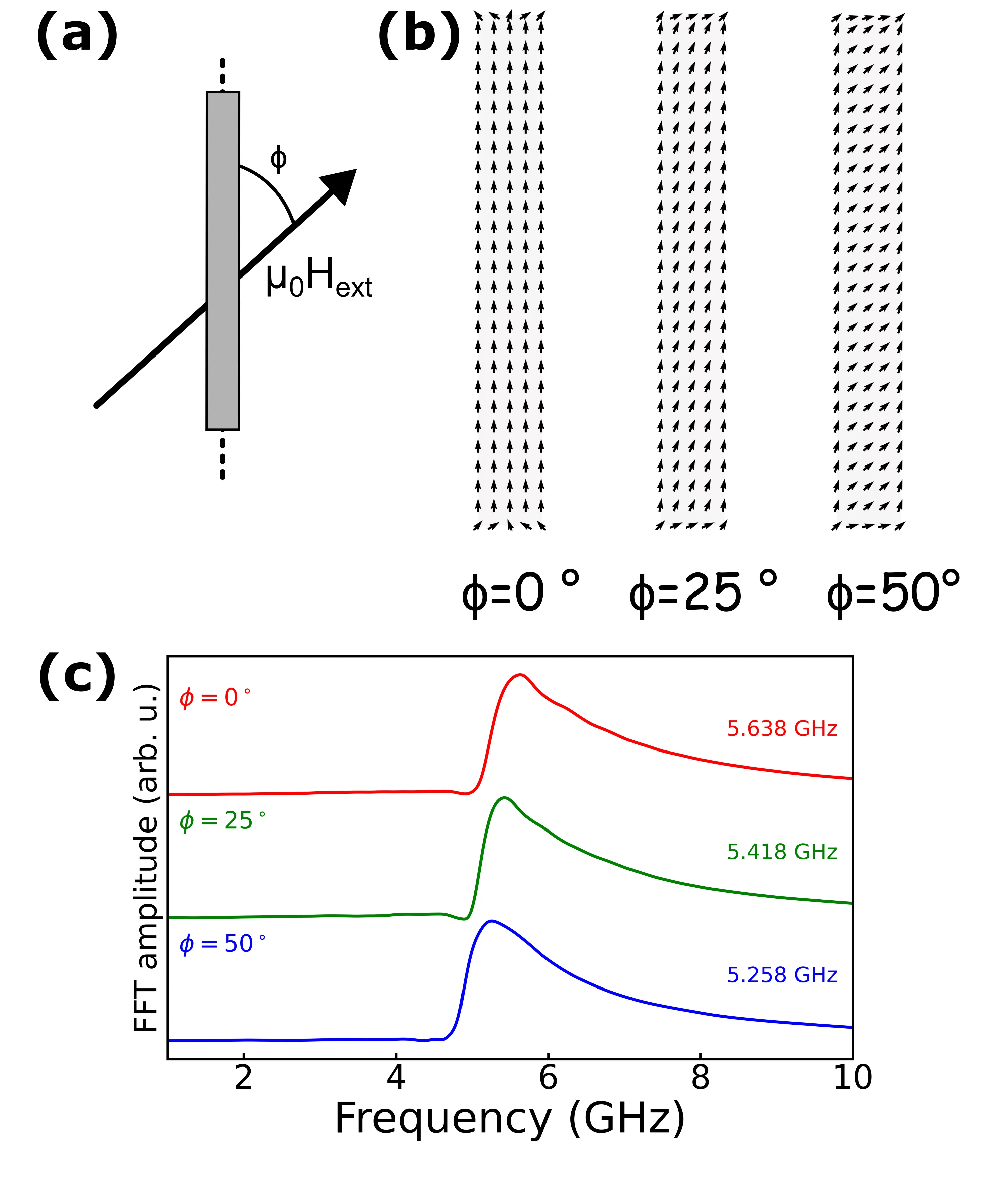
The strips were placed at a 50-degree angle. By rotating the field 25 degrees left or right, the researchers tuned first one strip, then the other. When both strips hit resonance with the track, the coupling strength increased: they began exchanging energy faster than they lost it. This means the two strips became linked through the track. Previously, such tuning required separate coils; now simply rotating the external field suffices. This makes it easier to build small quantum devices where magnetic oscillations store information.
The 50° angle between the strips was chosen so that with a symmetric field rotation of ±25°, both strips have the same resonance frequency. This allowed the observation of a dark mode, which is invisible in the absorption spectrum because the oscillations of the strips cancel each other out.