Couplingstrength is a measure of the interaction energy between two quantum systems, such as two qubits, an atom and a photon, or a mechanical resonator and a superconducting circuit. It quantifies how strongly one system influences the other, and it is typically expressed in units of frequency (e.g., megahertz or gigahertz) via Planck's relation E = hν. In quantum technology, the coupling strength determines how fast quantum operations can be performed and how well quantum information can be transferred between systems. A strong coupling (much larger than the decoherence rate) is essential for building reliable quantum gates and for observing coherent quantum phenomena.
History
The concept of couplingstrength has roots in early quantum mechanics, particularly in the Jaynes–Cummings model (1963) describing atom-photon interactions. The modern engineering of strong coupling in solid-state systems emerged in the 2000s with the development of circuit QED by Alexandre Blais and colleagues.
How it works
When two quantum systems interact, their combined energy levels shift by an amount proportional to the couplingstrength. This shift can be measured spectroscopically, for example by observing the splitting of resonance frequencies. In circuit QED, a superconducting qubit coupled to a microwave cavity exhibits a vacuum Rabi splitting of magnitude 2g, where g is the coupling strength. The coupling strength also determines the rate of coherent energy exchange between the systems: a stronger coupling leads to faster oscillations (Rabi oscillations) between the states. In practice, coupling is engineered by controlling the physicaldistance, the overlap of wavefunctions, or the mediating fields between the systems.
In circuit QED, couplingstrengths can reach values of several hundred megahertz, which is orders of magnitude larger than the decoherence rates, enabling thousands of coherent quantum operations before information is lost.
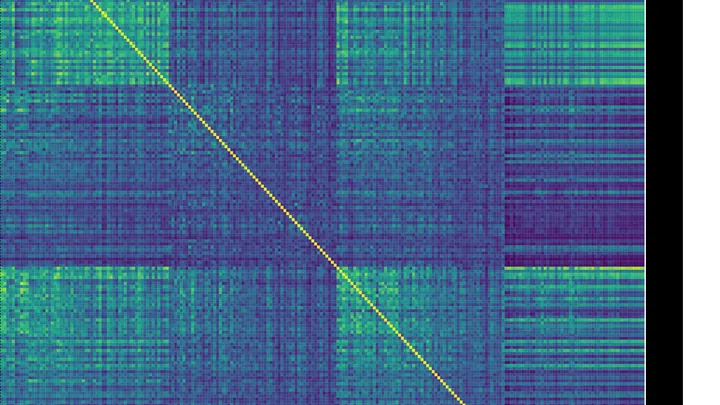
A quantum computer isn't just a bunch of qubits: it's a whole city, where each resident is one of the machine's possible states. Residents get to know each other through weak interactions between qubits: if one state can transition to another, a thread of acquaintance is drawn between them.
Two pendulums hang from the same crossbar. A push, and they start swinging, gradually falling into and out of sync. In a topological qubit, Majorana particles, special excitations that can store quantum information, play the role of these pendulums.
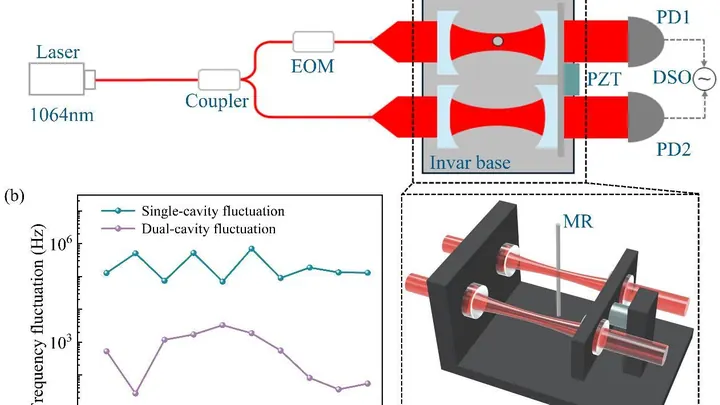
A guitar string is stretched between two mirrors. A beam of light bounces back and forth between them, and the string shudders at every touch. Sometimes the light loses energy — the string takes it and dissipates it as heat, like a fading sound. Other times, the string shifts the pitch of the light itself, changing its color but barely dimming it.
Light loves symmetry: in an open channel, it flows equally both ways. To steer it one way, physicists often use magnets. A new approach does without, using rotation — just the speed of a vinyl record — and interference from two atoms. Rotation changes the “pitch” of light for different directions, just as a siren’s tone shifts when a car approaches or recedes.
Quantum batteries harness quantum effects to circumvent the limitations of ordinary devices imposed by entropy — a measure of disorder and energy losses. Imagine a bucket under a powerful jet: filling is lightning-fast. But the bucket has holes: the environment constantly drains the energy.
The Universe is a vast city. In it, dark matter is the invisible framework of buildings, and dark energy is the force stretching the streets. For a long time they were considered independent, but new research has caught them in secret communication.
Ordinary batteries lose charge like tea cools down. A quantum battery works differently: its heart is a tiny cavity with darting photons. If you illuminate it with special photon pairs, energy flows into a chain of qubit cells instantaneously — much like a swing gets a boost from strong pushes.
Two tiny spinning tops fly apart after a collision. Their rotation is not predetermined: it becomes definite only at the moment of measurement. This is quantum entanglement: the state of one top instantly responds to the state of the other, no matter how far apart they are.
In a dark room, an infrared laser flashes, and a speck of black K3C60 powder conducts electricity without resistance for a split second. The light strikes at 10 terahertz — a thousand times faster than a microwave oven. The effect is a hundred times stronger than at other frequencies. Why this particular frequency?
A quantum dot is a trap for electrons, just a few atoms in size, where a particle behaves like a ball in a tiny box. Place two such boxes side by side, and electrons can hop between them, making the system akin to a pair of communicating vessels.
Two particles flying apart in opposite directions behave as a single whole: measuring one instantly determines the state of the other. Such quantum entanglement has long been known for light particles, but now it has been observed for the first time in heavy Z bosons — the carriers of the weak force.
In a superconducting resonator, light doesn't just bounce around: it embraces the qubit so tightly that their joint dance can no longer be described by old textbooks. The researchers took an indium arsenide nanowire, turned it into a superconducting qubit, and placed it inside a microwave resonator.
In a dark room, an atom and light are locked together in a mirrored box. The box is so small that the atom cannot simply release light: they constantly exchange energy, like two dancers who never let go of each other's hands.
In ping-pong, two paddles connected by an invisible thread feel each other's movements, guessing the ball's trajectory. Researchers gave a computer a similar thread — quantum entanglement. Into an ordinary trial-and-error learning program, they embedded a quantum circuit of eight qubits — particles that can spin like a coin on its edge.
The quantum Hall effect has long been suspected of superfluidity — the ability to flow without friction. Imagine a cook following a recipe: for each unit of magnetic flux, he must add exactly a certain number of electrons.
At the Large Hadron Collider, by accelerating particles to nearly light speeds, top quarks are created — the heaviest building blocks of the Standard Model. They live for vanishingly small fractions of a second but manage to exhibit complex quantum connections.
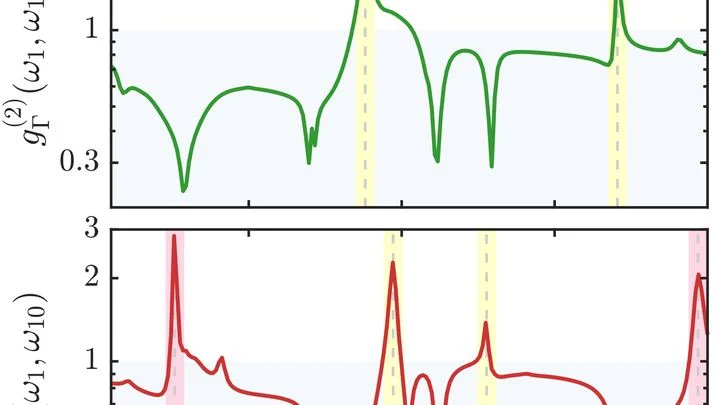
If light could be bottled, scientists would have the perfect assembly line: one bottle — exactly one photon, no stray drops. Such single particles of light are needed for quantum computers and secure communication: they carry information that cannot be eavesdropped on unnoticed.
Qubits in a quantum computer are like musicians in an orchestra: each must hear the others, or the music falls apart. But if you wire the musicians together permanently, they start getting in each other's way: that's how unwanted interactions arise in superconducting chips, spoiling computations.
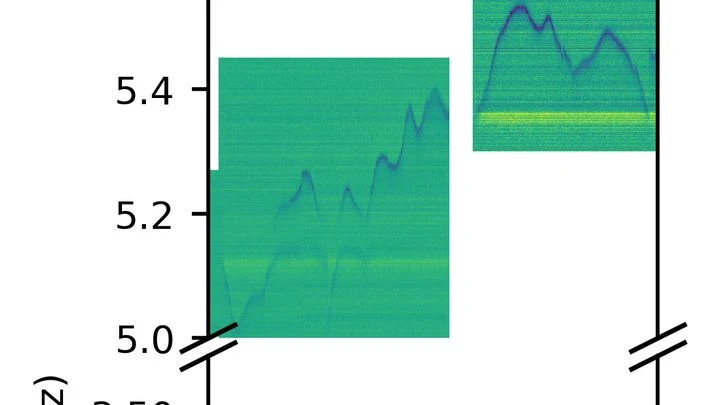
Two taut strings plucked at the same time sound different if they are connected by a rubber band. Energy starts to flow from one to the other, and the pitch of the combined sound shifts slightly. Two nanomechanical bridges, microscopic beams etched into a crystal, behave much the same way.
Two spinning tops are set off simultaneously in opposite directions. If one spins left, the other always spins right — no matter how far apart they fly. That's roughly how quantum entanglement works, except instead of tops, we have top quarks, the heaviest known particles.
Two superconducting qubits on a single chip sound as clean as soloists in an orchestra. Each is a transmon, a qubit with reduced sensitivity to charge noise. They are connected through a tunable coupler, an auxiliary element that adjusts the interaction strength between them.
A quantum battery is not a box of electrolyte but a handful of atoms or superconducting loops, with energy stored in excited states. It can be charged in fractions of a second using collective quantum effects.
In a chain of eight spins, a defect lurks — a tiny magnetic moment. The Kondo effect, known since the 1930s, makes electrons around it align into a collective screen. The material's resistance abnormally increases. But detecting such an impurity hidden deep in the structure is like finding a stone at the bottom of a dark pond.