Magnetic resonance is a physical phenomenon where atomic or subatomic particles with spin, such as protons or electrons, absorb and re-emit electromagnetic radiation at a specific resonant frequency when placed in a magnetic field. This frequency depends on the strength of the magnetic field and the particle's magnetic properties. The technique is the basis for magnetic resonance imaging (MRI) in medicine, nuclear magnetic resonance (NMR) in chemistry, and electron spin resonance (ESR) in physics and materials science. It allows researchers to probe the local environment of spins, revealing information about molecular structure, dynamics, and interactions.
History
The phenomenon was independently discovered by Felix Bloch and Edward Mills Purcell in 1946, for which they shared the Nobel Prize in Physics in 1952.
How it works
In a magnetic field, spin states split into discrete energy levels (Zeeman effect). When an oscillatingelectromagnetic field matches the energy difference between these levels, resonance occurs, causing spins to flip between states. The absorption or emission of energy at this resonance frequency is detected. The exact frequency is sensitive to the local magnetic environment, including shielding by electrons or interactions with neighboring spins, which provides detailed structural and dynamic information. In MRI, spatial gradients in the magnetic field encode position, allowing 3D imaging.
In practice
Magnetic resonance is used in MRI scanners for medical diagnostics, in NMR spectroscopy for chemical analysis, in quantum computing for qubit manipulation, and in geophysical prospecting to characterize subsurface materials.
Fun fact
The first MRI images of the human body were produced in 1977, and the technique was initially called 'nuclear magnetic resonance imaging' — the 'nuclear' was dropped to avoid public fear of radioactivity, even though the technique is completely non-ionizing.
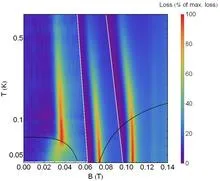
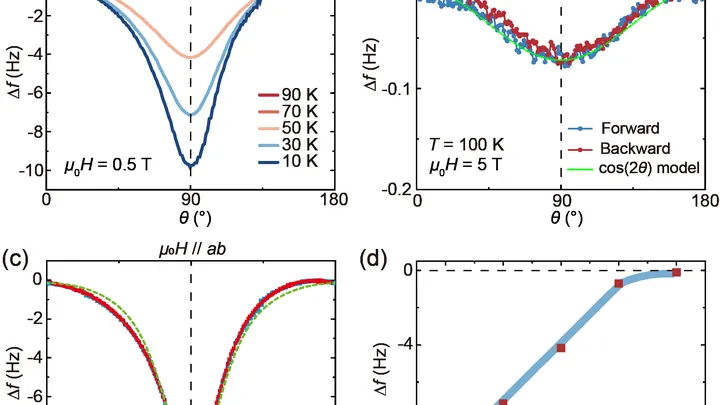
Tuning a radio receiver to a station that changes frequency as you cross a phase boundary: that is how you might picture the challenge facing the researchers. In the metal YbRh2Si2, electrons behave as "heavy" particles: their effective mass is hundreds of times that of a free electron.
A sculptor looks at a block of marble and sees the figure within, waiting to be freed from excess material. Instead of adding clay, he removes everything that is not part of the form. The authors of a new study on magnetic resonance took a similar approach: rather than complicating the tissue model by adding ever more details, they stripped away the superfluous to reveal the essence.
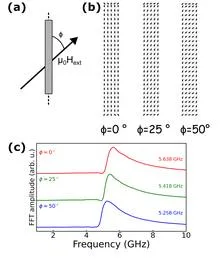
In a large hall, two tuning forks stand on rotating stands. Each is tuned to its own note, but if the stands are turned to the right angle, the forks begin to sound in unison, exchanging vibrations through the air.
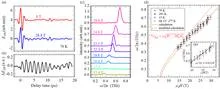
A taut string sounds higher when you pull it tighter. Magnetization in an antiferromagnet behaves similarly: the stronger the external field, the faster it oscillates. But in chromium oxide crystals, something goes awry.
In fields from 20 to 30 tesla, the resonance frequency grows more slowly than it should.
The flash lasts a thousandth of a second, but in that instant it releases as much energy as the Sun emits in a day. Such signals, fast radio bursts, have been caught by telescopes since 2007, and their source remains a mystery. A new study offers an elegant answer: it's all about a cosmic amplifier.
Fast radio bursts — millisecond radio pulses arriving from distant galaxies — long remained a puzzle. Their colossal energy, compressed into instants, pointed to cataclysms on neutron stars, perhaps pulsars or magnetars.
In some crystals, the magnetic moments of atoms oscillate in sync, like a wave in a stadium. It carries spin without charge current, without heating the material. This flow resembles an invisible river — silent and cold. Two-dimensional altermagnets are special materials: spin waves in them run differently along different axes.
An ordinary magnet is like a compass: its needle points north. But a quantum compass can look in both directions at once. If a magnet floating in a vacuum is gently spun, its electron 'tops' synchronize so the whole piece of metal starts living by the rules of the microworld — freezes in a superposition, like a split pointer.
In the orchestra of atoms, each instrument has its own score. But sometimes two musicians start playing in unison, and the sound amplifies many times over. In the quantum world, this 'harmony' is called a Feshbach resonance. It allows you to control atomic interactions with jeweler-like precision.
The magnetic field increases, but the magnetization stays put. It's like a scale where you add weight, yet the needle doesn't move until enough has accumulated to jump to the next mark. That's exactly how rare-earth tetraboride crystals behave, and physicists have been puzzled for decades.
A distant lighthouse flashes for an instant brighter than an entire galaxy. This is a fast radio burst — a mysterious signal from deep space. Some repeat, and astronomers have noticed a peculiarity: these bursts show rapid changes in polarization — a property indicating how the radio wave is twisted in space.
A figure skater glides across the ice, gradually moving toward the center. Their trajectory isn't a perfect spiral: sometimes they catch the rhythm of the music and add an extra turn, slightly changing their speed. That's roughly how a small black hole behaves when it falls into a supermassive one.
A single electron in a magnetic field is like a tiny top that spins and weakly "squeaks" at its own frequency. Hearing that squeak directly is nearly impossible: it gets lost in the noise. Scientists have devised a resonator: a superconducting microwave strip that works like a tuning fork tuned to the same note.
The atomic nucleus is not just a ball of protons and neutrons. Inside it, like a tiny magnet, there is its own distribution of magnetization. Until now, it has been difficult to see: nuclei live for tiny fractions of a second, and their magnetic field is weak. Now physicists at CERN have found a way to look inside.
The crystal CeB6 is like a box with a secret: inside it, electrons can occupy four nearly identical positions, like four chairs around a table. While no one is watching, the electron seems to sit on all four at once. Physicists call this hidden state quadrupolar, and it affects magnetic properties, but it is hard to see directly.
A drop of water on the table looks calm, but inside it, quantum life is bustling. Protons in hydrogen atoms are like tiny spinning tops that constantly rotate. Each has its own direction of spin.
A magnet, like a compass needle, likes to point in a certain direction. But what if the material is layered, like a stack of pancakes? Scientists took just such a magnet made from a compound of chromium, germanium, and tellurium and set out to find out how stubbornly it resists having its magnetization turned.
In a piece of manganese oxide just a few atomic layers thick, electrons behave like a crowd on an escalator: each moves by its own rules, but together they create a common flow. Physicists shone soft X-rays on such a film and knocked electrons out.
Magnetic waves in an ultracold gas behave like elastic cords. Two or three such cords can twist into a single knot that breathes: it contracts and expands, but never unravels. For the first time, scientists assembled such knots in the lab and confirmed that their breathing matches calculations exactly.
The gas consisted of two atomic species that do not mix, like oil and water.
In a solid, atoms vibrate, transmitting sound. Sometimes this wave doesn't run straight but curls into a spiral, like a corkscrew entering a cork. In ordinary crystals, such 'sound vortices' are known, but in magnetic materials they had long eluded detection.
A tuning fork rings dully when it strikes a crack. That principle scales up in this experiment: physicists turned molecules into an ultrasensitive tuning fork to eavesdrop on the electron's asymmetry.
Magnetic resonance is like a tuning fork that rings only at its own note. Each molecule has its own frequency, and from that you can tell what the molecule is and what state it's in. But previously, this tuning fork was listened to through a thick wall: the signal was blurred, and you couldn't make out the exact note.