Two Magnetic Resonators on One Superconducting Stage ✛
Context
Hybrid quantum systems that connect magnons and microwave photons are being actively developed for quantum information processing and storage. Single magnon resonators have been coupled to superconducting resonators many times before, but controlling the coupling of two magnon resonators through a shared resonator remains challenging. Typically, independent tuning of each magnet requires separate bias coils, which hinders miniaturization. Neighboring works used macroscopic yttrium-iron-garnet spheres or local coils, whereas here a planar geometry is proposed where tuning is achieved solely by rotating the magnetic field. This places the work in line with the search for simple, integrable circuits for quantum hybrids.
Methods
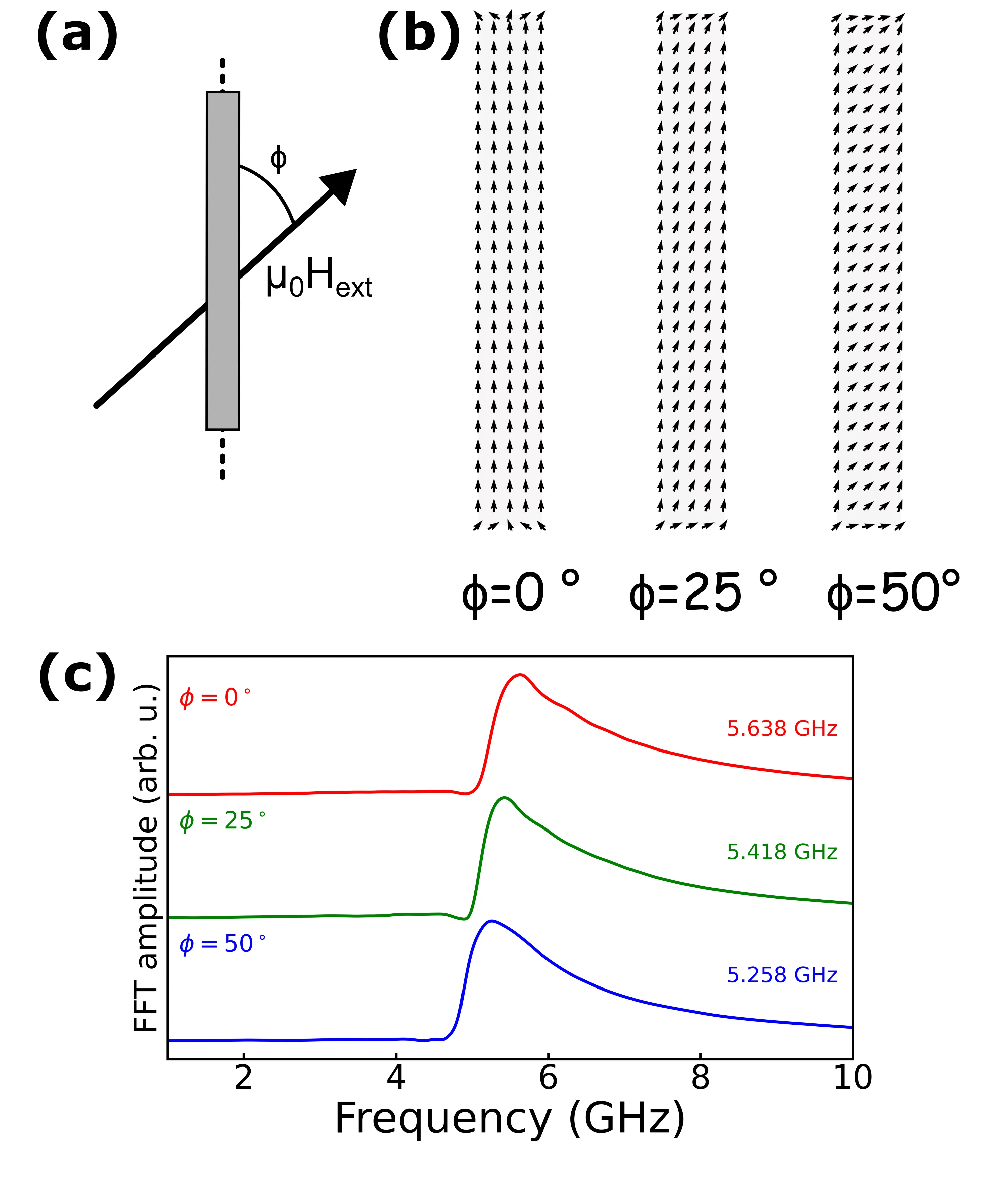
We fabricated a superconducting coplanar resonator on a sapphire substrate from a multilayer Nb/NbN/Nb film. On top, separated by a 20 nm insulating MgO layer, we placed one or two permalloy strips measuring approximately 12×900×0.03 μm. The two strips were arranged at a 50° angle to each other. Samples were cooled to 1.6 K and microwave transmission (S21 parameter) was measured using a vector network analyzer. An external magnetic field was applied in the plane of the sample and rotated to various angles, exploiting the shape anisotropy of the strips to tune their ferromagnetic resonance. Micromagnetic simulations in mumax3 confirmed the expected shift in resonance frequency as the field was rotated.
Results
The bare resonator had a frequency of 5.52 GHz and a quality factor of about 8134. With one strip, the frequency dropped to 5.518 GHz and the quality factor fell to 1029; with two strips, the frequency became 5.385 GHz and the quality factor 715. For a single strip with the field along its axis, an avoided crossing was observed with a splitting of about 280 MHz, giving a coupling strength geff/2π ≈ 140 MHz. The cooperativity C ≈ 97, which confidently exceeds the strong-coupling threshold. When the field was rotated by ±25°, the coupling strength changed: 145 MHz for +25° and 127.25 MHz for −25°, likely due to the asymmetric resonator geometry. For two strips in a symmetric configuration (angles ±25°), a single avoided crossing was observed with a coupling strength of about 171.5 MHz, larger than for a single strip. This indicates coupling between the strips through the resonator. When deviating from symmetry, a third state appeared in the center of the gap, and at angles |φ1| ≥ 50° and |φ2| ≤ 15°, two separate avoided crossings emerged, corresponding to each strip.
Implications
This work shows that shape anisotropy allows tuning the coupling of two magnon resonators without local coils, unlike previous experiments with individual coils or macroscopic spheres. This simplifies the design and paves the way for on-chip integration. The enhanced coupling strength in the symmetric case confirms that the two strips interact through the common resonator rather than simply adding up. The method applies to any magnets with sufficient shape anisotropy and is not limited to small samples.
Future development
The approach could be extended to a larger number of magnon resonators, creating networks of coupled magnetic elements. Quantum memory based on dark modes is possible, where two magnons oscillate in antiphase and do not radiate into the resonator. Integration with qubits and other quantum elements on a single chip becomes more realistic. Also promising is the study of coherent transfer of excitations between distant magnets through a superconducting bus.
Impact
The results will influence the development of hybrid quantum devices, magnon networks, and quantum memory elements. The field-rotation tuning method could be used in spintronics and magnonics.
Next steps
The next step will be to measure the coherence of the dark mode and test the possibility of storing and retrieving quantum information. We also plan to investigate coupling to qubits and scaling to a larger number of resonators.
Key open problems
In the field of hybrid quantum systems, the problem of scalable integration of many magnon resonators with controllable coupling remains. This work offers a simple solution for tuning without local fields, bringing us closer to creating quantum networks based on magnons.
The knowledge machine's view
This section is addressed to the author of the paper and their colleagues. Neighbouring works were found by meaning-based search across our archive, not by word overlap. We do not review: we show the field around the work.
What the work does
The study demonstrates how two permalloy ferromagnetic strips, arranged at an angle of 50°, are simultaneously strongly coupled to a common superconducting resonator. Their resonant frequencies are tuned by rotating an external magnetic field, without the need for local coils. Measurements at 1.6 K reveal an avoided crossing and enhanced coupling strength under symmetric tuning.
Where its strength is
A key strength is the use of shape anisotropy to independently tune two magnon resonators via a shared superconducting resonator, simplifying the integration of hybrid quantum devices on a chip.
Where it could go next
- It might be interesting to see how planar magnets with shape anisotropy combine with single-spin readout approaches, where coupling to a resonator and control without local fields are also important.based on: A Resonator That Catches a Single Spin arXiv:2603.25258
- Related work on magnon-exciton systems for quantum communication is nearby; perhaps your scheme with two magnon resonators could be adapted to interact with other collective excitations, expanding the functionality of hybrid devices.based on: Magnons and Excitons Open the Path to Quantum Communication arXiv:2604.03441
- In our archive, there is an analysis of superconducting resonators with low current and strong effects; optimizing the resonator design in your scheme could further increase cooperativity and coupling strength.based on: Superconducting Resonators: Small Current, Big Effect arXiv:2512.23119
Worth trying
- Test whether strong coupling persists when the strip dimensions are reduced to submicron scales, where shape anisotropy may be even stronger.
- Use micromagnetic simulations to find the optimal angle between the strips that maximizes tunability and coupling strength.
- Try coupling the two strips not only through a common resonator but also directly via dipole-dipole interaction, adjusting the distance between them.
Why this may matter
The proposed approach could serve as a foundation for scalable hybrid quantum circuits, where multiple magnon resonators are controlled by a single external field without individual coils, which is important for quantum information processing.
Nearby works in our archive
- A Resonator That Catches a Single Spinsimilarity 0.57
- Electron on Helium Catches a Microwave Photon for the First Timesimilarity 0.54
- A Magnetic Field Sensor That Doesn't Choke on Its Own Precisionsimilarity 0.53
- Light Trapped in a Wiresimilarity 0.53
- Quantum Duet on the Edgesimilarity 0.53
- Diamond Resonator: How to Catch a Loud Echosimilarity 0.53
- Superconducting Resonators: Small Current, Big Effectsimilarity 0.52
- Magnons and Excitons Open the Path to Quantum Communicationsimilarity 0.52
The archive is sparse around this work: the closest review is only 0.57, against a usual 0.64. It looks like few have drilled nearby.
The 50° angle between the strips was chosen so that with a symmetric field rotation of ±25°, both strips have the same resonance frequency. This allowed the observation of a dark mode, which is invisible in the absorption spectrum because the oscillations of the strips cancel each other out.
Key numbers
- resonator frequency without strips: 5.52 GHz
- resonator quality factor without strips: 8134
- coupling strength for one strip with field along axis: 140 MHz
- cooperativity: 97
- coupling strength for two strips in symmetric configuration: 171.5 MHz