Two tuning forks in a superconducting hall ✛
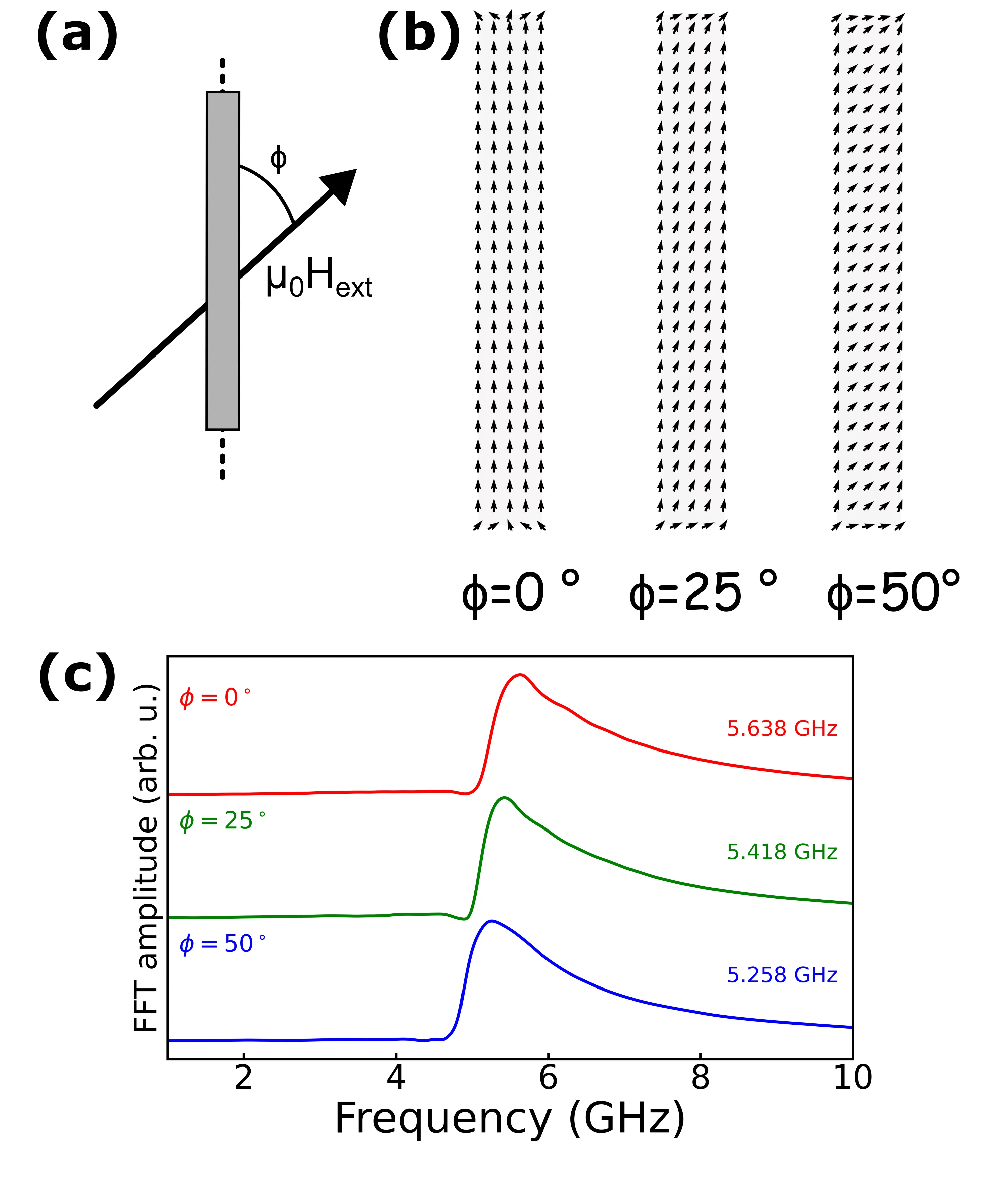
In a large hall, two tuning forks stand on rotating stands. Each is tuned to its own note, but if the stands are turned to the right angle, the forks begin to sound in unison, exchanging vibrations through the air. In the experiment from the quantum technology laboratory, the tuning forks were played by two strips of permalloy, an alloy of nickel and iron that is easy to magnetize and demagnetize. The strips, about 900 micrometers long and only 30 nanometers thick, lay on a superconducting resonator, a flat track that can store microwave oscillations the way a hall stores sound.
The strips were placed at an angle of 50 degrees to each other. If you rotate the external field by 25 degrees one way, one strip becomes tuned to the resonator's frequency; rotate it 25 degrees the other way, and the second strip hits resonance. At 1.6 K, when the superconductor operates without losses, both strips coupled to the resonator simultaneously. The coupling strength turned out to be even larger than for a single strip: about 171.5 megahertz versus 140. This means the two strips were not just sitting side by side; they interacted with each other through the shared resonator, just as two tuning forks amplify each other's sound when placed in the same hall.
Previously, tuning each magnetic resonator required a separate coil, which took up space and hindered miniaturization. In the new work, tuning is achieved solely by rotating the external field, making it easier to place many elements on a single chip. This technique will be useful for quantum networks, where magnetic oscillations carry information between qubits, and for quantum memory, where data must be held without dissipating. A chip with two tuning forks, tuned by rotating the stand, is a step toward such devices.
The 50° angle between the strips was chosen so that with a symmetric field rotation of ±25°, both strips have the same resonance frequency. This allowed the observation of a dark mode, which is invisible in the absorption spectrum because the oscillations of the strips cancel each other out.