Magnetic superconductivity coupling refers to the intricate relationship between magnetic order and superconductivity—two phenomena that were long considered mutually exclusive. In unconventional superconductors, such as high-temperature cuprates or iron-based superconductors, magnetism and superconductivity often coexist or compete, and understanding their interplay is central to deciphering the mechanism of high-temperature superconductivity.
History
The concept emerged in the 1980s with the discovery of high-temperature superconductivity in cuprates, where antiferromagnetic order was found adjacent to the superconducting phase. Since then, it has been a central theme in condensed matter physics, with many experiments probing the coexistence and competition of these orders.
How it works
In conventional superconductors, electrons pair up via lattice vibrations (phonons). In unconventional ones, magnetic fluctuations are believed to mediate the pairing. The magnetic order can either suppress superconductivity by breaking Cooper pairs or, in some cases, coexist with it in spatially separated regions or in a uniform microscopic state. The balance between these phases is controlled by parameters like pressure, doping, and temperature, as seen in the title 'Pressure separates superconductivity and charge order'.
In practice
Understanding this coupling is key to designing materials with higher superconducting transition temperatures, which would enable lossless power transmission, powerful magnets, and quantum computing components.
Fun fact
In some iron-based superconductors, the magnetic order and superconductivity can actually coexist in the same crystal, with the magnetic moments forming a spin-density wave that does not destroy the superconducting pairs.
MOND function interpolating between Newtonian and deep-MOND regimes.
What is in the formula
g_N
variable
Newtonian gravitational acceleration — acceleration metre per second squared
ν
variable
MOND interpolation function
a_0
constant
Characteristic acceleration scale of Modified Newtonian Dynamics, below which deviations from Newtonian gravity appear. — mond acceleration scale = 1.2e-10metre per second squared
A jazz trio plays in the dim light of a club. The pianist leads the melody, the bassist holds the rhythm, and the drummer sprinkles out rolls. If you listen only to pairs of musicians, you can catch how the pianist adjusts to the bass or the bass to the drums.
In a large hall, two tuning forks stand on rotating stands. Each is tuned to its own note, but if the stands are turned to the right angle, the forks begin to sound in unison, exchanging vibrations through the air.
A superconductor is like an orchestra that plays without a single wrong note, until the conductor turns a tuning knob. In this new work, that knob turned out to be the magnetic history of nickel contacts.
A metal made of five different atoms is like a soup with bits of carrot, peas, potato, onion, and meat floating in it. Each bit is its own element: chromium, vanadium, titanium, niobium, and tantalum. Such an alloy is called high-entropy: there is no single order, and the atoms are mixed almost randomly.
Two dancers on one stage: the triangle and the stripe. In a quantum gas of dysprosium atoms cooled to 62 nanokelvin, these two spatial structures have met for the first time in a single experiment. The gas is held in a trap shaped like a surfboard, and its atoms are among the most magnetic in the periodic table.
Imagine a ladder whose rungs are tiny magnets. If neighboring magnets point in opposite directions, the ladder is "calm." But if you make them all point the same way, the whole structure becomes magnetized and "stubborn."
Scientists built such a ladder from germanium atoms — a semiconductor used to make transistors.
Hidden within thin layers of tantalum selenide (TaSe₂) is a property that defies conventional physics. When guest atoms were added between the layers of this material, the structure lost its center of symmetry, and inside, superconductivity with armor emerged.
In superconductors, electrons pair up and flow without resistance. Usually, these pairs are distributed uniformly, like water in a calm lake. But sometimes ripples appear in the material — pairs bunch up and thin out with a certain period. This state is called superconductivity with pair-density waves.
Honeycombs filled with electronic 'honey.' In the normal state, electrons move chaotically, but upon strong cooling they can pair up: this is how superconductivity emerges. The shape of these pairs, or pairing symmetry, determines the material's properties: some dance a waltz, others a foxtrot.
Two sheets of tungsten diselenide (not carbon, but a compound of tungsten and selenium) are rotated relative to each other by a tiny angle, about 5 degrees. This creates a moiré pattern: an enlarged periodic lattice where electrons behave very differently than in a regular crystal.
A thin magnetic film is like a row of toy soldiers with tiny magnetic arrows. In the flat world, thermal jostling quickly disrupts this formation — even the slightest heating destroys the order. This is the Mermin–Wagner prohibition: in two dimensions, continuous symmetry cannot survive at finite temperature.
Using laser spectroscopy — a method akin to listening to the echo from a crystal — physicists examined the layered material. They found regions where electrons move freely (Fermi pockets) and noticed that each such region behaves in its own way.
A layered cake of atomic planes of nickel and oxygen: that's how bilayer nickelates are built. Two such planes are separated by a spacer layer. If an oxygen atom sits in that spacer, it acts as a bridge: it links the layers and triggers a state in which electrons move without resistance.
In a piece of ordinary magnet, all electron spins, tiny magnetic arrows, point in the same direction. It's a formation of soldiers facing their commander. This order is called a collinear altermagnet.
Two superconducting banks are connected by a bridge of magnetic material. Inside the bridge lies a domain wall: a narrow boundary where the magnetization rotates, like a column of soldiers changing their marching direction.
Superconductivity is when electric current flows without losses, like water through a perfectly smooth pipe. It usually occurs at very low temperatures, but there are materials where it appears at higher ones.
The crystal of the uranium compound UTe2 resembles a layered cake where electrons flow without resistance. But if you examine its surface under a microscope, you see ripples, like waves on water from a thrown stone.
In a crystal lattice that resembles a woven basket, electrons sometimes pair up and flow without resistance. Such a material, a superconductor based on a kagome lattice, behaves like a temperamental orchestra: add a bit of titanium, and the conductor's baton switches from one order to another.
A tiny superconductor, levitating above a magnet, is like a cork on the surface of an invisible ocean. The slightest breath of dark matter makes it shudder. Scientists examined two kinds of such 'wind'. The first – gravitational waves, which stretch and squeeze space itself, like ripples on the fabric of the cosmos.
In a crystal made of europium, zinc, and phosphorus, electric current behaves like a car on a bumpy road. Electrons don't run freely but drag magnetic clouds, polarons, behind them.
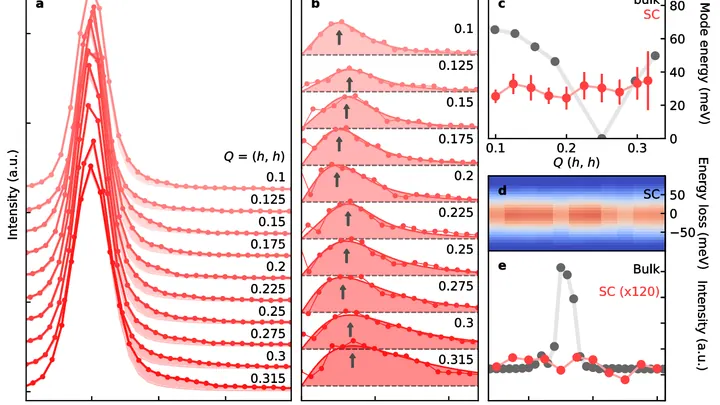
At ambient pressure, the LBCO-0.125 crystal barely conducts electricity without loss. Inside, electrons arrange into stripes with alternating magnetization, and these stripes act as barriers: superconducting pairs form but cannot flow freely through the whole sample.
The crystal Co2SeO3Cl2 resembles a layered cake, with each layer being a buckled honeycomb grid of cobalt atoms. When cooled to 25.4 K (−247.75 °C), the magnetic moments of the atoms begin to align like compass needles, but not all at once — rather in four steps, at 25.4, 16.8, 11, and 3 K. Each step brings a new pattern of magnetic order.
An ordinary superconductor expels magnetic fields, but this ring does the opposite: it creates a magnetic field inside itself. The ring is made of Fe(Te,Se) — a compound of iron, tellurium, and selenium that loses its electrical resistance at very low temperatures.
A superconductor is a material that, at very low temperatures, conducts electricity without losses: electrons move without bumping into each other, like a crowd walking down a perfectly smooth corridor. But turn on a strong magnetic field, and vortices appear inside the superconductor — tiny regions where superconductivity vanishes.
An ordinary superconductor is like a squad of soldiers marching in pairs: electrons pair up, and their spins (internal 'tops') point in opposite directions. A magnetic field easily flips such pairs, destroying superconductivity.
In UTe₂, things are different.
The crystal CeRh₂As₂ behaves like a switch: cool it down and it becomes a superconductor, then bring a magnet close and it abruptly jumps to another superconducting state. Such behavior is rare: most superconductors have only one state, but here there are two, separated by a sharp boundary.
Layered cuprate crystals resemble a stack of pancakes: each pancake is a plane of copper and oxygen atoms, with spacer layers of other elements in between. Usually, superconductivity is studied in the whole stack, where layers influence each other.
A regular switch clicks, and current either flows or it doesn't. Now imagine a material that switches itself between 'conducts without loss' and 'resists' under the influence of a magnet. That's exactly the sandwich physicists built: a thin lead film on top of a superconductor made of bismuth, strontium, calcium, copper, and oxygen.
In NaAlSi, as it cools, electrons form fleeting ripples — stripes that appear and vanish, like patterns on water stirred by wind. These stripes intertwine with superconductivity, a state where current flows without resistance. Typically, for this, electrons pair up with uniform binding energy.
In a conventional superconductor, electrons team up into pairs that stay put: their total momentum is zero. But sometimes it's different: pairs gain a shared momentum and start moving, like a school of fish swimming against the current. This state is called a pair density wave, and it's very finicky: it needs special conditions.
In the crystal La₂₋ₓSrₓCuO₄, at a certain composition, two states coexist: superconductivity, where electrons move without loss, and a charge-density wave — a periodic bunching of electron density. These states compete for the same electron clouds, which resemble cross-shaped petals.
In the TiSe2 crystal, electrons behave like compass needles that suddenly start pointing in the same direction. This is called a nematic state — by analogy with liquid crystals, where molecules align along a common direction even though the material itself remains liquid.
Run a current through a contact between a superconductor and a ferromagnet, and you will hear the whisper of the quantum world. In the lab at 0.3 K, that whisper turned into a roar: the shot noise—electrical noise due to the discreteness of charge—was a hundred times louder than theory allows for ordinary contacts.
Strike a gong and the sound fades in layers: the low hum lingers longer, the high overtones vanish first, leaving silence behind. So too a qubit, living its quantum life, leaves not one but three echoes of its own past.
A superconducting qubit, a tiny loop with zero resistance, crunches problems faster than you can blink. But cut the power, and everything it has calculated vanishes. Like a chef who cooks without writing down the recipe: as long as he's at the stove, he remembers every step, but an hour later — nothing.
The authors of the study propose writing the result into diamond.