Blood parasite swims faster when surrounded by cells ✛
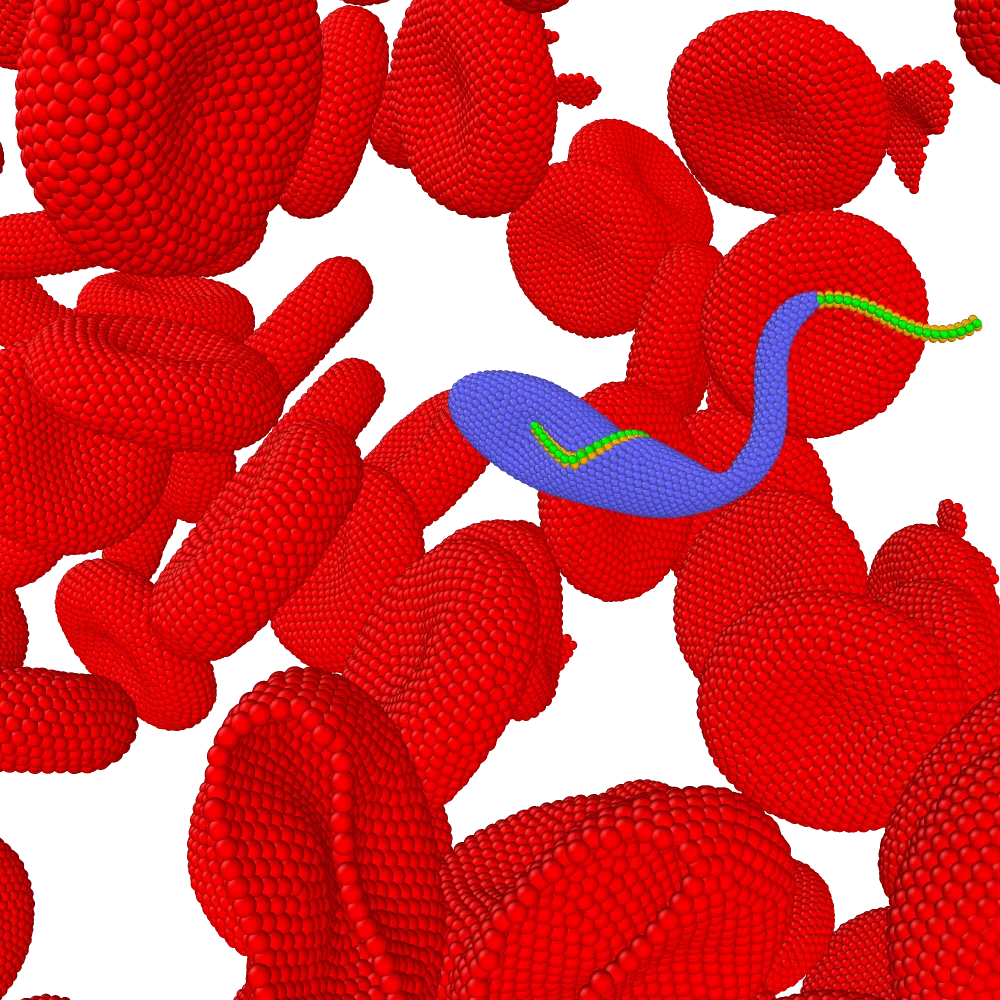
If a pool is full of light balls, a swimmer can push off them and move faster than in clear water. That's roughly how trypanosomes behave: these tiny parasites cause sleeping sickness. In human blood, red cells take up almost half the volume, and scientists used to think they got in the parasite's way. But it turns out that in such a thick mixture, trypanosomes actually move faster.
A trypanosome has a flagellum, a long, flexible extension that beats in waves and propels the cell forward. In pure fluid, the flagellum meets nearly the same resistance in every direction, so the push is weak. But when particles are floating around, they hinder sideways motion more than forward motion. The flagellum starts pushing off the particles like an oar against water, and the parasite accelerates.
This mechanism helps trypanosomes survive in blood and may work in other microorganisms, such as sperm in mucus. Understanding it could aid in designing devices for rapid diagnosis of parasitic infections.
A trypanosome, 24 micrometers long, can accelerate from 11 to 36 micrometers per second when swimming into a cluster of microparticles, as shown in one of the article's videos. That is like a person walking suddenly breaking into a run just by entering a crowd.
The idea of a microorganism using surrounding particles to speed up evokes the sandworms in Frank Herbert's novel "Dune," which move through sand by leveraging friction against particles. Though the scale and medium differ, the principle of "bracing against the environment" resonates with the discovered mechanism.