Trypanosome in a Crowd of Red Blood Cells: Speed Increases, Not Decreases ✛
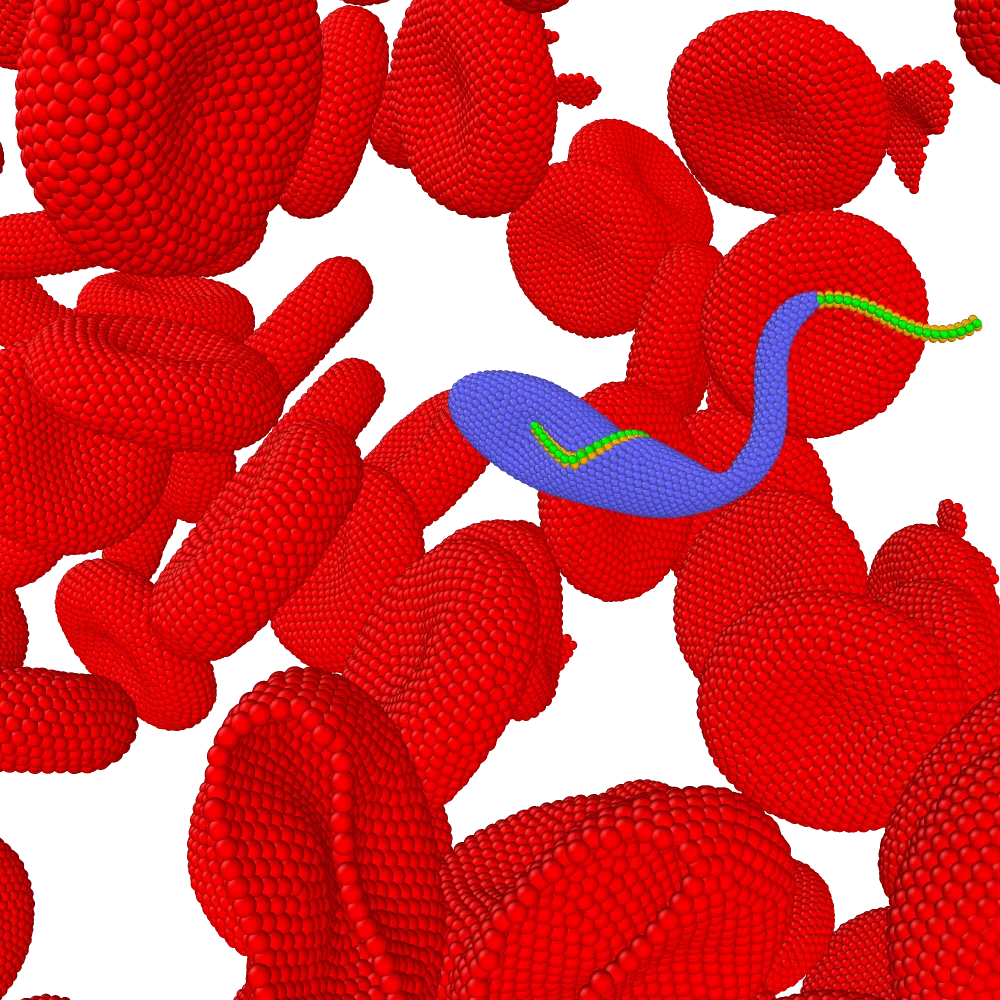
A swimmer in a pool filled with light balls pushes off them and swims faster than in clear water. That is roughly how a trypanosome, a single-celled parasite that causes sleeping sickness, behaves when it enters blood, where red cells occupy nearly half the volume. It used to seem that such a dense suspension would hinder movement, but calculations and experiments showed the opposite: the parasite speeds up by tens of percent.
The key is the flagellum, a long motile extension of the cell that beats in a wave and pushes the parasite forward. In a clear fluid, the resistance to flagellar motion perpendicular to its axis is only slightly greater than along it, so thrust is weak. But if particles are floating around, they hinder the flagellum more when it moves perpendicular than along, and this difference grows with their concentration. The flagellum starts pushing off the particles, like a swimmer off balls, and speed increases.
The effect is especially noticeable when the particle size does not exceed half the wavelength of the flagellar beat. In trypanosomes, this wave is about 10 micrometers long, and red blood cells are 7–8 micrometers, so conditions are ideal. In experiments with live parasites in a chamber filled with microspheres, speed increased with particle concentration, and the increase was greater for smaller spheres than for larger ones.
Previously, it was unclear how trypanosomes move at all in blood, where erythrocytes occupy up to half the volume. Now it has been shown that the suspension does not hinder but helps: particles enhance the anisotropy of flagellar friction, and the parasite swims faster. This explains how it survives and spreads in the bloodstream despite the high cell density.
Such a mechanism may be common to many flagellated microswimmers in biological fluids, for example spermatozoa in mucus or bacteria in biofilms. The results will be useful in developing microfluidic devices for diagnosing parasitic infections, where the influence of particles on motility must be considered. Ultimately, a trypanosome in a crowd of red blood cells resembles a swimmer who has learned to use balls in a pool as support to accelerate.
A trypanosome, 24 micrometers long, can accelerate from 11 to 36 micrometers per second when swimming into a cluster of microparticles, as shown in one of the article's videos. That is like a person walking suddenly breaking into a run just by entering a crowd.
The idea of a microorganism using surrounding particles to speed up evokes the sandworms in Frank Herbert's novel "Dune," which move through sand by leveraging friction against particles. Though the scale and medium differ, the principle of "bracing against the environment" resonates with the discovered mechanism.