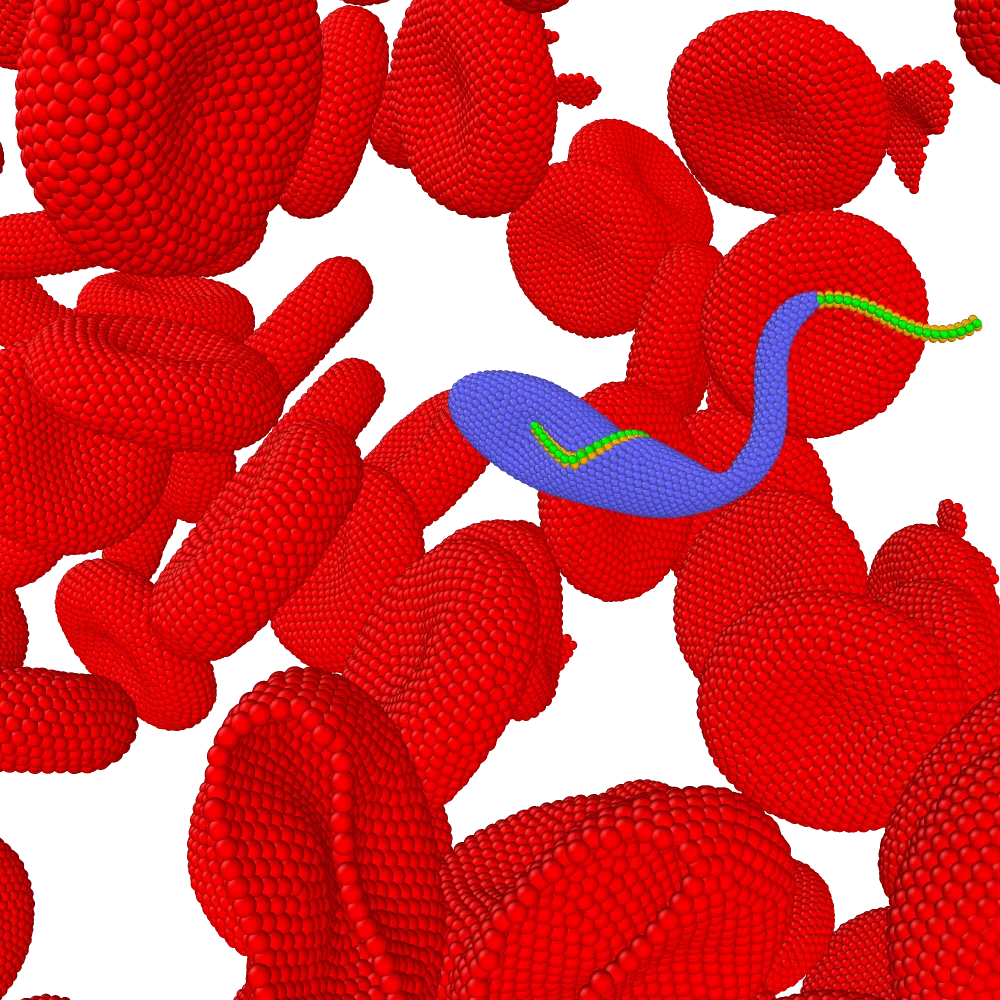
Trypanosome in a Crowd of Red Blood Cells: Speed Increases, Not Decreases ✛
Context
This work fits into research on microbial motility in complex environments. Related studies include bacterial motion in mucus, the influence of water flow on bacterial gait, the collective dance of bacteria, and how cellular motors set droplet sizes. All examine how microswimmers interact with their surroundings, but this paper stands out by considering a parasite in a medium closely mimicking blood: a suspension of red blood cells with volume fractions up to 50%. Direct observations of trypanosomes in blood are difficult due to the high cell concentration and their optical properties, so combining simulations and experiments with colloidal particles fills an important gap.
Methods
The authors built a numerical model of a trypanosome with an elastic body and an attached flagellum that generates a bending wave. The parasite was placed in a suspension of deformable red blood cells or rigid spheres of various sizes. The fluid hydrodynamics were described using smoothed dissipative particle dynamics. To test the mechanism, they measured the drag coefficients of a passive flagellum oriented perpendicular and parallel to the flow in a suspension of red blood cells. Experiments were conducted with live trypanosomes in a chamber 8 μm thick filled with polystyrene microspheres of diameters 3 and 5 μm, recording motion on video at 100 frames per second.
Results
In a suspension of red blood cells, the swimming speed of the trypanosome increases with hematocrit: at a volume fraction of 0.5, the increase is about 43% for forward motion and 24% for backward motion compared to pure fluid. In a suspension of spheres, the effect is even stronger: for the smallest spheres (radius 0.8 μm) at a volume fraction of 0.5, the speed increases by 116%. Experiments with microspheres confirmed the qualitative picture: speed increases with particle concentration, with a larger increase for smaller spheres (3 μm) than for larger ones (5 μm). Drag coefficient measurements showed that the difference between perpendicular and parallel flagellar drag increases with particle concentration, explaining the enhanced thrust.
Implications
This work shows that a dense particle suspension does not necessarily hinder microbial movement; it can actually accelerate it by increasing flagellar drag anisotropy. This differs from neighboring studies, which mostly considered single swimmers in viscous or polymeric fluids, but not in concentrated cell suspensions. The mechanism identified here may be common to many flagellated microswimmers in biological fluids, such as spermatozoa in mucus or bacteria in biofilms. For trypanosome biology, this explains how the parasite survives and spreads in the bloodstream despite the high cell density.
Future development
Further research could include modeling trypanosome motion in blood flow, where shear gradients and cross-stream migration come into play. It is also important to study how flagellar beat characteristics change in real blood, rather than in a model fluid with plasma viscosity. The thrust enhancement effect may depend on particle shape and deformability, requiring comparisons with other cell types. Finally, it is worth testing whether this mechanism works for other parasites, such as Leishmania or spermatozoa in complex environments.
Impact
The results could aid the development of microfluidic devices for diagnosing parasitic infections, where the influence of particles on motility must be considered. They also provide a basis for understanding pathogen dissemination in the bloodstream and may inspire the creation of artificial microswimmers that exploit suspensions to enhance motion.
Next steps
The immediate next step is to simulate trypanosomes in blood flow, accounting for shear and vessel wall interactions. Experimentally, one could try observing the parasite in thicker channels to reduce boundary effects and measure the local particle concentration around the flagellum.
Key open problems
For parasite biology, an open question remains how trypanosomes orient and move in real blood flow with variable speed and turbulence. It is also unclear how thrust enhancement affects the parasite's ability to evade the immune response, since higher speed might increase the shedding of surface proteins. This work links microfluidic physics to parasite adaptation to the host, but does not answer how the parasite regulates flagellar beating in response to local cell density.
The knowledge machine's view
This section is addressed to the author of the paper and their colleagues. Neighbouring works were found by meaning-based search across our archive, not by word overlap. We do not review: we show the field around the work.
What the work does
The authors built a numerical model of a trypanosome with an elastic body and a flagellum generating a bending wave, placed it in a suspension of deformable red blood cells or rigid spheres, and computed the hydrodynamics using smoothed dissipative particle dynamics. They measured the drag coefficients of a passive flagellum in the suspension and ran experiments with live trypanosomes in a chamber with polystyrene microspheres. They found that swimming speed increases with particle concentration (up to +116% for small spheres) and explained this by an increase in the difference between perpendicular and parallel drag on the flagellum.
Where its strength is
The study identifies a concrete mechanism (enhanced anisotropy of flagellar drag in a dense suspension) that leads to faster swimming of a microswimmer, and confirms it both by simulation and experiment. This opens the possibility of transferring the approach to other systems where a swimmer interacts with a dense medium of deformable or solid particles.
Where it could go next
- A related paper examines how water flow changes bacterial gait; it might be interesting to see how an external shear flow in a red blood cell suspension affects the flagellar beating of trypanosomes and the enhancement of thrust.based on: How Water Flow Changes a Bacterium's Gait arXiv:2601.16721
- In the archive there is an analysis of the motion of an ellipse in a crowd of active dumbbells; one could consider how the shape and flexibility of the trypanosome body affect its motility in a dense suspension and compare with that model case.based on: An Ellipse in a Crowd of Active Dumbbells arXiv:2608.30377v1
- A paper on how a bacterium swims through mucus considers motion in a viscoelastic medium; one could test whether the speed enhancement persists in a medium with polymer additives mimicking mucus, and how that changes the drag anisotropy.based on: How a Bacterium Swims Through Mucus arXiv:2603.27445
Worth trying
- Test how the speed increase depends on particle stiffness (red blood cells vs. spheres) at the same size and volume fraction.
- Run simulations with active particles (self-propelled spheres) instead of passive ones to see how the collective dynamics of the suspension affects trypanosome speed.
- Experimentally measure trypanosome speed in suspensions of red blood cells with different stiffness (e.g., treated with glutaraldehyde) to separate the effect of deformability.
Nearby works in our archive
- Tumor Cells Reveal Their Mapssimilarity 0.49
- How Sleep Washes the Brainsimilarity 0.49
- How Water Flow Changes a Bacterium's Gaitsimilarity 0.48
- An Ellipse in a Crowd of Active Dumbbellssimilarity 0.47
- Mitochondria in a Traffic Jam: How Shape Decides a Neuron's Fatesimilarity 0.47
- Ultrasound Through Bone: A New Calculationsimilarity 0.47
- How a Bacterium Swims Through Mucussimilarity 0.46
The archive is sparse around this work: the closest review is only 0.49, against a usual 0.64. It looks like few have drilled nearby.
A trypanosome, 24 micrometers long, can accelerate from 11 to 36 micrometers per second when swimming into a cluster of microparticles, as shown in one of the article's videos. That is like a person walking suddenly breaking into a run just by entering a crowd.
The idea of a microorganism using surrounding particles to speed up evokes the sandworms in Frank Herbert's novel "Dune," which move through sand by leveraging friction against particles. Though the scale and medium differ, the principle of "bracing against the environment" resonates with the discovered mechanism.
Key numbers
- speed increase in red blood cells: 43% at hematocrit 0.5
- speed increase in small spheres: 116% at volume fraction 0.5
- critical particle size: 4–5 μm (half the beat wavelength)
- acceleration in experiment: from 11 to 36 μm/s upon entering a dense region
- human blood hematocrit: 40–50%