Flat Bands in Graphene Grown from Gas ✛
Context
The world of two-dimensional materials has lived for a decade and a half on graphene exfoliated from graphite with Scotch tape. This method yields crystals with almost no defects, but each sample is unique, and areas rarely exceed tens of micrometers. Chemical vapor deposition grows graphene on copper foil in sheets hundreds of micrometers across, yet it was long thought that such films are too dirty for delicate quantum effects. Neighboring papers in the archive have already shown superconductivity and strange currents in graphene, but all relied on exfoliated layers. This article enters that series from the other side: it tests whether an industrial method can produce the most fragile state, the flat bands of the magic angle.
Methods
Two graphene single crystals were grown on a single copper grain so that their crystal lattices were initially aligned. The layers were then transferred onto a hexagonal boron nitride substrate and stacked with a rotation of about 1.2 degrees, compensating for subsequent relaxation toward Bernal stacking. The surface was cleaned by mechanical 'sweeping' with an atomic force microscope tip. The moiré structure was confirmed by scanning tunneling microscopy: the lattice period was 12.9 nanometers, corresponding to an angle of 1.11 degrees. The electronic structure was measured using nano-ARPES at the Advanced Light Source synchrotron with a spot of about one micrometer, allowing mapping of the flat-band distribution across the sample.
Results
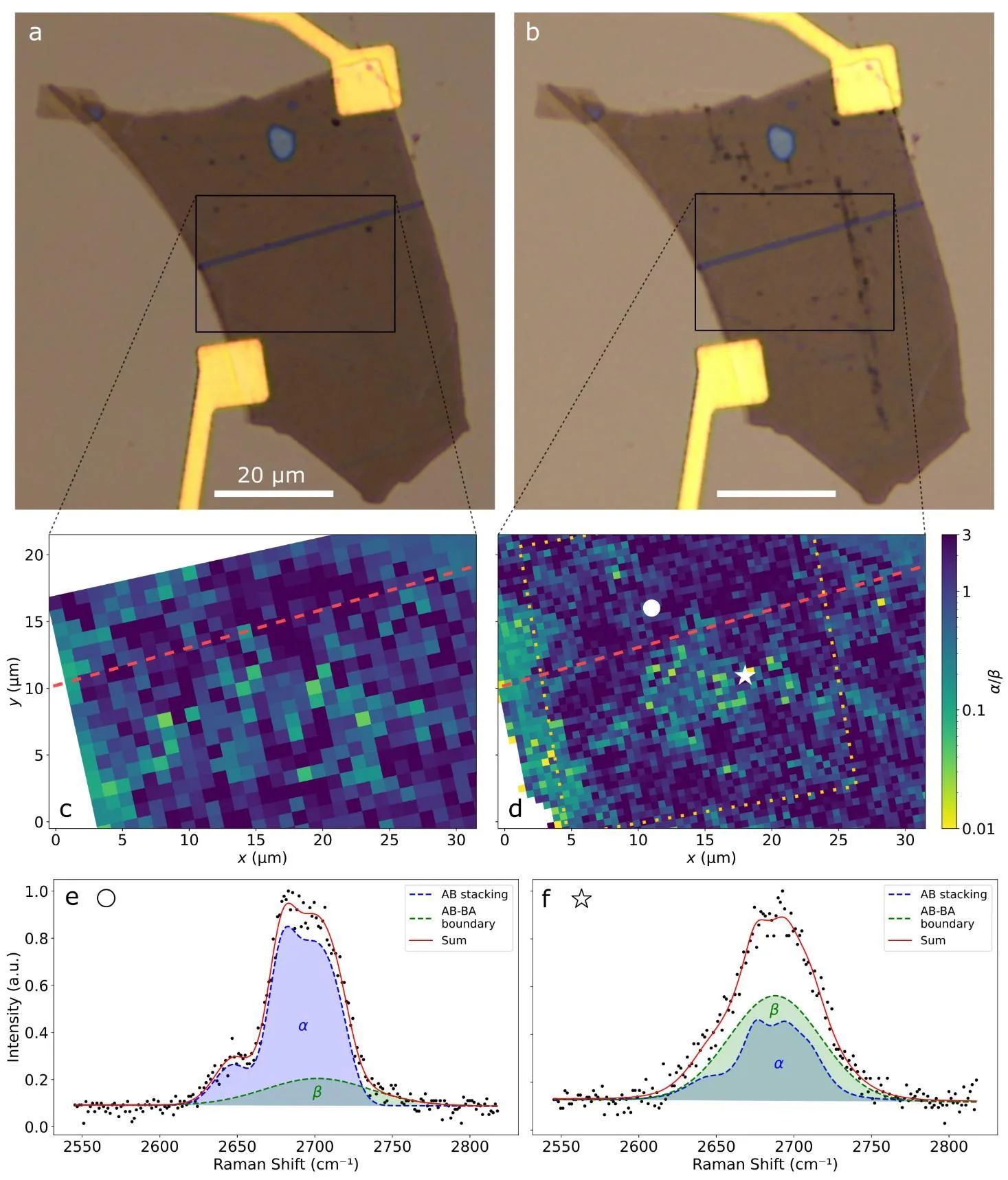
The photoemission spectra clearly show flat bands near the Fermi level, as well as a hybridization gap of about 0.2 electronvolts. The flat-band width from dispersion was approximately 24 millielectronvolts, comparable to the best exfoliated graphene samples. Non-negative matrix factorization analysis identified a domain with a near-magic angle measuring 15 by 10 micrometers in the field of view, and fitting position-dependent curves gave an area of 84 ± 41 square micrometers. The relaxation length of the magic configuration toward Bernal stacking was 4.1 ± 1.1 micrometers, which limits the useful area but does not hinder device fabrication. Interestingly, photodoping under the synchrotron beam was observed, shifting the Fermi level by more than 100 millielectronvolts.
Implications
The work shows that graphene grown from the gas phase has reached a quality where flat bands exist, a state previously considered the privilege of exfoliated crystals. This is not merely repeating a known result with another method: the authors quantitatively estimated for the first time the size of the magic-angle domain and its relaxation length, which neighboring studies did not do. Thus, the main barrier to scalable production of moiré-based devices has been removed. The community can now move from the question 'is it possible?' to 'how to make it reproducible?'
Future development
The next logical step is to fabricate transport devices with contacts and gates based on such domains and test whether correlated states persist at low temperatures. In parallel, photodoping should be investigated: understand its dependence on photon flux and find ways to suppress it, for example by choosing a substrate or a protective coating. Another direction is automating the assembly to eliminate the human factor during layer transfer and increase the yield of good samples.
Impact
The result directly impacts the development of scalable quantum devices based on two-dimensional materials, as well as the technology of chemical vapor deposition of graphene in general.
Next steps
Immediate next steps include fabricating field-effect transistors on grown magic-angle domains and measuring their transport properties at cryogenic temperatures.
Key open problems
For the field of two-dimensional material growth, the key unresolved problem remains the control of defects and contamination during transfer, which directly affects the reproducibility of quantum states. This work shows that even with residual contamination, flat bands can be obtained, but the question of stability and uniformity over large areas remains open.
The knowledge machine's view
This section is addressed to the author of the paper and their colleagues. Neighbouring works were found by meaning-based search across our archive, not by word overlap. We do not review: we show the field around the work.
What the work does
The study shows that bilayer graphene grown by CVD can host flat bands when twisted to the magic angle. Using nano-ARPES, the authors directly observed the flat bands and mapped their distribution, identifying a domain with a near-magic angle spanning about 84 μm² and a relaxation length to Bernal stacking of 4.1 μm.
Where its strength is
The strength of this work lies in the quantitative assessment of the magic-angle domain size and its relaxation length, something not previously done for CVD graphene. This paves the way for scalable production of devices based on moiré materials.
Where it could go next
- It might be interesting to correlate the observed flat bands with transport measurements of superconductivity in magic-angle graphene to see whether correlated states persist in CVD samples.based on: Superconductivity in Magic-Angle Graphene: Quantum Geometry arXiv:2604.05994
- A related avenue is studying how defects affect the superconducting order in graphene; one could examine how defects, unavoidable in CVD graphene, influence the stability of flat bands and the relaxation length.based on: Superconducting Web: How Defects in Graphene Weave Quantum Order arXiv:2607.02267
- One could look into methods for controlling the twist angle in CVD graphene described in a neighboring paper, to improve the reproducibility of the magic angle.based on: Twisted Graphene at a Preset Angle arXiv:2604.15639
Worth trying
- Perform transport measurements on the magic-angle domain in CVD graphene and compare with data from exfoliated samples.
- Investigate how defects (e.g., grain boundaries) affect the relaxation length of the magic configuration.
- Optimize the transfer and cleaning process to increase the area of the magic-angle domain.
Why this may matter
If CVD graphene can reliably reproduce magic-angle superconductivity, it would make moiré devices accessible for mass production and practical applications.
Nearby works in our archive
- Twisted Graphene at a Preset Anglesimilarity 0.56
- The Edge of Graphene: How the Rim of Two-Dimensional Carbon Behavessimilarity 0.55
- Superconductivity in Graphene: A Dance of Electronssimilarity 0.55
- Superconductivity in Magic-Angle Graphene: Quantum Geometrysimilarity 0.55
- Superconductivity in Graphene: Magnetic Field Reveals the Secretsimilarity 0.54
- Superconducting Web: How Defects in Graphene Weave Quantum Ordersimilarity 0.54
The archive is sparse around this work: the closest review is only 0.56, against a usual 0.64. It looks like few have drilled nearby.
The moiré lattice period of 12.9 nanometers means that over a single domain length of 10 micrometers, about 775 supercell unit cells fit.
Key numbers
- twist angle: 1.11 degrees
- moiré lattice period: 12.9 nm
- largest domain area: 84 ± 41 μm²
- flat band width: 24 meV
- relaxation length: 4.1 ± 1.1 μm