A flat band is a special energy band in a material's electronic structure where the energy does not depend on the momentum of the electron. In ordinary materials, electrons with different momenta have different energies, forming a curved band. In a flat band, all electrons have the same energy regardless of how fast they move, which means they have an infinite effective mass and are effectively localized. This extreme condition leads to strong electron-electron interactions, as the kinetic energy is quenched, and can give rise to exotic quantum phases such as superconductivity and magnetism.
History
The concept of flat bands was theoretically predicted in the 1990s, but it gainedprominence in 2018 when Pablo Jarillo-Herrero's group at MIT discovered that twisting two layers of graphene at a 'magic angle' of about 1.1 degrees creates flat bands that exhibit superconductivity. This sparked a surge of research into twistronics and flat-band physics.
How it works
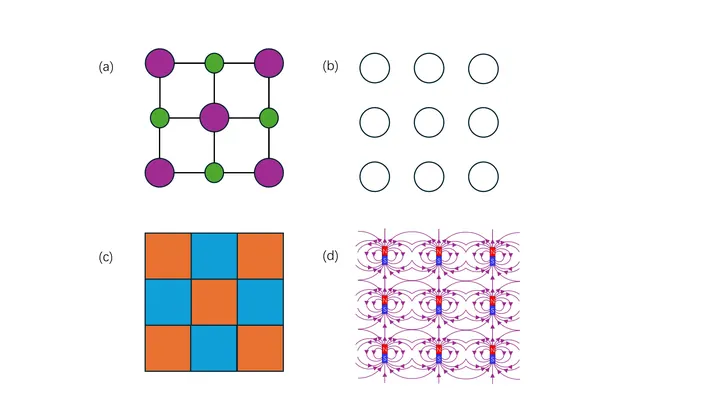
Flat bands arise from destructive interference of electron wave functions in certain lattice geometries, such as the Kagome lattice or Lieb lattice. In these structures, the hopping of electrons between sites can cancel out for certain states, trapping them in place. The flatness of the band is a result of the lattice symmetry, and it can be tuned by applying strain or magnetic fields. When the band is partially filled, the electrons' Coulomb repulsion dominates over their kinetic energy, leading to correlated states that are not described by simple band theory.
In practice
Flat bands are a platform for studying strongly correlated electron systems and for designing new superconductors, quantum spin liquids, and devices for quantum computing.
Fun fact
The 'magic angle' in twisted bilayer graphene is so precise that a deviation of just 0.1 degrees destroys the flat band and the associated superconductivity.
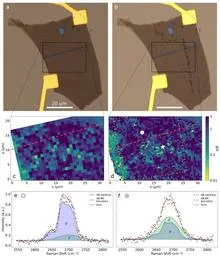
A Stradivarius violin can only be made from wood that grew under special conditions. For a long time, it was believed that graphene for delicate quantum effects had to be exfoliated from graphite with tape, and that a crystal grown in a test tube was incapable of such feats. This work shows that graphene grown from a gas mixture can sound like a Stradivarius.
In a tight row of atoms, spaced closer than the wavelength of light, a remarkable state hides. The excitation is distributed among all particles so that their radiation cancels itself out. This quantum 'silence' is an ideal vault for a photon: it can be stored there hundreds of times longer than usual.
A flashlight beam cuts through fog. The denser the fog, the more the light scatters and the later it reaches your eye. A similar principle works with fast radio bursts — mysterious, super-powerful pulses from distant galaxies. As their radio waves travel through space, they interact with free electrons — particles stripped from atoms.
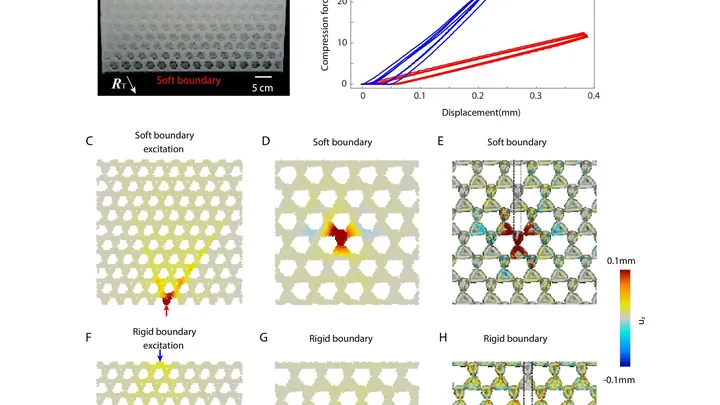
Hit a table, and the sound quickly fades. Elastic waves in solids usually behave like ripples on water: they spread from the source and die out. But there is a way to make them freeze in place — by creating a 'flat band' in the frequency spectrum. This is a range where waves lose their speed and pile up, like cars in a traffic jam.
Bending a sheet of paper is easy. But compressing it by pushing from the edge is a different story: the paper will crumple but barely transmit the force further. That's how ordinary elasticity works — deformation depends on where and how you press. The new three-dimensional lattice pushes this contrast to the limit.
A Tesla coil crackles, and a beam of light begins to rotate around it. The medium it passes through is still stable, but the field grows, and the rotation intensifies. This is not a trick but the behavior of special materials that couple electricity and magnetism. For such coupling, there is a fundamental limit — the Tellegen limit.
A guitar string keeps vibrating even after the musician lets it go, and that vibration changes the sound the listener hears. Magnetic moments in a crystal behave much the same way: they align into a strict antiferromagnetic order (neighbors point in opposite directions), but they never completely freeze.
Light or sound can be confined in a tiny region of a crystal, like a pearl in a shell. Usually, two methods are used. The first is like a heavy ball in a pit: a particle with large mass simply cannot roll out. The second is a perfect cage of mirrors, where waves cancel each other everywhere except in the trap itself.
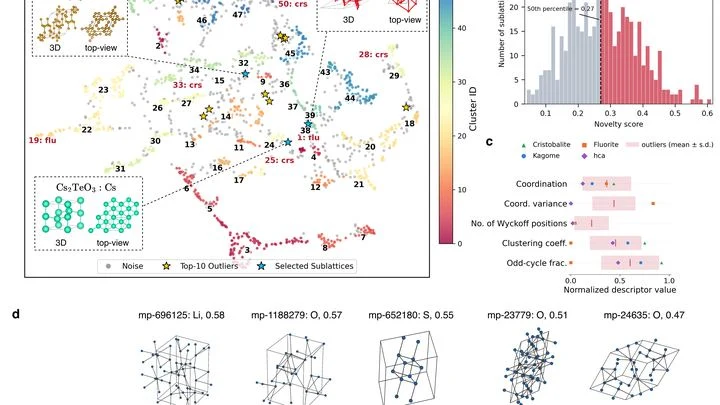
A sheet of paper with square grid, one with diamond grid, and one with honeycomb — three different universes for an ant. Change the sheet, and the rules of movement change. That's roughly how electrons experience the crystal lattice: geometry dictates whether they become little magnets, superconductors, or something else. In ordinary materials, the lattice is as rigid as if engraved.
Electrons in a crystal are like cars on city streets: some race down avenues, others get stuck in traffic jams. In certain lattices, motion freezes entirely — velocity stops depending on energy, and electrons become "flat." This isn't a traffic jam but a special rhythm of the network where waves cancel each other out.
A stone falls into a pond, and ripples spread across the water. Long waves and short ones travel at the same speed: that's how ordinary sound behaves in almost any medium. But in quantum liquids, things can be different.
Physicists considered a superfluid where particles move along a "flat" energy band.
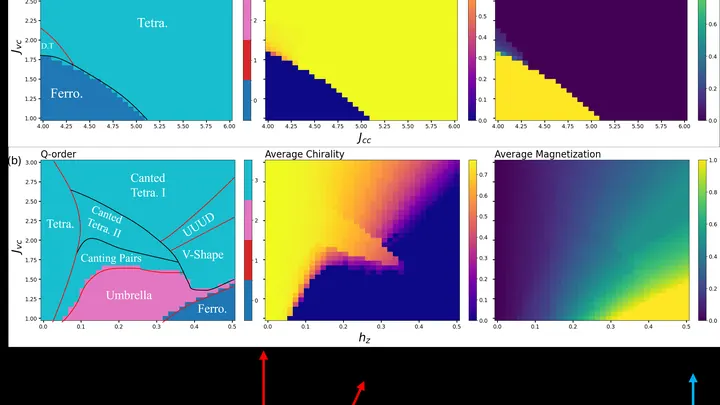
Imagine a triangular grid with tiny magnetic arrows at each node. Electrons, the charge carriers, run across this grid. Usually, the arrows align simply: all pointing the same way (ferromagnet) or alternating in the plane.
Superconductivity is when electric current flows without losses, like water through a perfectly smooth pipe. It usually occurs at very low temperatures, but there are materials where it appears at higher ones.
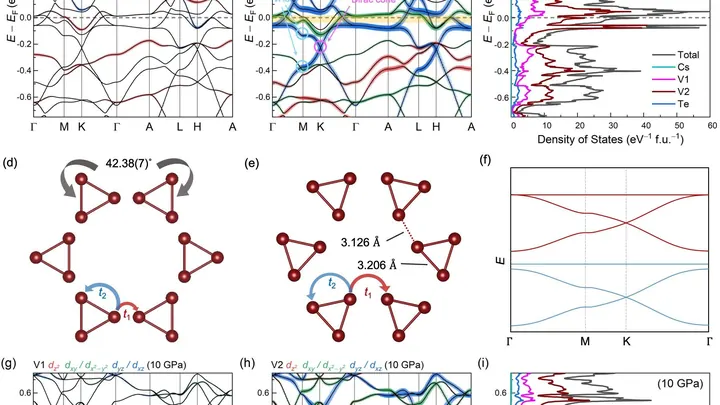
A woven basket made of willow twigs holds its shape thanks to the interweaving. A similar pattern, triangles linked into a flat network, has been found in a new crystal with the formula Cs₃V₉Te₁₃. Here, vanadium atoms form two sets of triangles that pierce each other like threads in fabric.
This pattern is not just pretty: it forces electrons to move along special "flat" energy pathways.
In the woven basket pattern, where the strands interlace into triangles, some electrons get stuck in place, like coins wedged in the gaps of the weave. Other electrons roam freely across the whole basket, like light filling a room. Physicists have long sought the moment when these two types of electrons start to influence each other, and now it has been found in the material CsCr6Sb6.
A sheet of graphene is a lattice of carbon atoms arranged like a honeycomb. Electrons in it zip around so fast they seem to have no mass, just like light. When a powerful laser pulse hits such a sheet, the electrons get a kick and start accelerating. Their path can be compared to a road with occasional barriers — the forbidden zones.
An ordinary rubber pad dampens vibration the way a thick blanket muffles sound: the thicker and heavier, the better. Engineers have long dreamed of a material that is light yet "eats" oscillations as well as a massive damper.
Plasma is a gas heated so intensely that electrons are stripped from atoms. Waves run through it, akin to sound in air, but they are governed by the magnetic field. When the magnetic field becomes periodic rather than uniform, like a fence with alternating slats, waves behave differently. Some frequencies simply vanish: the wave cannot propagate and is reflected back.
Light usually tends to scatter in all directions, like splashes from a thrown stone. But it can be caught in an invisible cage where it swirls in place, losing almost no energy. Physicists have built just such a cage using the magnetic material CrSBr — a layered crystal that can be split into flakes just a few atoms thick.