A synchrotron is a ring-shaped particle accelerator that races electrons to near light speed, bending them with magnets and emitting intense beams of X-rays. These X-rays are millions of times brighter than those from a hospital X-ray tube, and they span a broad spectrum of energies. Synchrotrons are the workhorses of modern materials science, biology, and chemistry, letting researchers see the atomic structure of proteins, the magnetic domains in a crystal, or the internal stress in an airplane wing.
History
Synchrotron radiation was first observed in 1947 at General Electric's 70 MeV electron accelerator, though the phenomenon was predicted earlier. Dedicated synchrotron facilities for research emerged in the 1960s and 1970s.
How it works
Electrons are injected into a circular vacuum tube and accelerated by radio-frequency cavities. As they round the bends, powerful magnets force them into curved paths; the acceleration they experience makes them radiate photons tangentially — this is synchrotron radiation. The light is channeled into beamlines, where monochromators pick out specific wavelengths and focus them onto samples. The ring's circumference and magnet design determine the X-ray energy range and brightness.
In practice
Synchrotrons are used for protein crystallography, X-ray imaging of batteries and microchips, and studying the magnetic properties of materials; they also serve as sources for X-ray lithography in nanofabrication.
Fun fact
The first synchrotron radiation was seen as a bright spot of light in the accelerator's vacuum chamber — researchers initially thought it was a spark from a short circuit.
For three days straight, a laser blasted a jet of gas, and every second it produced a beam of electrons with the energy of a tiny lightning bolt. Previously, such beams could only be produced in huge halls where the accelerator takes up an entire building. Now the whole setup fits in a room and ran without a glitch for 72 hours.
When a laser beam hits a gas, it tears electrons from atoms and accelerates them to nearly the speed of light. As these electrons fly through the plasma, they emit X-rays, like a glowing trail from a fast particle. In the new work, physicists made a single laser pulse create not one but two such trails in succession.
A shooter aims at a target, pulls the trigger, and hears two shots: one loud, one quiet. That's how the new setup works, except instead of bullets, there's an electron bunch, and instead of shots, there are two flashes of light. One flash is X-ray, the other is terahertz. They fly to the same point with perfect timing.
Deep inside a neutron star, matter is squeezed so tightly that familiar protons and neutrons give way to new players. Hyperons are born there — particles that harbor a strange quark.
For a long time, astronomers searched for the 'factories' of the most energetic cosmic rays — particles that carry the macrocosm compressed to the size of an atomic nucleus. Colossal star-forming regions like Cygnus OB2, where winds from young giants collide, were prime suspects.
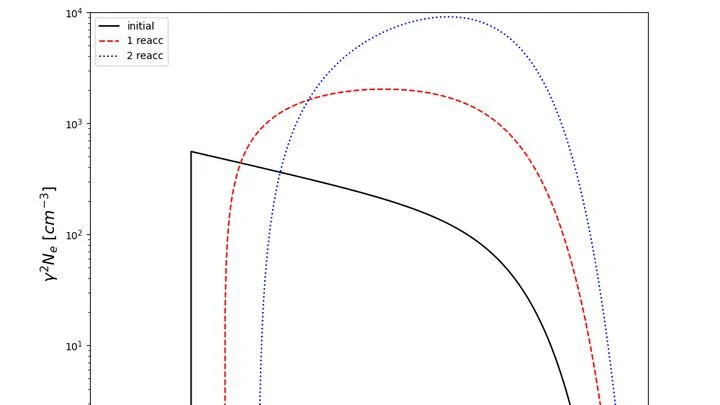
A stone falls into a pond, and ripples spread across the water. Likewise, light from distant galaxies spreads in all directions — calmly and steadily. But at the center of some galaxies, it's not a stone but a veritable cannon: it fires particles with monstrous force. Astronomers call such objects HSP BL Lac.
A flashlight beam aimed through frosted glass turns into a blurry spot with every extra millimeter of thickness. Scintillators, materials that convert X-rays into visible light, behave much the same way. They underpin medical imaging, baggage screening, and detectors at particle accelerators.
When matter is heated to millions of degrees, it turns into plasma — a mix of free electrons and ions, like a boiling soup of charged particles. You can't measure the temperature of such a 'soup' with an ordinary thermometer, but you can shine X-rays through it.
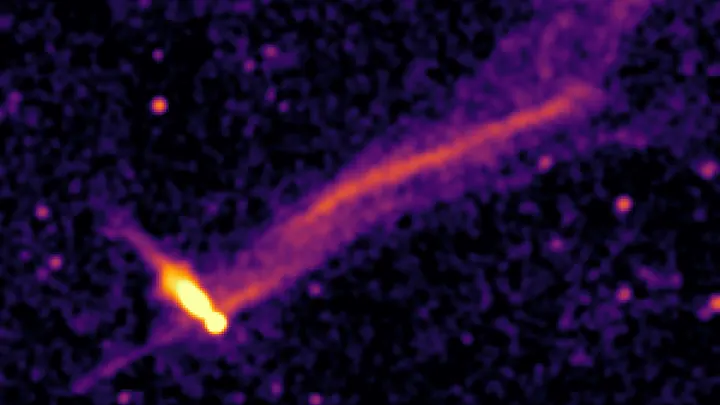
Deep in space, a rapidly spinning neutron star, a pulsar nicknamed the Lighthouse, speeds through tenuous gas. Like a motorboat cutting through water, it leaves a glowing trail of charged particles behind. In X-rays, this trail appears as a bright tail and a thin filament stretching over many light-years.
A charged particle spiraling in a magnetic field doesn't stay silent: it emits light. This light is called synchrotron radiation, and it shows up everywhere — from distant galaxies to laboratory accelerators.
A blazar is a distant galaxy with a plasma jet shooting from its center, aimed almost directly at us. Inside this jet, particles are accelerated to near-light speeds and emit powerful radiation.
In a dark room, two flashlights shine on a wall. Usually, their beams simply add up, and the spot becomes brighter. But if the flashlights emit light in special packets, photons, then under certain conditions they can behave differently. Instead of independently hitting different spots, two photons 'agree' and only come out together, as a pair, from a single output.
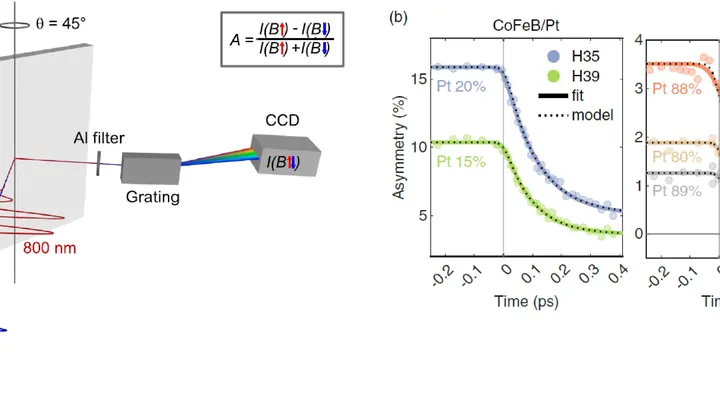
A fridge magnet holds on thanks to tiny internal arrows: each one like a miniature compass. If you hit the metal with an ultrashort flash of light, these arrows start to jitter chaotically, and magnetism melts away in a millionth of a billionth of a second. Previously, such 'melting' was too fast to observe.