Electronic structure describes how electrons are arranged in atoms, molecules, or solids — their energy levels, spatial distributions, and spin states. This arrangement dictates nearly all material properties: whether a substance conducts electricity, how it responds to magnetic fields, its optical color, and its chemical reactivity. In condensed matter physics, the electronic structure is the blueprint from which macroscopic behavior emerges.
History
The concept crystallized in the 1920s–30s with the development of quantum mechanics and the band theory of solids by Felix Bloch and others.
How it works
Electrons in a material occupy quantized energy bands, separated by gaps. The filling of these bands determines whether a material is a metal, semiconductor, or insulator. Spin ordering (ferromagnetic, antiferromagnetic, or more exotic patterns) arises from exchange interactions between electrons. Computational methods like density functional theory solve approximate equations to predict these structures, while experimental techniques like angle-resolved photoemission spectroscopy (ARPES) directly map them.
In practice
Understanding electronic structure is essential for designing semiconductors, magnetic storage media, superconductors, and new materials for quantum computing.
Fun fact
The color of a crystal — from ruby red to sapphire blue — is often a direct consequence of its electronic structure, specifically the energy gaps between electron levels.
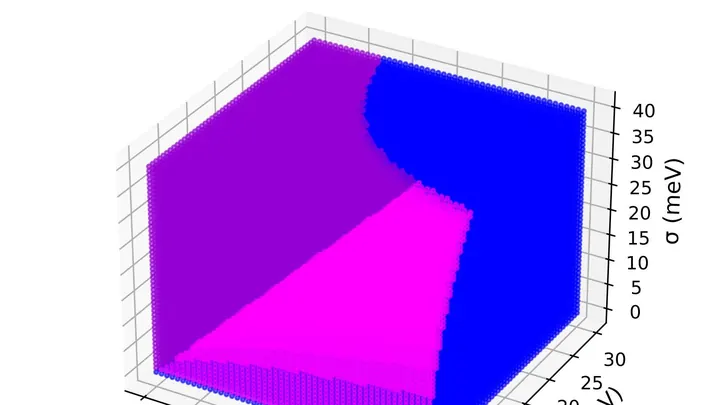
In some crystals, electrons are not spread uniformly but arrange themselves into a strict checkerboard: one cell has more electrons, the neighboring cell has fewer. Such a pattern is called charge order, and for a long time it was considered something frozen, like a pattern on frosty glass.
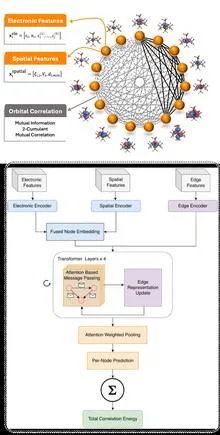
A cartographer who draws not mountains and rivers but invisible bonds between electrons: that's one way to describe the new neural network. Instead of atomic coordinates, it takes molecular orbitals and draws a graph where nodes are orbitals and edges are measures of their quantum entanglement.
An electron leaves a molecule like a tenant leaving the top floor: to get out, you have to climb the energy steps. But in the quantum staircase, the steps are not empty: other electrons crowd on them, and the crowding changes the height of the climb. The standard ADC(3) method does not notice this crowding; it assumes each electron climbs an empty staircase.
In the world of magnetism, a simple dichotomy long reigned: ferromagnets, where spins point in one direction, and antiferromagnets, where they line up in a checkerboard pattern, canceling each other out. But a recent 'third player' — altermagnets — forced a rewrite of the rules.
A sheet of paper with square grid, one with diamond grid, and one with honeycomb — three different universes for an ant. Change the sheet, and the rules of movement change. That's roughly how electrons experience the crystal lattice: geometry dictates whether they become little magnets, superconductors, or something else. In ordinary materials, the lattice is as rigid as if engraved.
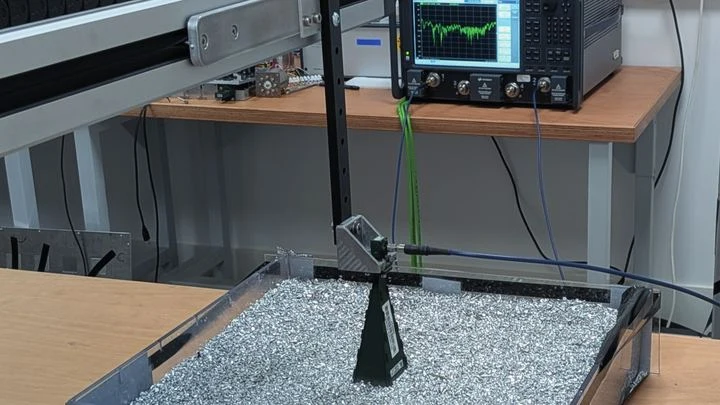
Physicists have achieved three-dimensional Anderson localization of electromagnetic waves — a phenomenon where waves become permanently entangled in a random labyrinth of metal particles and cease to propagate.
A drop of water in your palm holds roughly $$10^{21}$$ molecules, each made of three atoms surrounded by a swarm of electrons. To understand how matter behaves, physicists solve equations for these electrons. The trouble is that the number of equations grows like an avalanche: for N electrons, you need to store $$N^2$$ numbers.
In a benzene molecule, electrons buzz around the nuclei like a swarm of bees around a hive. But this swarm doesn't just hum: it pulses: every 856 attoseconds, the electron cloud completes a full oscillation cycle. The hive itself, the carbon nuclei, rocks more slowly, with a period of 36 femtoseconds.
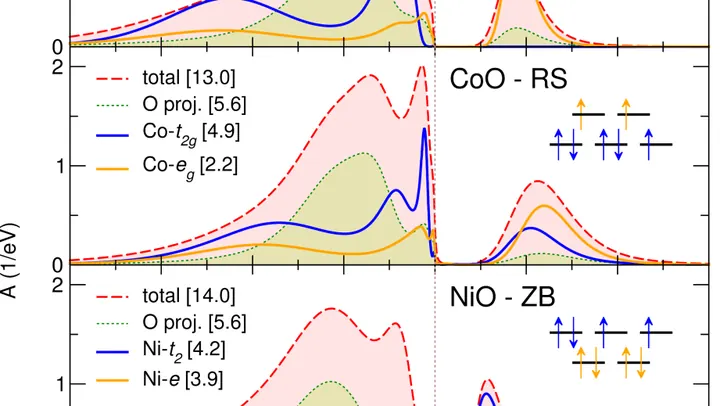
If you change not the composition but only the arrangement of atoms, you can make the same material conduct electricity or absorb light differently. That's exactly what the authors did with nickel and cobalt oxides. In one case, atoms are stacked like balls in a cubic box: each metal atom is surrounded by six oxygen atoms (rock salt structure).
Picture a crowded hall where each person is a molecule, and their private conversation is the motion of electrons within it. Normally, everyone talks to themselves, and the overall buzz is chaotic. But if a bright spotlight is turned on in the center, it begins to conduct the crowd: people synchronize their movements, even though the light merely reflects off the walls.
According to the Standard Model, the vacuum is not emptiness but an ocean of virtual ghost particles. An ultra-strong electromagnetic field, like a storm, yanks electron-positron pairs into reality.
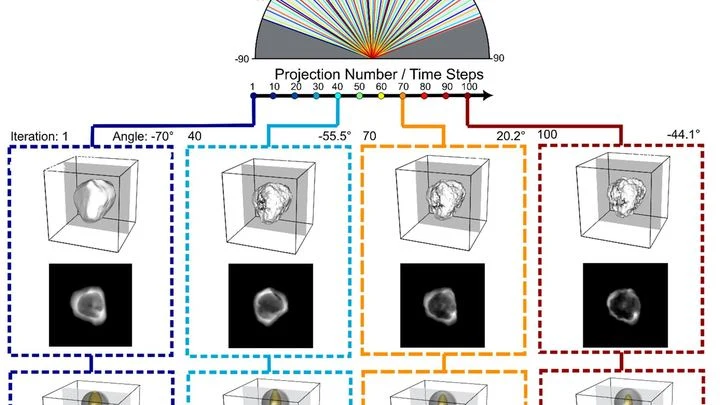
A tiny gold star melts under the beam of an electron microscope, its points slowly rounding off. In the past, such a process could only be seen in snapshots taken with long pauses, and the probing beam itself would alter the sample.
Two quantum dots are like two tiny pockets in a piece of silicon where an electron can sit, like a ball in a cup. When the pockets are far apart, each electron lives on its own, and its energy resembles the levels of a solitary atom.
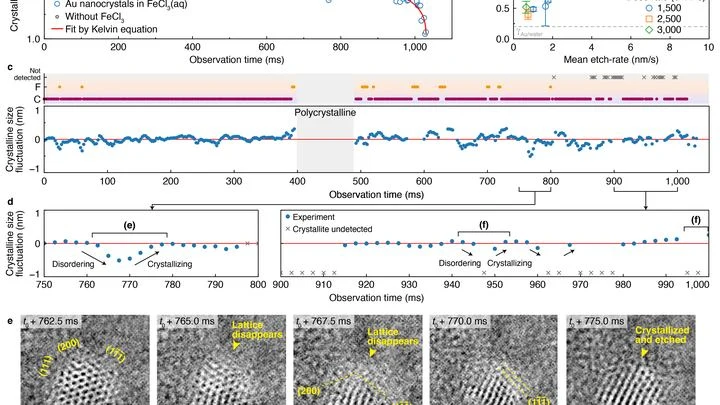
Gold nanoparticles in liquid are like tiny living creatures: they constantly change their internal structure, as if breathing. Scientists managed to peek into this process using an electron microscope that takes snapshots every millisecond, and a neural network that cleans the images from noise.
In a piece of manganese oxide just a few atomic layers thick, electrons behave like a crowd on an escalator: each moves by its own rules, but together they create a common flow. Physicists shone soft X-rays on such a film and knocked electrons out.
Toss a handful of pebbles into a stream: some settle on the bottom, others get swept around. That's roughly how waves behave in a disordered medium — light in frosted glass, sound in porous material. Usually, disorder slows things down: the wave gets stuck, spreads out, loses direction. But in a new study, physicists built an acoustic lattice where things work differently.
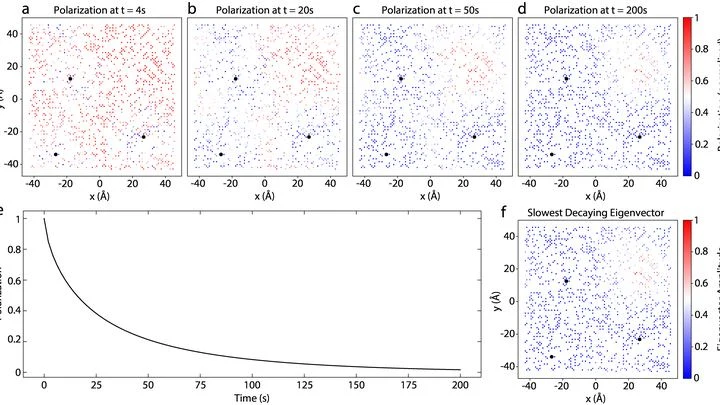
In the everyday world, order preserves and disorder destroys. But in quantum computing, this logic is turned on its head. Consider a diamond: carbon atoms with their nuclei and electrons behave like tiny magnets capable of storing a quantum "whisper"—information encoded in the orientation of their spins.