The Brain as a Jazz Trio: Why Three-Way Connections Matter More Than Pairs ✛
A jazz trio plays in a club: pianist, bassist, and drummer. If you listen to only two of them, you can understand how the pianist adapts to the bass or the bass to the drums. But the real music emerges when all three play together: one phrase changes the playing of the others. The brain at work resembles such a trio: several regions act in concert, and this collective interplay cannot be reduced to individual pairs.
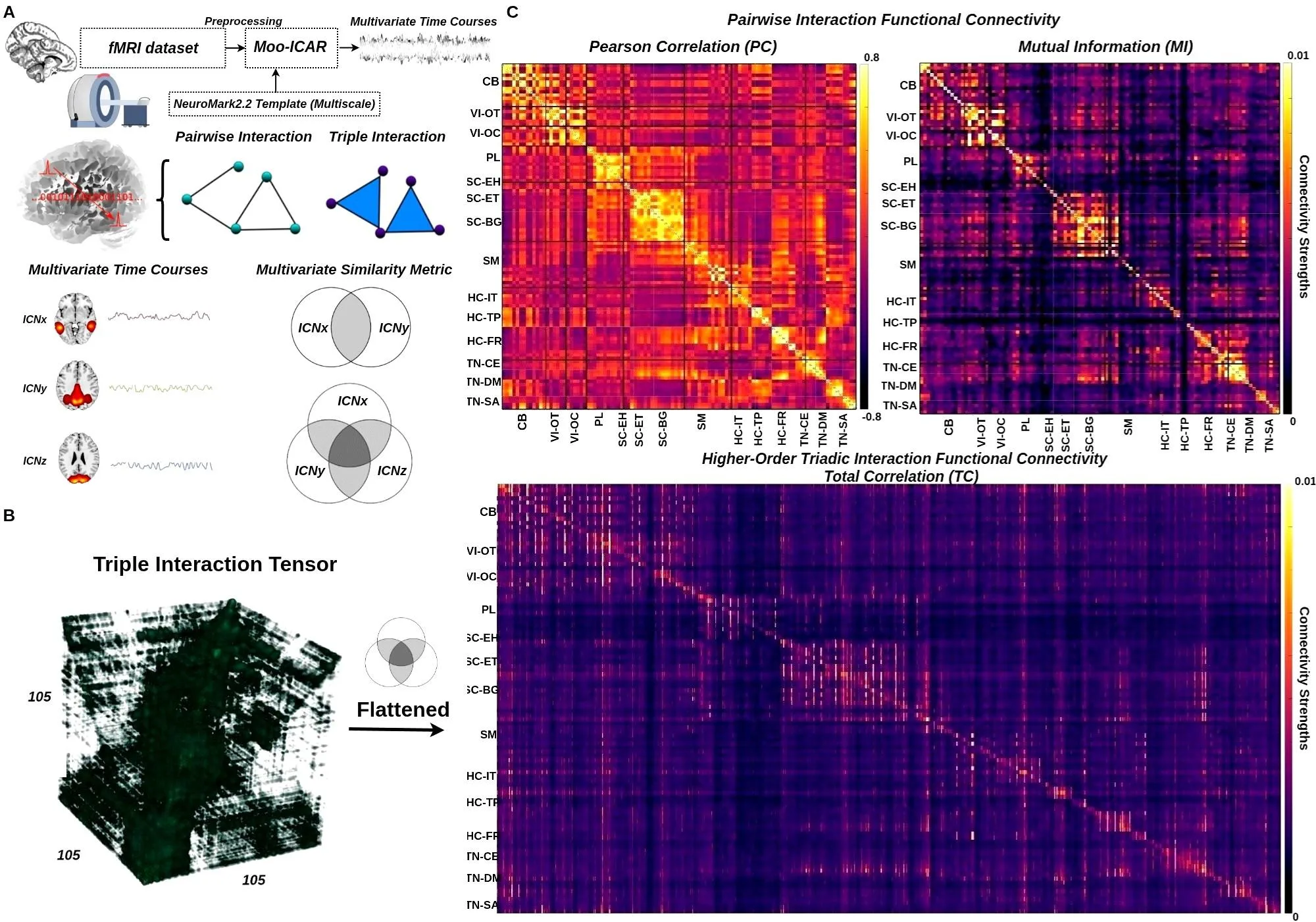
Previously, scientists measured brain connections only in pairs: they took the signal from one region, the signal from another, and looked at how well they agreed. But this missed situations where three regions coordinate together. The new method assesses exactly these triple interactions. The researchers used fMRI data from 600 people at rest and 66 people watching a movie. For each triple among 105 brain regions, they computed a measure of joint dependence that indicates how strongly these regions are linked.
It turned out that triple connections carry more information than pairwise ones, and that during task performance the brain uses more complex collective interactions. This is like jazz: when musicians play together, the music is richer than the sum of individual duets. The new method allows us to see this collective play and understand what happens when the ensemble falls apart in disease.
The number of unique triples from 105 networks (187,460) is roughly equal to the number of words in the novel "War and Peace" (about 188,000). If we tried to enumerate all triples for 1,000 regions, the number would exceed the number of atoms in the observable universe.
The idea that the brain processes information not pairwise but as whole ensembles echoes the concept of collective intelligence in Stanisław Lem's "Solaris," where the ocean exhibits intelligent behavior only as a whole, not through individual elements.