Functional analysis is a branch of mathematics where functions are viewed as points in infinite-dimensional spaces (e.g., Hilbert and Banach spaces). In these spaces, analogs of distance (norm) and angle (inner product) are defined, and linear operators (mappings that transform one function into another) play the role of matrices from linear algebra. The central idea is the study of the properties of operators and their spectra (generalization of eigenvalues).
History
The roots of functional analysis lie in the works of Volterra, Fredholm, and Hilbert on integral equations in the late 19th century. A decisive contribution was made by Stefan Banach, who in the 1920s systematized the theory of normed spaces (Banach spaces) and proved fundamental theorems. John von Neumann in the 1930s introduced the concept of Hilbert space for a rigorous formulation of quantum mechanics. Development continued in the works of Gelfand, Naimark, Pontryagin, and others.
How it works
Functional analysis investigates the structure of infinite-dimensional spaces by introducing topologies (notion of closeness) and algebraic operations. Just as in the finite-dimensional case linear operators are represented by matrices, in functional analysis operators on functions can be integral, differential, or more general. The spectral theorem (for self-adjoint operators in Hilbert space) asserts that an operator can be diagonalized in a suitable basis, meaning decomposition into eigenfunctions. The Schrödinger equation from quantum mechanics is naturally viewed as an eigenvalue problem for the Hamiltonian operator in the Hilbert space of states.
In practice
Quantum mechanics: particle states are described by vectors in functional spaces. Image compression: reconstructing a picture from a few measurements.
Fun fact
Quantum mechanics was mathematically formulated in the language of functional analysis: a particle's state is a vector in Hilbert space, and physical quantities are operators.
A jazz trio plays in the dim light of a club. The pianist leads the melody, the bassist holds the rhythm, and the drummer sprinkles out rolls. If you listen only to pairs of musicians, you can catch how the pianist adjusts to the bass or the bass to the drums.
Epithelium lines our organs like tiles on a floor. At rest, cells cling to each other, and the tissue is elastic. But during embryonic development, wound healing, or tumor growth, this layer begins to flow like thick honey. What exactly triggers such softening?
2 is the threshold beyond which a well-behaved sequence risks losing its structure.
Instead of the usual uniform scale, picture a rubber ruler with uneven elasticity. That's exactly how Orlicz spaces work: Banach spaces of sequences where each scale has its own stiffness, described by a convex Young function (a kind of spring).
Why do some systems, from gene networks to air travel, preserve imprints of the past longer than others? For a long time, network science blamed topology: the number of connections, modularity, spectrum. But two networks with the same skeleton can remember and forget in completely different ways.
In the 1990s, philosopher John Searle devised a thought experiment: a person sits in a room and, without knowing Chinese, follows instructions to produce correct answers in Chinese. From the outside, it seems they understand the language, but inside, it's just mechanical rule-following.
A handful of sand falls onto a table: each grain rolls down until it rests in a hollow. That's how a potential works: the table's surface tells the grains where to go. But in a river with whirlpools, there's no single basin everything flows into. Water swirls, returns, and meanders. For such systems, the usual map of 'pits and hills' doesn't apply.
For a long time, we only saw proteins in their final form — like photographs of dancers frozen in a beautiful pose. Programs like AlphaFold learned to predict that pose from a chain of carbon links. But the real magic is how a protein finds this shape faster than you can blink, performing a swift dance.
In a grand courtroom, a meeting is in session. Hundreds of translator-neurons simultaneously hear fragments of phrases, and must piece them into a single coherent picture. This is exactly how large brain networks turn scattered signals from the eyes into a unified object image.
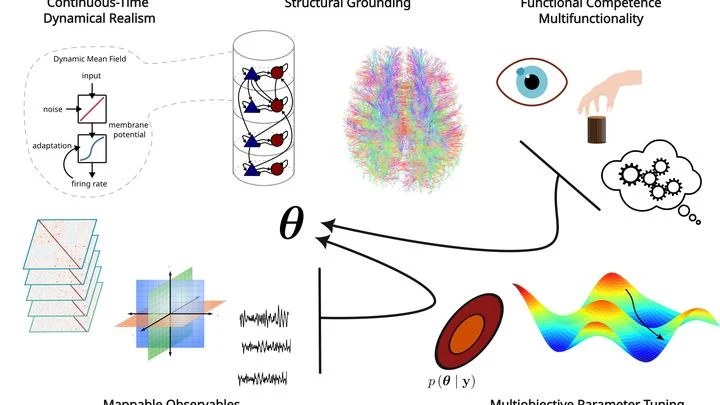
Engineers are building a car. Some assemble an exact replica of the engine, every piston and spark plug, but the car doesn't move: there's no steering wheel or wheels. Others build a fast self-driving go-kart, but its engine is made of playdough and doesn't resemble a real one. This is roughly the situation in brain science.
You can feel an unfamiliar object along its length, across its width, or diagonally: each time gaining new information. But what if one way of feeling tells you absolutely nothing about what another would reveal? That's exactly how mutually unbiased bases work in quantum mechanics: measuring in one of them leaves you completely in the dark about the outcome in another.
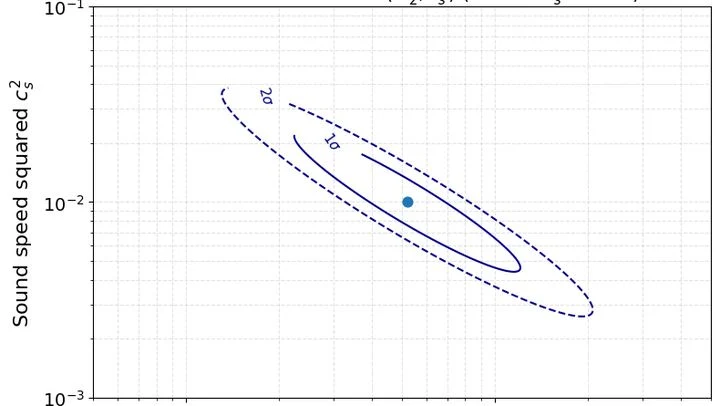
Astronomers, like chefs, have long been preparing a description of the Universe using the same cumbersome recipes. These recipes — complex mathematical formulas — estimated how many galaxies of different luminosity and mass fill the cosmos, as well as how the invisible frameworks of dark matter are distributed. But the dishes lacked accuracy.
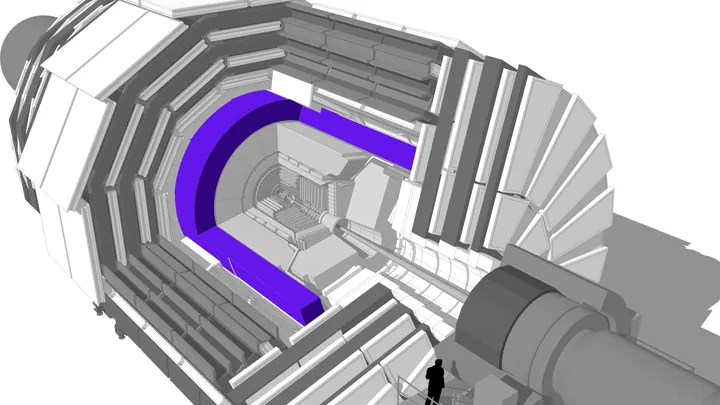
A physicist analyzing particle collisions typically spends weeks on dull work: cleaning noise from data, estimating how many false signals will slip through, double-checking every number. Now that routine can be handed to a program.
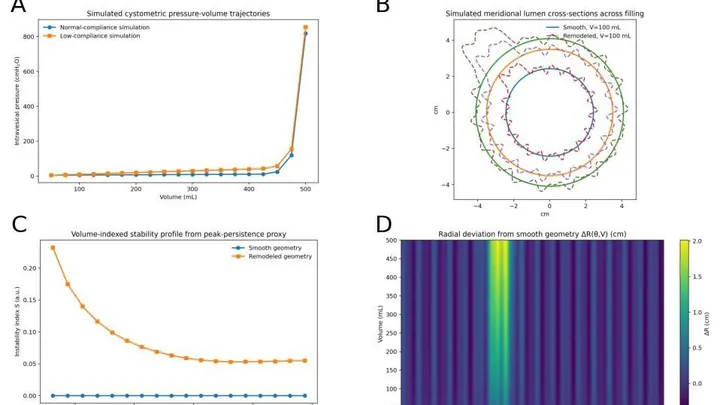
The bladder is like a balloon: as it fills, the wall stretches and the shape changes. Doctors usually monitor the pressure inside and how much fluid has entered, but they rarely look at the geometry itself — how the surface curves. Yet irregularities can appear before the usual metrics deteriorate.
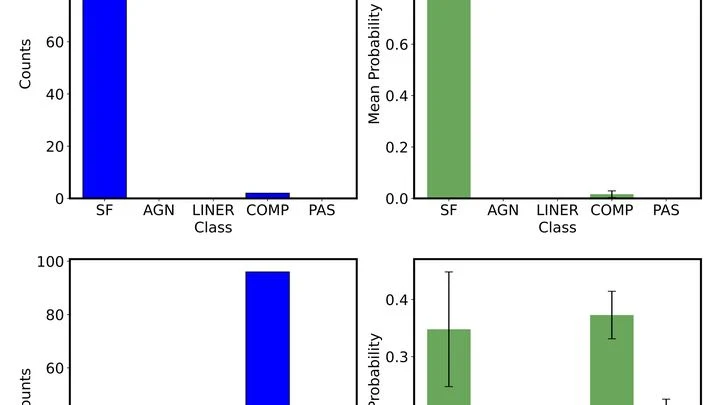
A galaxy is not just a sprinkle of stars. At the center of many, something shines brighter than billions of suns: hot gas falling into a black hole. The color of this glow reveals what kind of life the galaxy leads — quietly birthing stars or violently consuming matter.
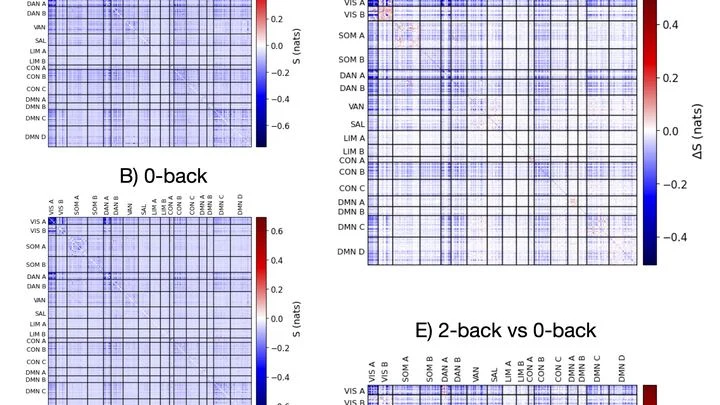
Imagine an office where employees exchange notes. When there are few tasks, everyone works independently. But when an urgent order arrives, some departments start actively messaging others, and the overall work becomes more coordinated. That's roughly how the brain behaves when we try to hold several things in mind at once.
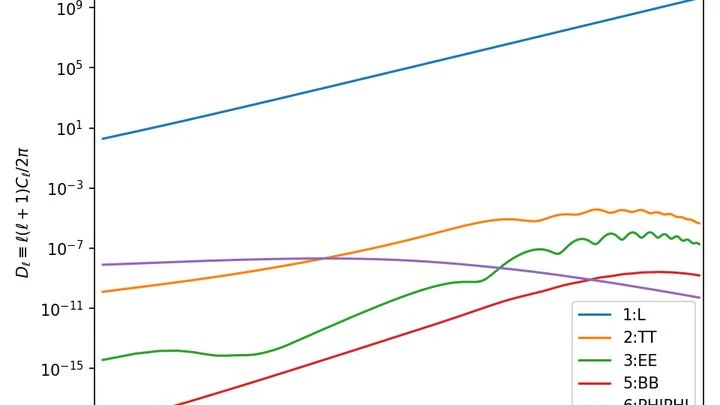
Light passing through a birefringent crystal changes its polarization depending on wavelength. This profile is like a mosaic assembled from rare flashes, where each shard hints at the shape of its neighbors.
Picture a translator at a meeting where everyone speaks an unfamiliar language. They don't know the words, but they notice: when one person raises their voice, another starts nodding a minute later. At first it seems like coincidence, but over time the translator learns to understand who influences whom.
A steel plate with an 8×8 grid of cells dampens elastic waves in two frequency corridors at once. This is not a lucky accident but the outcome of a calculation using a new scheme: first a coarse template for the low frequency, then fine-tuning within free pixels for the high frequency.
A seismograph records underground tremors: the smooth line suddenly jerks and changes its character. Similarly, functional data, such as ocean temperature maps or brain signals, may shift their shape at some point. The new algorithm FSBS catches such breakpoints, even when each curve is measured at only one point and noise drowns the signal.