Triple Connections: How the Brain Links Regions in Threes ✛
Context
The brain consists of billions of neurons organized into networks that constantly reconfigure. Until now, researchers have mostly measured functional connectivity as the correlation between pairs of regions. This approach misses situations where three or more areas interact jointly, for example, when one region coordinates the activity of two others. There is already work on dynamic connectivity, multiscale networks, and thought transmission, but all of it largely stays within pairwise measures. This work stands apart: it introduces triple interactions as an independent object of analysis, building on information theory and matrix-based entropy estimates.
Methods
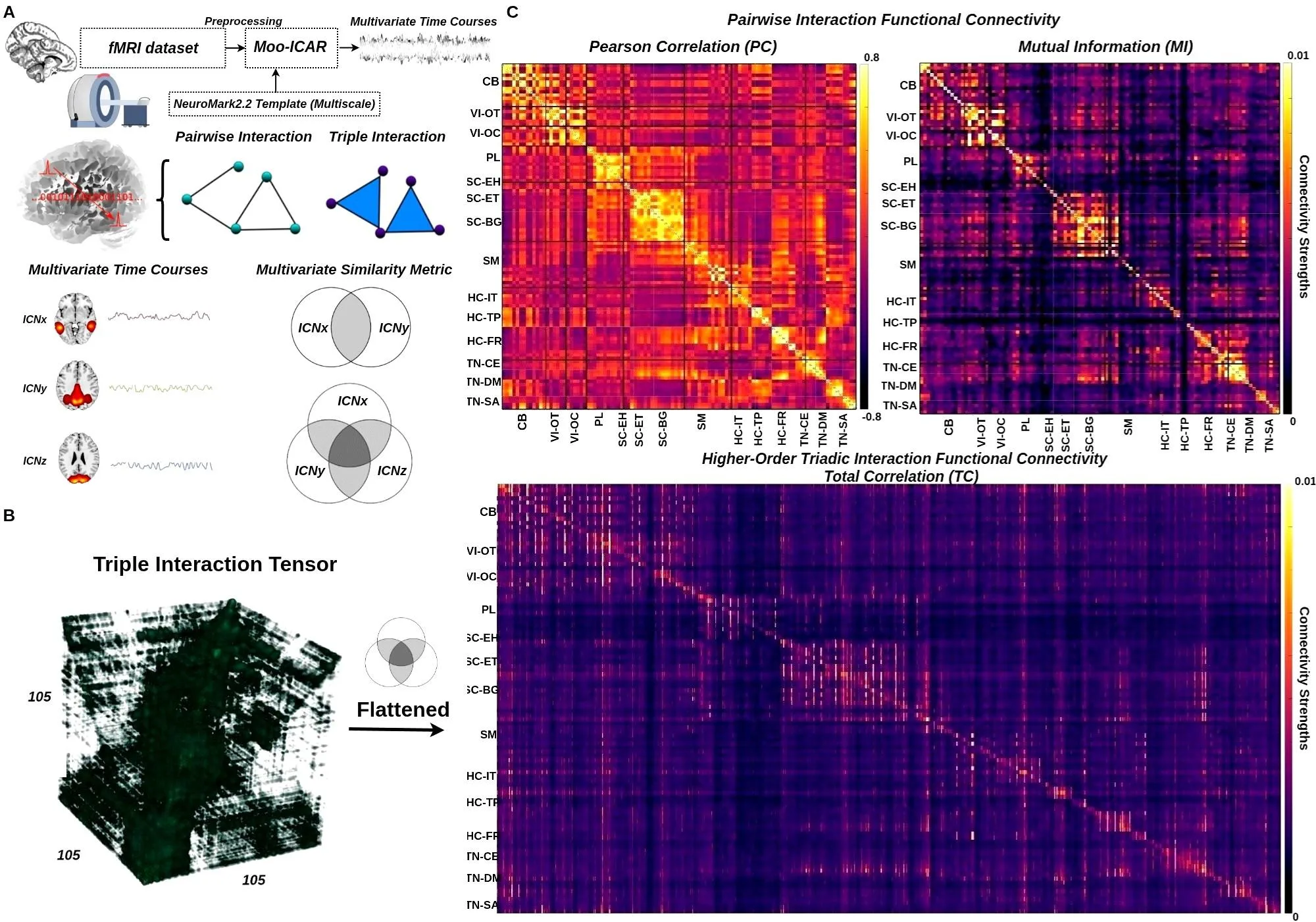
To estimate triple interactions, the authors used a generalization of mutual information called total correlation (TC). They computed it via matrix-based Rényi entropy with parameter α = 1.01, which approximates Shannon entropy while ensuring numerical stability. Signals from 105 intrinsic connectivity networks (ICNs) were extracted from fMRI data of 600 healthy subjects using spatially constrained independent component analysis (scICA) with the NeuroMark fMRI 2.2 template. Then, for all triples of ICNs, they computed TC, yielding a tensor of size 105 × 105 × 105, which was transformed into a matrix for comparison with pairwise measures. Additionally, they analyzed data from 66 participants (33 children and 33 adults) while they watched the short film "Partly Cloudy."
Results
For interaction order 2, total correlation and double total correlation (DTC) give the same values, as both reduce to mutual information. As the order increases from 3 to 10 in the resting state, the amount of captured information increases monotonically, indicating contributions from distributed multi-regional interactions. In the task, the increase is stronger, especially at orders 9 and 10, meaning that performing the task engages more coordinated high-order interactions. The difference between rest and task becomes more pronounced at high orders, whereas low orders provide limited differentiation. In total, for 105 networks there are 187,460 unique triples, which is 34.3 times more than the 5,460 unique pairs, yet the triple networks show an organized cluster structure reflecting biologically meaningful interactions.
Implications
This work differs from neighboring studies in that it is the first to apply matrix-based estimation of total correlation to triples of brain networks at the whole-brain scale and across two states (rest and task). Neighboring studies have examined pairwise connectivity, dynamics, or thought transmission, but did not single out triple dependencies as an independent information layer. Here, the authors show that triple connections carry additional information not reducible to pairwise ones, and that they manifest differently in rest and task. This opens the way to more realistic models of the connectome that account for collective effects.
Future development
The method can be extended to higher orders of interaction, but the computational complexity grows combinatorially, so sparse estimation, tensor decompositions, or motif analysis will be needed. It is also promising to introduce O-information and S-information to separate redundant and synergistic contributions to triple dependencies. A dynamic version of triple connectivity would allow tracking how collective interactions change over time under cognitive load or in pathology.
Impact
The method could be useful in cognitive neuroscience for studying how multiple regions work together, as well as in psychiatry for finding biomarkers of network organization disruptions. Beyond neuroscience, the approach applies to any multivariate signals where interactions of more than two variables matter.
Next steps
Immediate next steps include comparing triple connectivity in patients with schizophrenia and bipolar disorder against a control group, and developing computationally efficient algorithms for large networks. It is also worth testing how triple interactions depend on age, using data from children and adults.
Key open problems
An open question in neuroscience is how the brain integrates information from many sources without overloading computational resources. Triple connectivity directly addresses this problem by showing that collective dependencies can be estimated and that they have structure, despite the combinatorial explosion of possible triples.
The knowledge machine's view
This section is addressed to the author of the paper and their colleagues. Neighbouring works were found by meaning-based search across our archive, not by word overlap. We do not review: we show the field around the work.
What the work does
The authors introduce a method for assessing triple interactions between brain regions based on full correlation, computed via Rényi matrix entropy. They apply it to resting-state fMRI data from 600 healthy individuals and 66 participants watching a cartoon, showing that triple connections carry additional information and better distinguish states than pairwise ones.
Where its strength is
The work highlights triple dependencies as an independent layer of information that cannot be reduced to pairwise connections, and demonstrates their hierarchical structure across the whole brain. This paves the way for a more complete description of the connectome that accounts for multi-regional interactions.
Where it could go next
- It might be interesting to see how triple interactions change over time by combining the proposed approach with ideas of dynamic connectivity from the brain-orchestra work.based on: The Brain as an Orchestra That Also Plays Jazz arXiv:2605.18118
- A related avenue is to use a quantum language to describe neural networks: perhaps triple correlations could be interpreted as a measure of 'mental entanglement' and compared with the formalism proposed there.based on: Mental Entanglement: The Quantum Language of Neural Networks arXiv:2509.16253
- One could consider how triple networks relate to individual differences, for instance, the influence of genes and environment on the architecture of connections, as in the work on the braided networks of the brain.based on: How Genes and Environment Weave Brain Networks arXiv:2604.24614
Worth trying
- Test whether the additional information from triple connections persists across different Rényi entropy parameters (e.g., α=2 or α=0.5).
- Compare triple networks built from different parcellation templates to assess the robustness of the cluster structure.
- Apply the method to data with faster temporal resolution (EEG/MEG) to observe the dynamics of triple interactions in real time.
Why this may matter
Incorporating triple interactions could bring connectome models closer to the actual workings of the brain, where coordination among multiple regions is the rule rather than the exception. This has the potential to improve biomarkers for states and disorders based on functional connectivity.
Nearby works in our archive
- How the Brain Shares Experience Between Taskssimilarity 0.58
- How the Brain Passes Thoughtssimilarity 0.56
- The Brain as an Orchestra That Also Plays Jazzsimilarity 0.53
- The Brain's Conductor: How the Parietal Region Switches Modessimilarity 0.52
- Brain on a Wave: How Phase and Amplitude Reveal Diseasesimilarity 0.52
- How the Brain Rewires Itself in Alzheimer's Diseasesimilarity 0.50
- Mental Entanglement: The Quantum Language of Neural Networkssimilarity 0.50
- How Genes and Environment Weave Brain Networkssimilarity 0.49
The archive is sparse around this work: the closest review is only 0.58, against a usual 0.64. It looks like few have drilled nearby.
The number of unique triples from 105 networks (187,460) is roughly equal to the number of words in the novel "War and Peace" (about 188,000). If we tried to enumerate all triples for 1,000 regions, the number would exceed the number of atoms in the observable universe.
The idea that the brain processes information not pairwise but as whole ensembles echoes the concept of collective intelligence in Stanisław Lem's "Solaris," where the ocean exhibits intelligent behavior only as a whole, not through individual elements.
Key numbers
- number of subjects at rest: 600
- number of subjects in task: 66
- number of intrinsic connectivity networks (ICN): 105
- number of unique triples: 187 460
- parameter α in Rényi entropy: 1.01