Triple Connections: How the Brain Links Regions in Threes ✛
A jazz trio plays in the dim light of a club. The pianist leads the melody, the bassist holds the rhythm, and the drummer sprinkles out rolls. If you listen only to pairs of musicians, you can catch how the pianist adjusts to the bass or the bass to the drums. But the magic happens when all three improvise at once: a phrase from the pianist changes the drummer's playing, which in turn nudges the bassist toward a new move. The brain during active moments is like such a trio: several regions can act together, and this collective play cannot be reduced to the sum of individual duets.
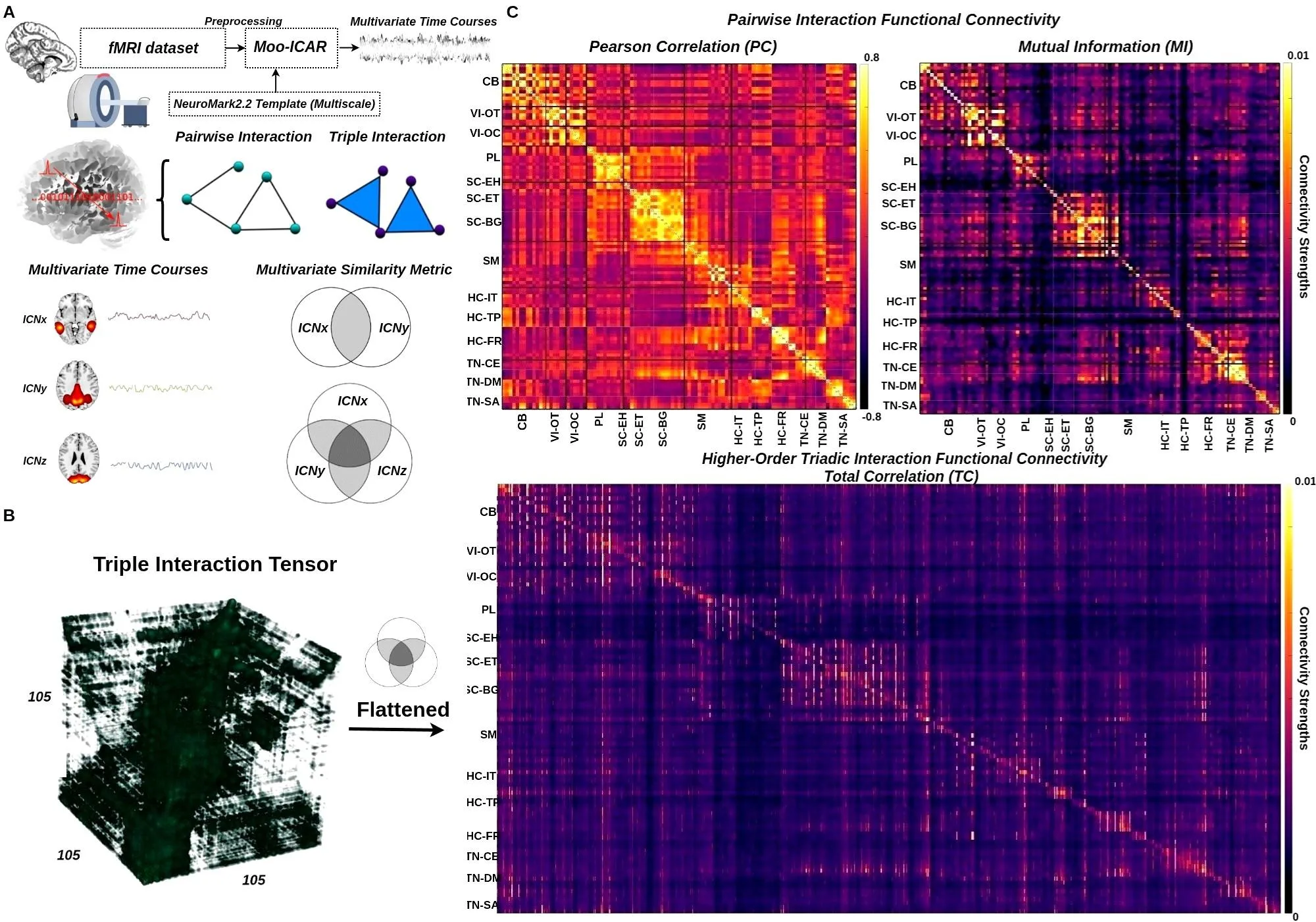
Until recently, neuroscientists measured brain connectivity almost exclusively in pairs. They took the signal from one region, the signal from another, and looked at how well they matched over time. This approach missed situations where three or more regions coordinate together: for example, one region might control the activity of two others, which in turn influence it. The authors of the new study proposed a method that specifically assesses triple interactions, grounded in information theory. They focused on 105 intrinsic resting-state networks, which are groups of regions that activate coherently when a person is not engaged in any task. For each triple of networks, they computed a measure of overall dependence called total correlation.
The results were surprising. At rest, triple connections carried noticeably more information than pairwise ones, and as the number of interacting regions grew from three to ten, the amount of captured information increased monotonically. When participants watched a cartoon, the difference between rest and task became especially pronounced at higher orders of interaction. In other words, performing a task engages more coordinated collective processes that pairwise analysis simply cannot see. For 105 networks, there are 187,460 unique triples, which is 34 times more than the number of pairs, yet instead of chaos, these triples form organized clusters that reflect biologically meaningful connections.
The method used in this work relies on a matrix-based estimation of Rényi entropy, a mathematical technique that computes complex dependence measures without cumbersome probability density estimation. This allowed the researchers to process data from 600 healthy subjects at rest and 66 participants (children and adults) while they watched the short animated film Partly Cloudy. It turned out that triple connections are not reducible to pairwise ones: they carry additional information and manifest differently at rest and during a task. This paves the way for more realistic models of the connectome that account for collective effects, not just isolated duets.
Returning to the jazz trio: pairwise interactions are like a rehearsal where each musician individually adjusts to another. But real music emerges when all three hear each other simultaneously. The brain is the same: its true workings are visible not in isolated pairs of regions but in their collective improvisation. The new method lets us hear this music, and perhaps understand what goes wrong when the ensemble falls out of tune in disease.
The number of unique triples from 105 networks (187,460) is roughly equal to the number of words in the novel "War and Peace" (about 188,000). If we tried to enumerate all triples for 1,000 regions, the number would exceed the number of atoms in the observable universe.
The idea that the brain processes information not pairwise but as whole ensembles echoes the concept of collective intelligence in Stanisław Lem's "Solaris," where the ocean exhibits intelligent behavior only as a whole, not through individual elements.