A Wing That Remembers Its Acceleration ✛
An airplane wing, like a skier on a ski jump, remembers its acceleration. Change the angle of attack sharply, and the lift does not immediately reach its new value. It builds up gradually, as if the wing is not yet sure the maneuver is for real.
This effect was discovered by engineer Herbert Wagner in 1925. He described the growth of lift after an instantaneous change in angle of attack, but his formula remained without an explicit expression. For nearly a century, Wagner's function existed only in tables. Now the authors have derived a formula that links the vortex wake to the quasi-steady circulation of the wing.
The key move was to approximate the kernel of Wagner's integral equation with a function that can be inverted analytically. The error of this approximation is about one percent. This allowed them to obtain a convolution expression for the intensity of the vortex sheet. It turned out that the renormalized vortex lift is self-similar: curves for different circulation growth times collapse onto a single universal curve.
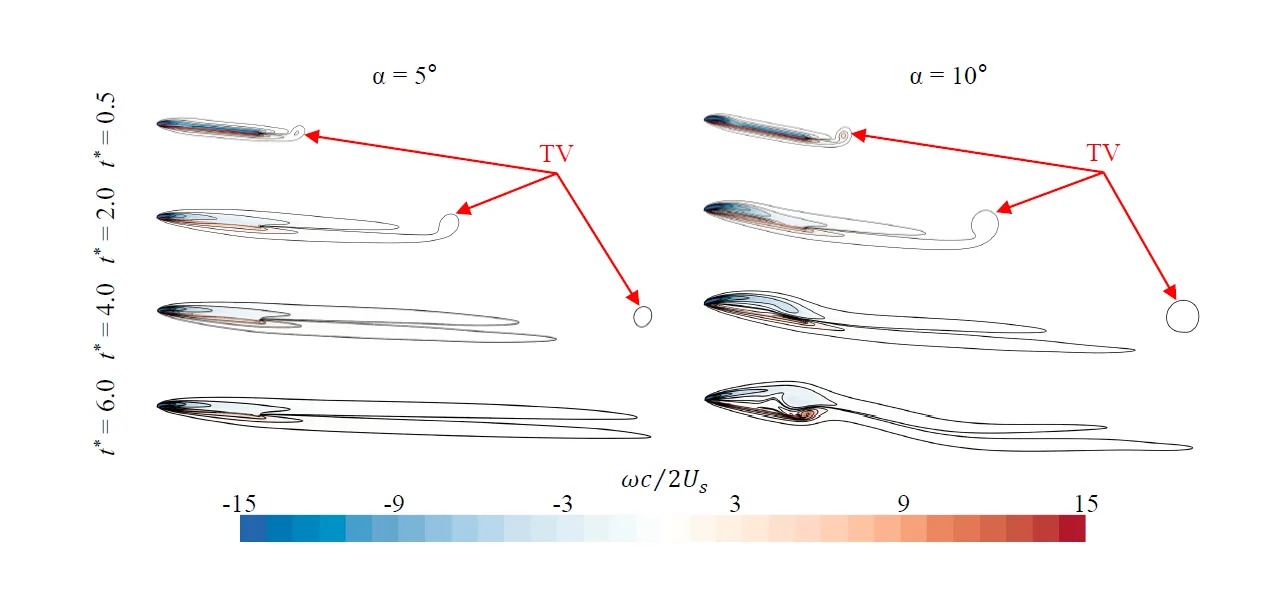
Numerical simulations of flow past a starting plate at angles of attack of 5° and 10° and Reynolds numbers from 126 to 1000 confirmed the self-similarity. Even with moderate flow separation, the data fell onto a single curve. The time to reach the local minimum of lift follows a power law with an exponent of −1/5. The acceleration component of the force is also self-similar, but with different scales, so the total force is not self-similar.
A wing that remembers its acceleration can now be described by a simple formula. This matters for engineers designing flapping wings, helicopter rotors, and wind turbines. Viscous effects are no longer an obstacle to predicting lift in transient regimes.
The Wagner function, which describes the lift buildup after a sudden change in angle of attack, was first published in 1925 as tables because no explicit formula existed for nearly a century.
In Stanisław Lem's novel The Invincible, mechanical 'flies' are described that fly by rapid wing beats in a dense atmosphere. Understanding unsteady aerodynamics of viscous flows, as achieved in this work, brings us closer to describing such hypothetical flying machines.