The Ornstein–Uhlenbeck process is a mathematical model for a quantity that tends to drift back toward a central value, but is constantly jostled by random fluctuations. Imagine a ball rolling in a shallow bowl: gravity pulls it toward the bottom, but if you keep tapping it randomly, it never settles exactly—it wanders around the center. This process is the continuous-time version of that idea. It is the simplest stationary Gaussian process, meaning its statistical properties do not change over time, and it is often used as a building block for more complex random models.
History
The process is named after Leonard Ornstein and George Uhlenbeck, who introduced it in 1930 to describe the velocity of a particle undergoing Brownian motion, accounting for friction and random collisions.
How it works
Mathematically, it is defined by a stochastic differential equation: the change in the variable over a tiny time step equals a term that pulls it back to the mean (proportional to how far it is from the mean) plus a random noise term. The pull is linear, so the process is Gaussian (its values follow a bell-shaped distribution). The strength of the pull and the intensity of the noise determine how quickly it reverts and how much it fluctuates. Over long times, the process reaches a stationary distribution, meaning its average and variance become constant.
In practice
It is widely used in finance to model interest rates and commodity prices, in physics for describing noisy relaxation, and in neuroscience for modeling membrane potentials of neurons.
Fun fact
The Ornstein–Uhlenbeck process is the only stationary Gaussian Markov process in continuoustime, making it a unique and fundamental object in probability theory.
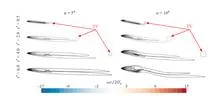
An airplane wing, like a skier on a ski jump, remembers its acceleration. Change the angle of attack sharply, and the lift does not immediately reach its new value. It builds up gradually, as if the wing is not yet sure the maneuver is for real.
This effect was discovered by engineer Herbert Wagner in 1925.
It is commonly believed that a black hole is a merciless cosmic vacuum cleaner, sucking in everything indiscriminately. But new research flips the picture: right at the horizon, curvature transforms from a trap into a trampoline.
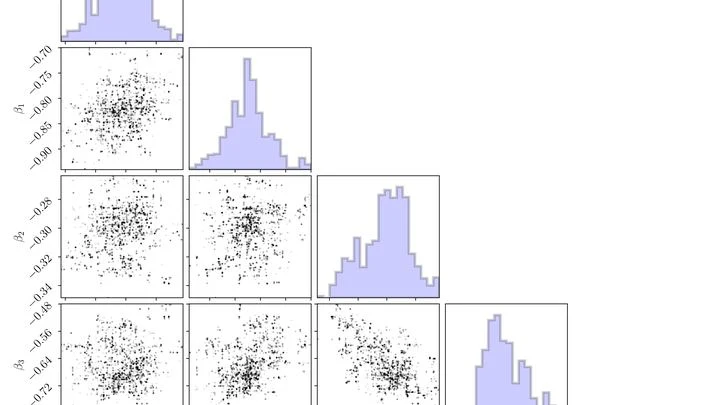
Many natural processes are described by differential equations, but scientists often have only fragmentary data — a sort of torn map. The new computational method works like a cartographer who reconstructs a complete map of the terrain from a few landmarks.
A stable system behaves like a ball in a bowl: give it a push, and it rolls back to the bottom. The spread of possible trajectories, uncertainty, shrinks over time. But the speed depends on the slope of the bowl's walls. In complex systems, this 'bowl' has sections of varying steepness.
A candle flame in a draft dances: now it flares up, now it almost goes out. Quasars behave much the same way — supermassive black holes in the centers of distant galaxies, surrounded by a scorching disk of infalling matter. Only they flicker not over seconds, but over months and years.
A guitar string decides for itself how tightly to stretch when a musician plays a chord in different octaves. That's roughly the picture physicists paint when they try to unite gravity, the weakest but most pervasive force, with the quirky laws of the microcosm.
A boiling pot, a gust of wind, a wisp of smoke from a campfire — all obey equations that mathematicians call 'nonlinear and dissipative.' In plain terms, energy is lost to friction, and parts of the flow influence each other so strongly that predicting the motion ahead of time is a task on the edge of feasibility.
Light trapped in a tiny cavity is like a pendulum that gets pushed harder and harder. At first, it swings smoothly and predictably, like an ordinary clock. But if you push it hard enough, the motion becomes strange: the pendulum seems to be in two extreme positions at once.