In quantum gravity, time disappears as a fundamental quantity. The Wheeler–DeWitt equation is a direct result of applying the laws of quantum mechanics to Einstein's theory of gravitation. John Wheeler and Bryce DeWitt formalized quantum theory in the so-called canonical approach in 1967. It turned out that the wave function of the universe (the amplitude of all possible geometries) is independent of time — it is a static eigenvalue equation where the Hamiltonian operator yields zero. That is, at the deepest level, there is no evolution: all moments of time 'are present' simultaneously. Analogy: a vast library where, instead of books, three-dimensional slices of space are kept, and the equation is the rule binding them into a single four-dimensional framework.
History
In 1967, John Archibald Wheeler and Bryce DeWitt published a paper deriving the equation for the quantum wave function of the universe. They relied on earlier work by Paul Dirac on quantizing constrained systems and on the ADM formalism of 1962. Wheeler actively developed the concept of 'quantum foam' and space-time at Planck scales, while DeWitt gave the idea a rigorous mathematical form. The equation became the starting point for quantum cosmology and the work of Hartle–Hawking, Vilenkin, and others.
How it works
Used to describe the quantum state of the universe as a whole, especially in the regime of strong gravitational fields where classical general relativity is inapplicable (near singularities). Allows the calculation of the wave function of the universe and the prediction of probabilities for various initial conditions for cosmological inflation. Limits of applicability: Planck scale of lengths and energies; the problem of interpreting time and choosing an internal time variable remains unsolved; the equation is difficult to solve for the general case.
In practice
Helps to find a quantum description of the Big Bang and to understand how three-dimensional space emerges from quantum foam.
Fun fact
Because time is absent from the equation, some physicists jokingly call it 'the equation where nothing happens.'
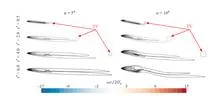
An airplane wing, like a skier on a ski jump, remembers its acceleration. Change the angle of attack sharply, and the lift does not immediately reach its new value. It builds up gradually, as if the wing is not yet sure the maneuver is for real.
This effect was discovered by engineer Herbert Wagner in 1925.
Dancers on a stage with moving walls: particles in a finite quantum system collide with each other and reflect off the edges, but the walls can move according to a prescribed scenario. Physicists have long been able to describe such dances only with fixed walls or in an infinite hall. Now there is a way to account for both the motion of the walls and the reflections from them.
A quantum detector is like a sensitive pendulum suspended in empty space. If a sharp gravitational wave passes by, you might expect the pendulum to swing. But the calculation shows otherwise: the wave doesn't swing it: it damps any existing oscillations.
When a fluid flows around an obstacle, it spawns vortices and shock waves. Describing their behavior means solving a nonlinear equation in which the flow velocity depends on itself. Classical supercomputers spend days on this, while quantum computers have barely been used: their native language is linear operations, but fluids are inherently nonlinear.
In the first instants after the Big Bang, the universe expanded faster than light could cross it. Like an inflating balloon, but instead of rubber, it was space itself. On this balloon, ripples inevitably formed — tiny compressions and rarefactions from which all galaxies and stars later grew.
Space is expanding, and that expansion is accelerating. But what if, in the first instants after the Big Bang, gravity behaved differently? The authors of a new study added an invisible field to Einstein's equations that siphons energy from ordinary matter and radiation.
A quantum particle moves in a circle, passing through several stations. At each station, something happens to it — for example, its properties change slightly. After completing a full circle, the particle returns, but its state is no longer exactly what it was at the start.
Quantum field theory is the language physicists use to describe elementary particles and their interactions. The authors of the work decided to slightly "tweak" this language: they introduced deformations, that is, small changes to the rules of the game.
Newton gave us a world where bodies move in a void and clocks tick the same for everyone. For three centuries, this picture worked flawlessly. But it relies on many invisible props: absolute position, the 'up-down' direction, and a single rhythm of time for the entire universe. We have never measured these directly — only through the relations between objects.
Two massive bodies frozen in a quantum superposition resemble a pair of dancers trying to keep a single rhythm while an orchestra blares around them. Each gravitational wave is a musician throwing them off beat.
The quantum world is like a kitchen where particles suddenly appear out of "nothing." But you need a chef — a classical field acting as an external source. Glauber's theorem, long known in optics, has now been generalized: it shows exactly how the field "cooks up" particles, be they photons or gravitons.
The quantum world is like a kitchen where particles suddenly appear out of "nothing." But you need a chef — a classical field acting as an external source. Glauber's theorem, long known in optics, has now been generalized: it shows exactly how the field "cooks up" particles, be they photons or gravitons.
In the big world, there's a simple rule: energy density can't be negative, and its flow can't outrun light. In a café, that would look like this: a waiter can't deliver orders faster than he can run. Physicists call this restriction the energy dominance condition.
But in the microworld, where quanta rule and spacetime can bend, energy starts acting up.
A rotating black hole is no calm whirlpool. Space around it shudders and rings at the slightest disturbance, like a guitar string after a pluck. These oscillations are described by the Teukolsky equation — a complex mathematical construct that physicists have studied for half a century.
Recently, a strange symmetry was noticed in this equation.
In 2017, detectors picked up a gravitational wave from the collision of two neutron stars. Just 1.7 seconds later, telescopes saw a flash of gamma-ray burst from the same spot. That tiny delay became a treasure for physicists.
The quantum vacuum is not empty: it is permeated by entanglement linking distant regions. But when physicists tried to compute this entanglement, it turned out to be infinite. The culprit: particles with very low energy that can smear out over arbitrarily large volumes. They are like waves with no shores to contain them.
A pendulum in a noisy room is constantly jostled by people passing by. Its motion is a mix of regular swings and random jerks. Something similar happens with weak gravitational waves against the backdrop of an expanding universe. In Einstein's general relativity, these waves are tiny ripples in spacetime.
A fraction of a second after the big bang, the universe was a searing hot soup of particles and antiparticles. By all rights, they should have annihilated each other completely, leaving only emptiness. But for some unknown reason, one "extra" matter particle survived for every billion pairs. It was from these surviving scraps that galaxies, stars, and people eventually formed.
Clocks in the Universe are tricky things. Usually, in calculations of the birth of the world, a special scalar field plays the role of a clock — something like an invisible fluid filling all of space. It ticks, and physicists watch how the world changes relative to that ticking. But these clocks are man-made, introduced for convenience.
The authors of the new work took a different path.
In the quiet of the quantum world, there is no emptiness. Particles are intertwined by invisible threads — entanglement. The authors of the work proposed that the very fabric of spacetime is woven from these threads. This is not just a metaphor: they built a mathematical framework where the distance between points is determined by how much shared information they hold.
An optical trap holds an atom almost motionless, like a ball on a soft spring. But as soon as acceleration appears, say gravity, the equilibrium shifts. The atom moves within the standing light wave, and this changes the rate at which it exchanges energy with the field. The frequency of this exchange becomes a direct indicator of acceleration.
At the dawn of time, the universe experienced a brief moment of frantic expansion — inflation. Tiny quantum jitters of spacetime stretched to cosmic scales. These jitters, primordial fluctuations, became the seeds from which galaxies and stars later grew.
A quantum particle can be a wave, and pass through two paths at once. But if something 'peeks' at which path it took, the wave disappears. This effect is called loss of interference. Usually, photons or air molecules do the peeking.
Gravity in our world is curved spacetime. That's how Einstein's general theory of relativity describes it. But what happens to gravity at the level of atoms and particles, where quantum mechanics rules? This question has remained unanswered for nearly a century.
At the center of attention is a black hole of unusual shape. Its geometry resembles a spindle: a slight elongation is added to the usual rotation. The parameter B measures this deformation.
The spindle deformation is not just a mathematical toy.
Two light rays meet at a point and then diverge. Their paths form two intersecting surfaces in spacetime — null hypersurfaces (boundaries along which light propagates). It is on such a pair of surfaces that physicists can set initial data for Einstein's equations. This is called the characteristic Cauchy problem.
Every river has an estuary — the place where its waters meet the sea. Spacetime, too, has its own 'shore': it is called future infinity, and it lies where all signals, light, and gravitational waves ultimately go.
In the first moments after the big bang, the universe was filled with quantum jitters — tiny fluctuations that could later turn into gravitational waves, ripples in space itself. But when physicists try to calculate this process, infinitely large numbers pop up in the equations.
Ever since Fritz Zwicky noticed that galaxy clusters were moving too fast, and Vera Rubin measured the rotation of spiral arms, dark matter has remained cosmology's greatest mystery.
A quantum wave is like a long-exposure photograph: everything’s blurred, but the blur itself reveals motion. Usually these frozen waves are treated as convenient abstractions. Yet if at each point in the image you estimate, by brightness, the moment on the particle’s internal clock it landed there, flat space suddenly acquires curves.
In the ordinary world without dark energy, the mass of any object is always positive. That seems obvious: positive mass attracts, creating gravity. But the real universe has dark energy — a mysterious force making the cosmos expand faster and faster.
A runner on the middle of a track suddenly switches to a walk — not speeding up or slowing down, but maintaining a constant pace. Something similar may have happened to the universe itself shortly after the Big Bang.
In the ocean, a whirlpool pulls everything into a closed loop, just as a gravitational wave in empty space twists time into a loop. Gravitational wave — a ripple in the fabric of spacetime, and its special shape can turn the usual flow of events into a closed cycle. In such a zone, an object can return to its own past without violating the laws of physics.
The explosion of a distant supernova told us something hard to believe: the universe is expanding faster and faster. The engine of this acceleration is dark energy — nearly 70% of everything that exists.
According to Einstein's general theory of relativity Albert Einstein, a massive rotating body drags the fabric of spacetime along with it, much like a spoon twirled in a jar sets thick honey flowing.
An object cannot be a point. At least, not in Einstein's gravity. The equations of general relativity require that the source of the field, matter, be smeared out in space, not concentrated in an infinitesimal volume. Otherwise, infinities appear in the formulas, and a smooth spacetime cannot be constructed.
Building a house on sand is a bad idea. In physics, it was long believed that a quantum theory of gravity could not be built on a fixed "sand"—a pre-existing spacetime.
At the centers of many galaxies lurk giant rotating black holes. Astrophysicists have long suspected that these objects are remarkably resilient: after swallowing a star or merging with another hole, they quickly settle down and forget the catastrophe.
A regular object moves along a predictable path, like a ball. In the quantum world, a particle is smeared into a probability cloud. To find order in this fog, scientists have recast Schrödinger's equation in the language of flowing water.
The void is never truly empty. In curved spacetime (for instance, in an expanding universe or near a black hole) the vacuum heats up. This is reminiscent of how acceleration makes particles appear seemingly out of nowhere: a phenomenon known as thermal vacuum radiation.