In mathematics, this is the divergence theorem, independently formulated by Carl Friedrich Gauss (for gravity), Mikhail Ostrogradsky (in a more general form), and George Green. In physics, it became the basis of Gauss's law for electricity (one of Maxwell's equations) and for gravity. The idea: the total 'outflow' of a field inside a volume equals the flux through its boundary. For electricity: ∮ E·dA = Q/ε₀ — a charge creates a field, and its flux through any closed surface enclosing the charge is the same.
History
Carl Friedrich Gauss used this result in 1813 in the theory of magnetic potentials, and in 1828 Mikhail Ostrogradsky gave the first general proof. George Green also derived related theorems. Gauss introduced the theorem into physics, formulating the law for electric fields in 1835. Later, James Clerk Maxwell included Gauss's law in his system of equations, and in the 20th century, the theorem found application in relativity and quantum field theory.
How it works
Gauss's theorem allows calculating fields of high symmetry (spheres, cylinders, planes) without complex integration. It is used in engineering calculations of electrostatic shields, gravitational lenses, and in fluid dynamics. Limitation: requires differentiability of the field and smoothness of the surface; for regions with discontinuities (e.g., on charged plates), boundary conditions are used.
In practice
Calculation of electric and gravitational fields, design of electrostatic shields and lightning rods.
Fun fact
The theorem works even in the curved space-time of general relativity, where it enters Einstein's equations for gravity.
A vacuum cleaner sucks in dust even if there is more of it near the nozzle. The same happens in a tokamak: plasma particles are drawn toward the center, even though their density is higher at the edge. This phenomenon is called particle pinch, and it contradicts the usual rule that everything tends to move from dense regions to sparse ones.
An airplane wing, like a skier on a ski jump, remembers its acceleration. Change the angle of attack sharply, and the lift does not immediately reach its new value. It builds up gradually, as if the wing is not yet sure the maneuver is for real.
This effect was discovered by engineer Herbert Wagner in 1925.
Imagine an interferometer as a giant ear listening to the radio whisper of a distant galaxy. Three antennas spread across continents capture the signal, and the difference in their phases combines into a quantity that is immune to atmospheric jitter. This quantity is called the closure phase.
A light ray skimming along a black hole horizon doesn't just move: it carries heat and information. Physicists have long suspected that the geometry of such rays obeys strict rules, but the details remained blurry. The new work turns these rules into a sharp inequality.
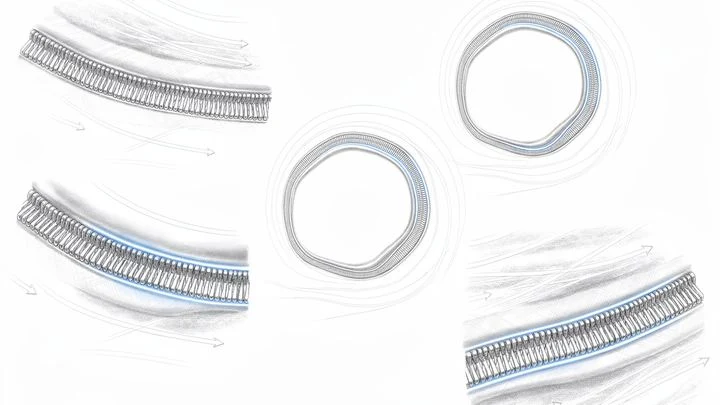
In the brain's white matter, the signal travels along axons — long neuronal processes wrapped in an insulating myelin sheath. Water fills the space inside axons and outside, in the narrow gaps between fibers.
Soil is not a solid sponge but a labyrinth of pores of various sizes. After rain, water does not fill them all at once: first the narrowest ones, then the wider ones. Physicists built a theory of this process based on a simple image — a set of communicating vessels.
An endless ocean where every wave carries information about what happens in the depths. That is roughly how our Universe works under the holographic principle: the physics inside a volume can be described by processes on its boundary.
Ever since Fritz Zwicky noticed that galaxy clusters were moving too fast, and Vera Rubin measured the rotation of spiral arms, dark matter has remained cosmology's greatest mystery.
A superfluid flows without friction, like water that never stops. But when you spin it, it doesn't just rotate: each tiny vortex remembers exactly how it was spun. This 'trace' is not a metaphor but a real geometric imprint, which physicists call the Berry phase (the phase acquired by a wave as it travels along a closed path).
In the conventional Heisenberg picture, spins at low temperatures are supposed to line up in a strict pattern. But there are crystals — like pyrochlore — where geometry has its own way. Each ion sits at a vertex of a tetrahedron, and the main interaction enforces a rule: two spins point inward, two outward.
Membraneless organelles, tiny factories inside the cell, defy conventional rules. Take the nucleolus: here ribosomal RNA is synthesized — long chains woven from carbon sugars, rich in oxygen phosphate groups, and stitched with hydrogen bonds, suspended in the watery environment of the nucleus.
In the microcosm, long-range forces, gravity or electricity, do not switch off even at enormous distances. Therefore, any particle drags behind it a trail of soft (i.e., very low-energy) photons or gravitons. This trail is called the "dress"; without it, calculations fall apart and infinities appear.
The light cone is a blueprint of causality, laser-cut onto the fabric of the universe. In classical physics, it is as sharp as a scalpel: events inside are linked by invisible threads of influence, while outside lies eternal isolation, sealed by the ultimate speed limit.
Physicists have mastered an elegant mathematical trick that lets them translate gravitational equations into the language of electricity. This method — double copy — works like a kind of dictionary: it replaces the complex geometry of curved spacetime, described by high-dimensional tensor fields, with the simpler rules of…
River water often swirls into funnels. But in semiconductors, the foundation of microchips, electrons at low temperatures and high purity also turn into a fluid. If you create a circular cavity, vortices appear, just like in a river backwater.
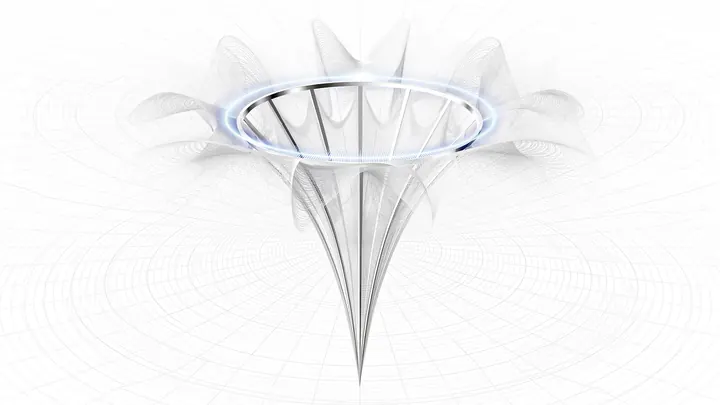
An invisible film, a quantum field, is stretched over a rubber bagel. While the bagel is small, the film stays taut and doesn't sag anywhere: the vacuum remains empty. But once you stretch the bagel to a certain size, a dent spontaneously appears in the film — the field starts to be felt at every point.
This dent is not random.
Imagine a city where streets are not straight but winding, with dead ends and hidden passages. A bike courier will take much longer to deliver a package than in a city with a regular grid of roads. Similarly, molecules inside living tissue: their path depends on how "tangled" the tissue structure is.
Scientists built a model that describes the movement of molecules in such a "tangled" environment.
A heavy spinning top launched near a black hole doesn't follow the curve that textbooks draw. Its own rotation and oblateness, like a pumpkin squashed at the poles, make the trajectory wobble. In a new study, this wobbling path has been calculated more precisely than ever before.
Usually, a small body in a black hole's field is treated as a point — without size or spin.
A branching network, like a river delta or a tree crown, is built on the principle of economy. The classic law, derived back in 1926, stated that the cube of the parent vessel's diameter equals the sum of the cubes of the daughter diameters. This rule worked beautifully for ideal tubes, but real arteries stubbornly gave a different exponent — around 2.7 instead of 3.
The authors of the new study found the reason.
A cell is a city with gates. Each gate is a protein channel in the membrane: through it, ions, sugars, and signaling molecules pass in and out. Some gates are almost always open, while others open and close randomly, like subway doors that let a passenger through one moment and slam shut in their face the next.
A superfluid flows without friction, like water in a perfectly smooth pipe, but the moment it hits an obstacle, the picture changes. In a new study, researchers looked at how a superfluid stream flows around rectangular walls and pits with sharp corners.
The law discovered by Wolfgang Pauli forbids identical particles from occupying the same spot. Hence, in cold matter, a Fermi sea is born: particles, like water, fill energy levels from bottom to top. The shape of the sea's surface — including 'islands' of emptiness — dictates the properties of the whole system.