A Wing That Remembers Its Acceleration ✛
Context
This work stands apart: its nearest neighbors in the archive study flow stability, turbulence, superfluidity, and dark matter, but not the unsteady aerodynamics of thin wings. The classical Wagner theory from 1925 describes the lift buildup after an impulsive change in angle of attack, yet the Wagner function has no explicit analytical expression, and its applicability to viscous flows at low Reynolds numbers remained an open question. Neighboring studies on vortex dynamics and flow separation touch only indirectly on the circulatory force problem, so this research fills a notable gap between idealized inviscid theory and real viscous flows.
Methods
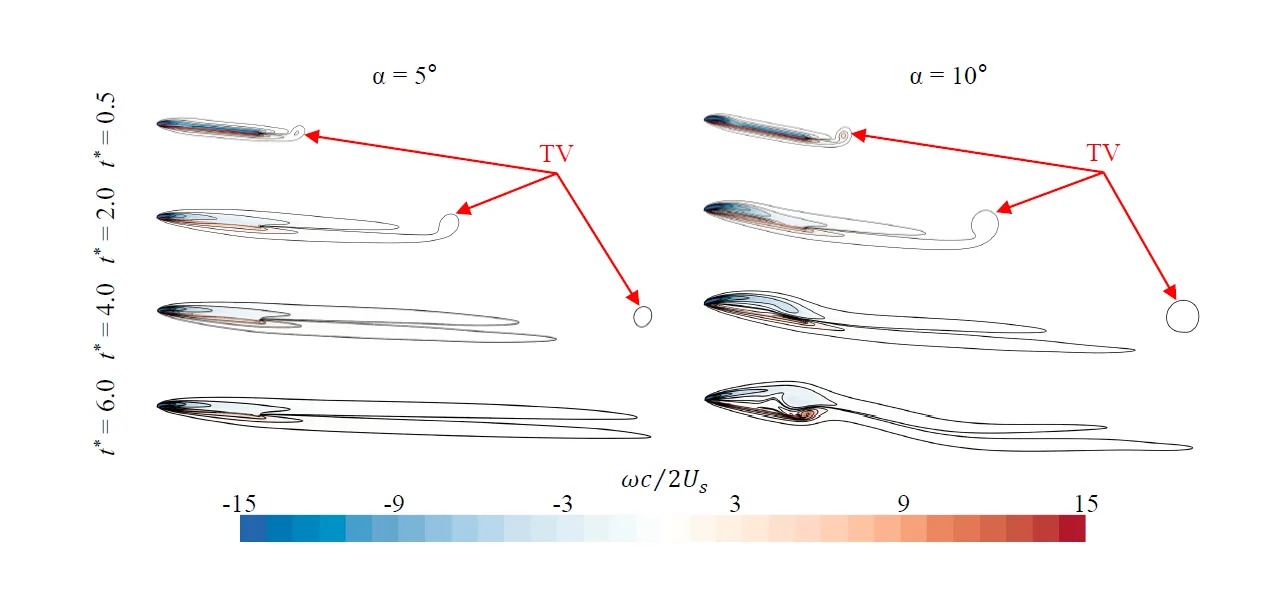
The authors recast unsteady thin-airfoil theory within a viscous framework, using the Kármán–Sears lift formula where the wake contribution is expressed through the vortex sheet intensity. The key step is approximating the kernel of the Wagner integral equation by a function that admits an analytical inverse Laplace transform, with a relative error of about 1%. This enabled a convolution expression for the wake vortex sheet intensity in terms of the quasi-steady circulation and its derivative. To test the predictions, they performed numerical simulations of flow past a starting flat plate at angles of attack of 5° and 10° and Reynolds numbers from 126 to 1000 using OpenFOAM, decomposing the total lift into vortex and acceleration components.
Results
An explicit integral expression for the Wagner function was obtained, agreeing well with known correlations and numerical inverse Laplace transforms. For the generalized Wagner problem with finite circulation rise time, self-similarity of the renormalized circulatory lift coefficient was found: curves for different rise times collapse onto a single curve equivalent to the renormalized Wagner function. Numerical simulations confirmed this self-similarity for the vortex lift under moderate separation: data for Reynolds numbers from 126 to 1000 fell onto one curve. The time to reach the local lift minimum follows a power law in Reynolds number with an exponent of −1/5 for both angles of attack. The acceleration component of lift also shows self-similarity, but with different scales, so the total force is not self-similar.
Implications
Unlike neighboring studies on vortex dynamics, which either stick to inviscid models or examine specific separation cases, this work provides for the first time a unified analytical description of unsteady lift applicable to viscous flows with moderate separation. The self-similarity of the renormalized vortex force means the Wagner effect is invariant with respect to Reynolds number, significantly broadening the scope of classical theory. This links idealized models to real flows and opens the way to simple engineering estimates for flapping wings and biological flight.
Future development
The topic could evolve toward accounting for strong separation and three-dimensional effects, where self-similarity may break down. It would be interesting to test the universality of the power law for circulation rise time at other angles of attack and wing geometries. Generalization to compressible flows and to unsteady maneuvers with arbitrary motion laws, including the flapping flight of insects and birds, is possible.
Impact
The results could influence the aerodynamics of flapping wings, wind energy, and aeroelasticity, where rapid transients and viscous effects matter.
Next steps
Conduct additional numerical and experimental checks of self-similarity at higher angles of attack and Reynolds numbers, as well as for wings of finite span.
Key open problems
This work directly addresses the long-standing problem of applying classical inviscid theories to real viscous flows. It shows that the Wagner effect persists even under moderate flow separation, raising questions about the limits of self-similarity and the role of separation in breaking Reynolds-number invariance.
The knowledge machine's view
This section is addressed to the author of the paper and their colleagues. Neighbouring works were found by meaning-based search across our archive, not by word overlap. We do not review: we show the field around the work.
What the work does
The authors reformulated unsteady thin-airfoil theory within the framework of viscous flow, using the Karman–Sears lift formula and approximating the kernel of the Wagner integral equation with a function that has an analytical inverse Laplace transform. They obtained explicit integral expressions for the Wagner and Theodorsen functions, and discovered self-similarity in the renormalized circulatory lift coefficient. Numerical simulations of flow past a starting plate confirmed that this self-similarity is invariant with respect to the Reynolds number at moderate separation.
Where its strength is
The strength of this work lies in obtaining a unified analytical description of unsteady lift that applies to viscous flows with moderate separation, filling the gap between idealized inviscid theory and real viscous flows.
Where it could go next
- It might be interesting to see how the approaches to stability and transient analysis from the work on fast return can be adapted to study the unsteady response of an airfoil to sudden changes in angle of attack.based on: The Secret of Quick Recovery: A New Method for Assessing Stability arXiv:2607.14291
- A related work on shock-wave interaction with rarefied gas, which considers unsteady effects, lies nearby; perhaps analogies in vortex-structure dynamics could help extend the applicability of your model to higher angles of attack or compressible flows.based on: How a Shock Wave Swells in Thin Air arXiv:2605.17099
Worth trying
- Test whether the self-similarity of the renormalized circulatory lift coefficient persists at angles of attack that cause strong separation, using numerical simulations at higher Reynolds numbers.
- Validate the proposed kernel approximation on problems with harmonic oscillations of the angle of attack and compare with known results for the Theodorsen function.
- Investigate how the derived convolution expression for vortex-wake intensity can be used in reduced-order models for aeroelasticity.
Why this may matter
The explicit analytical expressions obtained and the self-similarity discovered could simplify the modeling of unsteady aerodynamics in engineering applications such as flapping flight and blade dynamics, where viscous effects matter at moderate Reynolds numbers.
Nearby works in our archive
- The Secret of Quick Recovery: A New Method for Assessing Stabilitysimilarity 0.52
- The Angular Momentum Symphony: When Weak Gravity Is Strongsimilarity 0.51
- Winds from Black Holessimilarity 0.50
- How a Shock Wave Swells in Thin Airsimilarity 0.50
- Dark Energy That Changes Signsimilarity 0.49
- Quantum Brushstrokes on the Canvas of the Cosmossimilarity 0.49
The archive is sparse around this work: the closest review is only 0.52, against a usual 0.64. It looks like few have drilled nearby.
The Wagner function, which describes the lift buildup after a sudden change in angle of attack, was first published in 1925 as tables because no explicit formula existed for nearly a century.
In Stanisław Lem's novel The Invincible, mechanical 'flies' are described that fly by rapid wing beats in a dense atmosphere. Understanding unsteady aerodynamics of viscous flows, as achieved in this work, brings us closer to describing such hypothetical flying machines.
Key numbers
- relative error of kernel approximation: about 1%
- Reynolds number range: 126–1000
- angles of attack in simulations: 5° and 10°
- power-law exponent for minimum time: −1/5
- circulation rise time in model: 0.1 (dimensionless)