Wald entropy is a formula that gives the entropy of a black hole in any theory of gravity, not just Einstein's general relativity. In general relativity, the Bekenstein-Hawking entropy is proportional to the area of the event horizon, but in modified theories of gravity (like those with higher-order curvature terms), the entropy is no longer simply area. Wald's formula provides a general way to compute the entropy by varying the gravitational action with respect to the curvature tensor, evaluated on the horizon. It is a cornerstone of modern black hole thermodynamics and quantum gravity research.
History
Robert Wald introduced this formula in 1993 in a paper titled 'Black Hole Entropy in the Noether Charge.' It generalized earlier work by Bekenstein and Hawking and provided a rigorous framework that applies to any diffeomorphism-invariant theory of gravity.
How it works
The formula, derived by Robert Wald in 1993, states that the entropy is given by an integral over the horizon of a quantity derived from the Lagrangian of the theory. Specifically, it involves the derivative of the Lagrangian with respect to the Riemann curvature tensor, contracted with the binormal to the horizon. For Einstein gravity, this reduces to the area law, but for theories like f(R) gravity or Gauss-Bonnet gravity, it gives corrections. The derivation uses the Noether charge associated with diffeomorphism invariance, linking entropy to a conserved charge at the horizon.
In practice
Wald entropy is used in theoretical physics to test candidate theories of quantum gravity, such as string theory and loop quantum gravity, by comparing their predictions for black hole entropy with the Wald formula in the appropriate limits.
Fun fact
Wald's derivation shows that black hole entropy is not always proportional to area—in some theories, it can depend on other horizon quantities, like the curvature, which means black holes in those theories could have different thermodynamic properties than in Einstein's gravity.
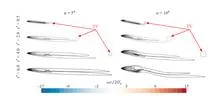
An airplane wing, like a skier on a ski jump, remembers its acceleration. Change the angle of attack sharply, and the lift does not immediately reach its new value. It builds up gradually, as if the wing is not yet sure the maneuver is for real.
This effect was discovered by engineer Herbert Wagner in 1925.
Stare long enough into the night sky, and sooner or later your gaze hits a blackness beyond which nothing is visible. This is not just a distant fence: it is the edge of the universe accessible to us, the cosmic horizon. Light from more distant stars simply hasn't had time to reach us.
A black hole is not just a dark spot in space. It has a temperature, and it radiates. It has entropy — a measure of hidden information encoded on its horizon's surface, like a pattern on a soap bubble.
A boiling kettle on the stove eventually boils dry — and so, according to the classical picture, a black hole should gradually vanish in a hiss of radiation. But what if you add a special ingredient to the kettle?
A dance floor where couples whirl. At the center, an invisible master of ceremonies sets the rhythm. This is the supermassive black hole at the heart of the Milky Way, and the couples are stars whose orbits astronomers have tracked for years. But what if the master himself is wrapped in a fluffy fur coat of tenuous matter?
A black hole has three laws, just like an ideal gas. The first: energy is conserved. The second: the horizon area never decreases. And the third, the most finicky, demands that at zero temperature the entropy (a measure of disorder) tend to zero or a universal constant.
A fussy thermometer shows different temperatures depending on who is looking at it. A black hole behaves much the same way: its thermal properties, entropy and temperature, depend on how we describe the information hidden inside.
A homogeneous, spherical cloud of cosmic dust begins to contract under its own gravity. At some point, by classical laws, it should collapse into a point of infinite density — a singularity.
Somewhere in the center of a galaxy, a black hole is spinning. It doesn't hang in a void — around it swirls an invisible swarm of dark matter particles. Until now, this swarm was described for non-rotating holes, but in reality, holes always rotate.
Quantum field theory is the language physicists use to describe elementary particles and their interactions. The authors of the work decided to slightly "tweak" this language: they introduced deformations, that is, small changes to the rules of the game.
A black hole is not an eternal vacuum cleaner. It slowly loses mass by emitting particles, much like a heated stone cooling as it radiates heat. This process, discovered by Stephen Hawking, is barely noticeable for large holes, but for tiny ones, with masses comparable to a mountain, it becomes a violent evaporation.
A black hole's shadow isn't just a black circle. Usually, we see a dark void surrounded by a glowing ring of hot gas. But if a black hole wasn't born from a dying star but has existed forever, its shadow might hide a surprise.
An eternal black hole is a solution to Einstein's equations with no past and no collapse.
A black hole that swallows matter might not just evaporate over billions of years: it could pop like a soap bubble and turn into its opposite: a white hole. This scenario emerged from numerical experiments in semiclassical gravity.
A black hole is like a perfect safe: everything that falls in disappears without a trace. But quantum mechanics whispers that on the microscopic level, information is not lost but recorded on an invisible "surface." Understanding this record means unraveling the fabric of gravity.
An old house. The facade is freshly painted, the stairs don't creak. A pretty picture. But try to move in heavy furniture, and the floorboards give way. The beauty of the facade says nothing about the strength of the floors.
It's much the same with black holes without singularities.
A black hole is like a perfectly smooth sphere. It has no features — only mass, charge, and spin. This rule is called "no-hair." But nature loves to complicate things: sometimes a cloud of a scalar field (a special field described by a single number at each point) spontaneously appears around a black hole.
A black hole is not an absolutely black bag. In 1974, Stephen Hawking showed that it glows — faintly, but continuously. This radiation is born not inside, but outside, right at the boundary from which even light cannot escape.
A new study sharpens the picture.
A black hole devours everything, even light. Yet it obeys the laws of physics: it possesses entropy — a measure of the hidden information an object 'remembers.' In the 1970s, Jacob Bekenstein and Stephen Hawking discovered a strange pattern: a black hole's entropy grows not with its volume, but…
A stone falls into still water — ripples spread across the surface. A black hole behaves similarly when something falls into it or when it merges with another black hole. The hole begins to oscillate, and these oscillations propagate through space as gravitational waves.
In 1973, Jacob Bekenstein proposed that black hole possess entropy — a measure of hidden disorder. Stephen Hawking later confirmed this by adding radiation, but the microscopic origin of entropy remained obscure.
At the center of nearly every galaxy lurks a supermassive black hole. Its gravity is so strong that it warps space itself. But few stop to wonder: what does it do to the very fabric of reality — the fields that permeate the cosmos?
One such field is the Higgs field.
A climber on a ridge notices something strange: the horizon around them seems to freeze. No forward, no backward — only emptiness and silence. This is roughly the picture painted by new calculations for our Universe. At some point in its expansion, the invisible boundary, the future event horizon, stopped growing.
Hot tea cools down, a pendulum comes to rest — nature loves equilibrium. But a charged black hole can reach a special, extreme state: the mass becomes minimal, and the temperature drops to zero.
In a two-dimensional universe, a black hole looks like a funnel in spacetime. But the authors of the new work went further: they proposed that the space where particle momenta 'live' is also curved, like a saddle.
An eardrum at the very edge of a waterfall. Sound behaves strangely here: echoes don't multiply: they fade. That's exactly what gravitational waves look like at the horizon of a black hole — the boundary beyond which even light disappears.
A light ray skimming along a black hole horizon doesn't just move: it carries heat and information. Physicists have long suspected that the geometry of such rays obeys strict rules, but the details remained blurry. The new work turns these rules into a sharp inequality.
A swarm of tiny invisible particles, like a cloud of pollen, drifts through space. A black hole sits in its path. Some particles fall in and vanish forever; others swing around the trap and fly away. The physicists built a map showing exactly how much matter gets swallowed and how much survives.
Imagine a pot of boiling water. Toss in a handful of pasta, and it quickly overcooks and clumps into a sticky mess. But in a huge restaurant kettle where the pasta floats freely, each piece stays separate.
A black hole is not eternal. Even in a perfect vacuum, it slowly loses energy — a process known as Hawking radiation. Quantum effects near the event horizon create pairs of particles, one of which escapes, carrying away some of the black hole's mass.
In a room, air touches the skin, and we feel its temperature. But if your body suddenly accelerated at a colossal rate, heat would come even from absolute emptiness. This is not fiction but a strict consequence of quantum field theory: for an accelerating observer, the vacuum becomes a warm bath.
Gravity is the invisible glue that holds stars and planets together. But what if this glue has a tiny mass? In massive gravity, the carrier particles (called gravitons) weigh a minuscule but nonzero amount. This changes the rules near black holes.
The authors of the new study built on a mathematical tool — eigenvalue decomposition.
A black hole is not just an abyss where everything falls. Right at its horizon, in the so-called quantum atmosphere, a faint glow is born — Hawking radiation. This is not calm light but a churning stream of particles that can influence the most delicate quantum connections.
10⁻¹²⁰. That's not just a small number: it's a chasm. That's the ratio of dark energy density to the Planck density, the natural scale of quantum gravity. The colossal difference of 120 orders of magnitude has long seemed an unsolvable puzzle. But the answer might lie in a drama played out at the dawn of time.
It is commonly believed that a black hole is a merciless cosmic vacuum cleaner, sucking in everything indiscriminately. But new research flips the picture: right at the horizon, curvature transforms from a trap into a trampoline.
A black hole usually hides its singularity behind an event horizon — an invisible boundary from which not even light can escape. But sometimes this 'cloak' is absent, and the singularity, a point where familiar physics breaks down, is exposed to an outside observer.
At the center of a classical black hole lurks a singularity — a point where the density and curvature of spacetime become infinite. Physics goes silent there.
The LIGO detectors caught the signal GW250114—a gravitational wave from the merger of two black holes. After the main burst, a decaying 'tail' remained — direct waves from the newborn hole's horizon. It was expected that their damping would reveal the gravitational strength at the horizon's surface. But the measured value came out smaller.
A black hole is not just a dark spot. It rotates, drags space along with it, and can carry imprints of the quantum world. To describe such a hole, one must solve gravitational field equations.
Quantum vacuum is not absolute emptiness. It is more like a taut membrane that constantly ripples from invisible particles popping in and out of existence. Even in total darkness, this membrane trembles. Physicists decided to see how it behaves around a thin spherical shell, inside which is ordinary flat space, like in our room.
Two light rays meet at a point and then diverge. Their paths form two intersecting surfaces in spacetime — null hypersurfaces (boundaries along which light propagates). It is on such a pair of surfaces that physicists can set initial data for Einstein's equations. This is called the characteristic Cauchy problem.