The Impostor Droplet: How Evaporation Makes a Microdroplet Crawl ✛
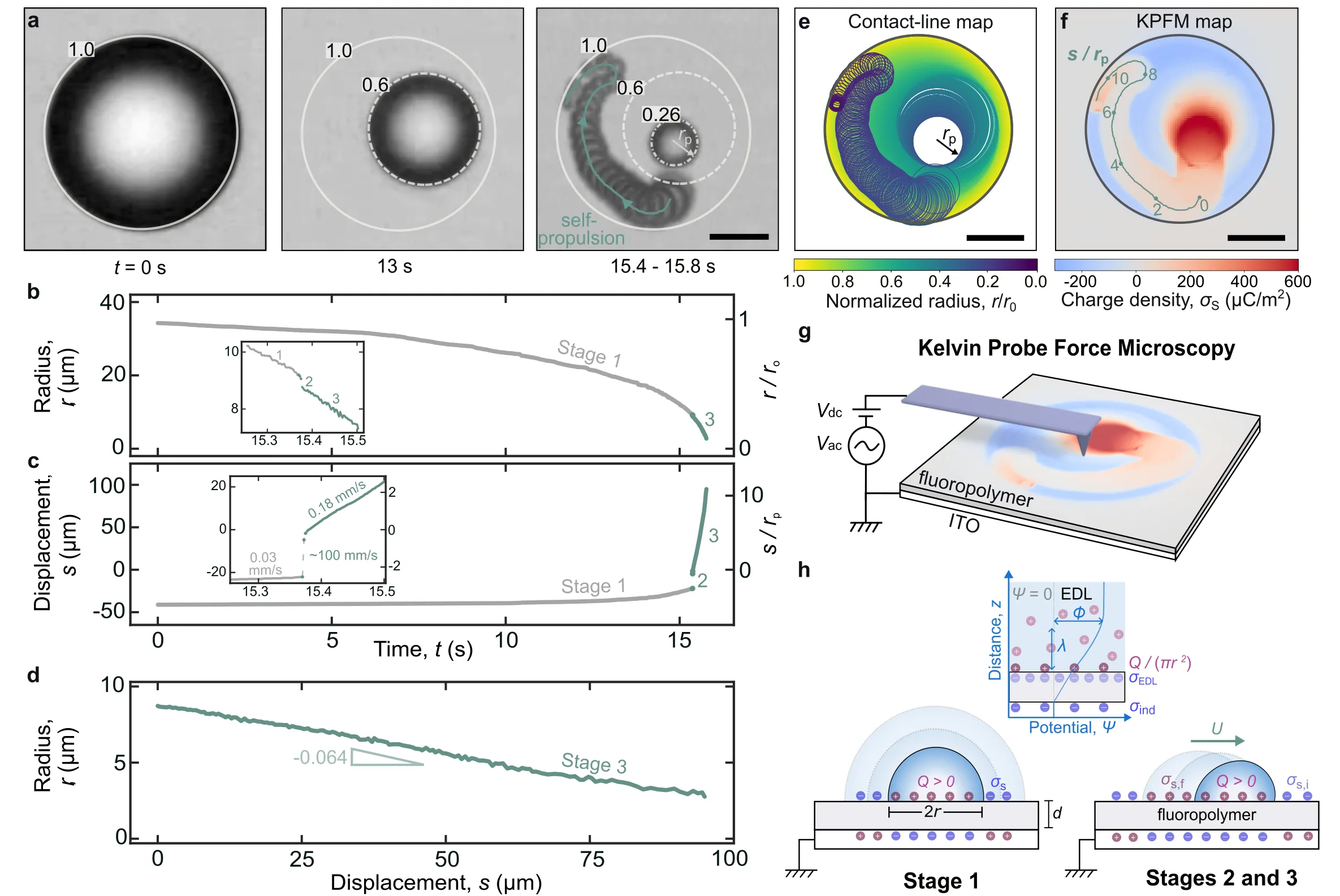
A water droplet on a film first sits still and evaporates. But when it becomes very small, it suddenly takes off and crawls, leaving an invisible trail behind. This trail is an electric charge that the droplet itself created.
Evaporation strips a thin layer of charges from the droplet, charges that always exist at the water-surface boundary. These charges remain on the film like fingerprints. As the droplet shrinks, it leaves charged patches behind. If the surface is slightly uneven, evaporation proceeds unevenly, and the charge becomes distributed in patches: some positive, some negative. The droplet itself carries a charge and is repelled by patches charged the same way. So it avoids already visited areas and crawls sideways.
Previously, it was thought that droplet evaporation was simply a matter of heat and humidity. But now it's clear that electric forces can be just as important. The droplet doesn't just dry up; it actively forges its own path. This discovery could help improve inkjet printing, where droplets must land precisely in their target spots rather than crawling away after landing.
The droplet moves at speeds up to 100 mm/s, which is like a 1.8 m tall person sprinting 18 meters per second, or 65 km/h.