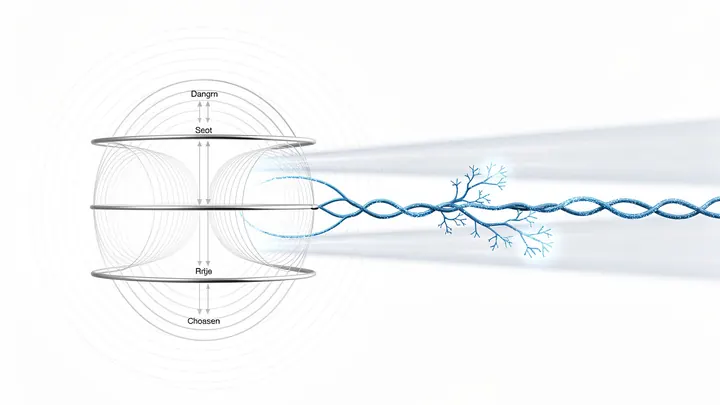
Spontaneous emission is the random release of a photon when an excited atom or molecule drops to a lower energy state. While this process is inherently noisy and unpredictable, it can also generate quantum entanglement — the mysterious correlation where particles share a single quantum state. The idea that natural, chaotic sources like sunlight could produce entanglement challenges the older assumption that entanglement requires carefully controlled laboratory setups with lasers and specialized crystals.
How it works
When an atom spontaneously emits a photon, the emitted photon and the atom's final state become entangled: the photon's properties (like polarization) are correlated with the atom's internal state. In a cascade, where one atom emits two photons in sequence, those two photons can be entangled with each other. Even in a chaotic thermal source like the Sun, each emission event creates a local entanglement, and under the right conditions, this can be harvested or detected.
In practice
This research could enable quantum communication and cryptography using natural light sources instead of fragile, expensive laser systems, potentially allowing satellite-based quantum key distribution powered by sunlight.
Fun fact
The Sun, despite being a chaotic thermal source, can produce pairs of entangled photons through spontaneous emission cascades in its atmosphere.
On the table lies a layered cake of hexagonal boron nitride flakes, a material similar to graphite but made of boron and nitrogen atoms. One flake is carefully transferred onto another, and at the spot where they overlap, after heating in oxygen, bright single light sources are born.
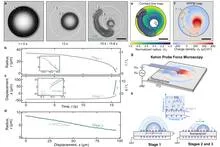
A water droplet on a fluoropolymer film initially behaves as expected: it sits and evaporates. But once it shrinks to a quarter of its initial size, it suddenly takes off and, within fractions of a second, covers a distance several times its own radius. Then it crawls slowly but persistently, leaving behind an invisible trail of electric charges. That trail is what drives the motion.
An electron and its antiparticle — the positron, predicted by Дираком, — upon meeting, momentarily form позитроний: a tiny pair circling each other, like in an atom but without a nucleus. Almost instantly it decays, emitting two photons that turn out to be mysteriously linked.
The riddle of quantum gravity has troubled minds for nearly a century. A classical field that curves spacetime refuses to fit into the probabilistic world of superpositions. Can gravitation, while remaining macroscopic, give rise to microscopic entanglement?
When many excited atoms are gathered together, they often fire light in concert, like a crowd clapping in rhythm. This well-known phenomenon is called Dicke superradiance. But the authors of the new study asked: what happens if the atoms are not identical and each one feels its neighbors?
Two musicians play a duet. In a perfect hall, they hear each other perfectly and gradually fall into resonance. But try playing in a room where someone keeps slamming the door. You'd think the rhythm would be thrown off. But no: sometimes that very random slam makes both of them sync up instantly.
A regular laser is like a choir where everyone sings their own part — the sound is loud, but with inevitable roughness. In the new quantum laser, the singers hear each other and harmonize their voices.
Sunlight is a turbulent stream carrying inseparable pairs of droplets. That’s what quantum entanglement looks like: two particles are so connected that a fluctuation in one instantly resonates in the other. In the past, creating such pairs required a 'calm pool' — a perfectly tuned laser beam.
Quantum communication via satellite is like a roll call between two distant lighthouses: the beam must hit the detector exactly, or the message can't be read. But in space, everything shakes — sunlight heats the hull, thrusters cause vibrations, and delicate optics drift off-axis.
An ordinary laser emits photons one by one, like a faucet dripping water. But what if you need several particles of light born at the same instant? Physicists have made a cloud of cold rubidium atoms emit quadruples of photons — as if the faucet suddenly released four drops at once, each falling into its own test tube.
Physicists have for the first time created a trio of photons entangled as a single whole, not just pairwise. To achieve this, a special chip was cooled to a temperature hundreds of times lower than that of deep space — any noise threatened to destroy the fragile link.
In 1989, John Wheeler proposed a bold idea: "it from bit," meaning everything that exists arises from information. For a long time, this remained a beautiful metaphor, but now physicists have found a concrete mechanism that turns bits into particles.
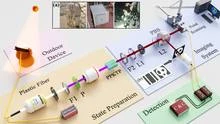
Sunlight collected by a Fresnel lens and passed through 20 meters of plastic fiber had a power of just 3 microwatts, a million times less than a typical laser pointer. That was enough to generate photon pairs correlated in position inside a nonlinear crystal. One photon from each pair passed through the object, the second was scanned by a detector, and coincidences built up the image.
Spontaneous emission, the very process that lights up lamps and stars, has long been considered a pesky noise in quantum physics. This cacophony of random photons ruthlessly destroys fragile quantum entanglement, like radio static drowning out a distant melody.