The Impostor Drop: How Evaporation Charges and Drives Microdroplets ✛
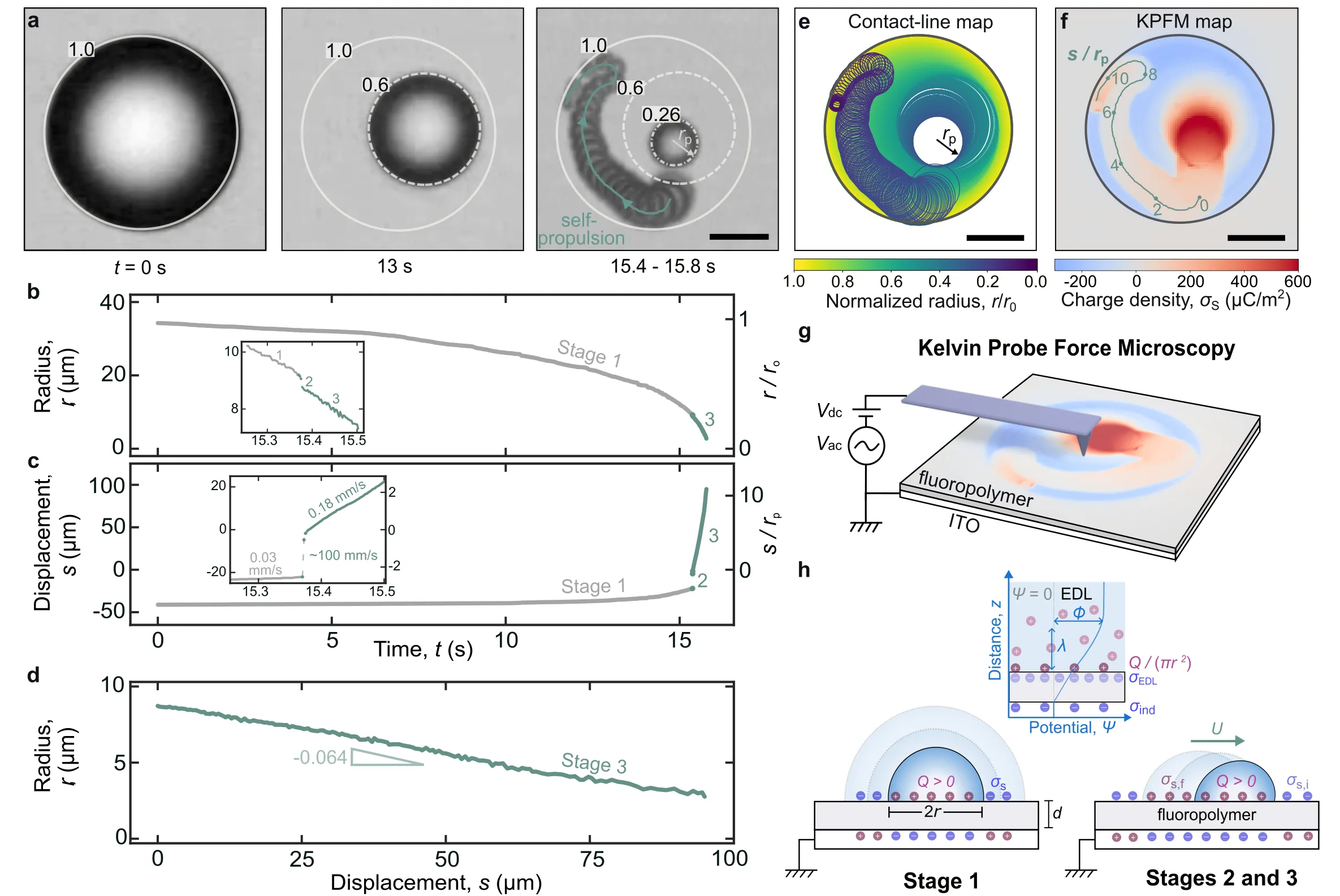
A water droplet on a fluoropolymer film initially behaves as expected: it sits and evaporates. But once it shrinks to a quarter of its initial size, it suddenly takes off and, within fractions of a second, covers a distance several times its own radius. Then it crawls slowly but persistently, leaving behind an invisible trail of electric charges. That trail is what drives the motion.
Evaporation strips the droplet of a thin layer of charges that always exists at the water-surface interface. The charges do not disappear; they remain on the film like fingerprints. As the droplet shrinks, it leaves behind charged patches. If the surface is slightly inhomogeneous, evaporation proceeds unevenly, and the charge is distributed in spots: some positive, some negative. The droplet, itself carrying a charge, senses these spots and repels from those with the same charge as its own.
Previously, it was thought that droplet evaporation was simply a matter of heat and humidity. But now it is clear that electric forces can be just as important as capillary forces. The droplet does not merely dry out passively; it actively paves its way, avoiding already "soiled" areas. A mosaic pattern remains on the surface, which can be read as a map of its journey.
This dance of droplets matters not only to physicists. Inkjet printers that deposit microchips or biological samples require the droplet to land precisely at a given spot. If the droplet decides to wander off after landing, accuracy suffers. Understanding the mechanism will allow either suppressing self-motion or, conversely, harnessing it for sorting and transporting microparticles. A droplet that paints its own path with electric strokes could become a tool rather than a nuisance.
The droplet moves at speeds up to 100 mm/s, which is like a 1.8 m tall person sprinting 18 meters per second, or 65 km/h.