Impostor Droplet: How Evaporation Charges and Drives Microdroplets ✛
Context
Evaporation of a droplet on a surface seems simple, but complex physics lies beneath. Previously, this process was treated as a heat and mass transfer problem, ignoring electrical effects. Recently, however, it was discovered that droplets leave an electric charge on the surface as they evaporate. This work fits into a growing research direction on electrification during the movement and evaporation of liquids, alongside studies of charged particles in water and dancing puddles of charge in crystals. But here, for the first time, it is shown that the charge does not merely remain; it makes the droplet move.
Methods
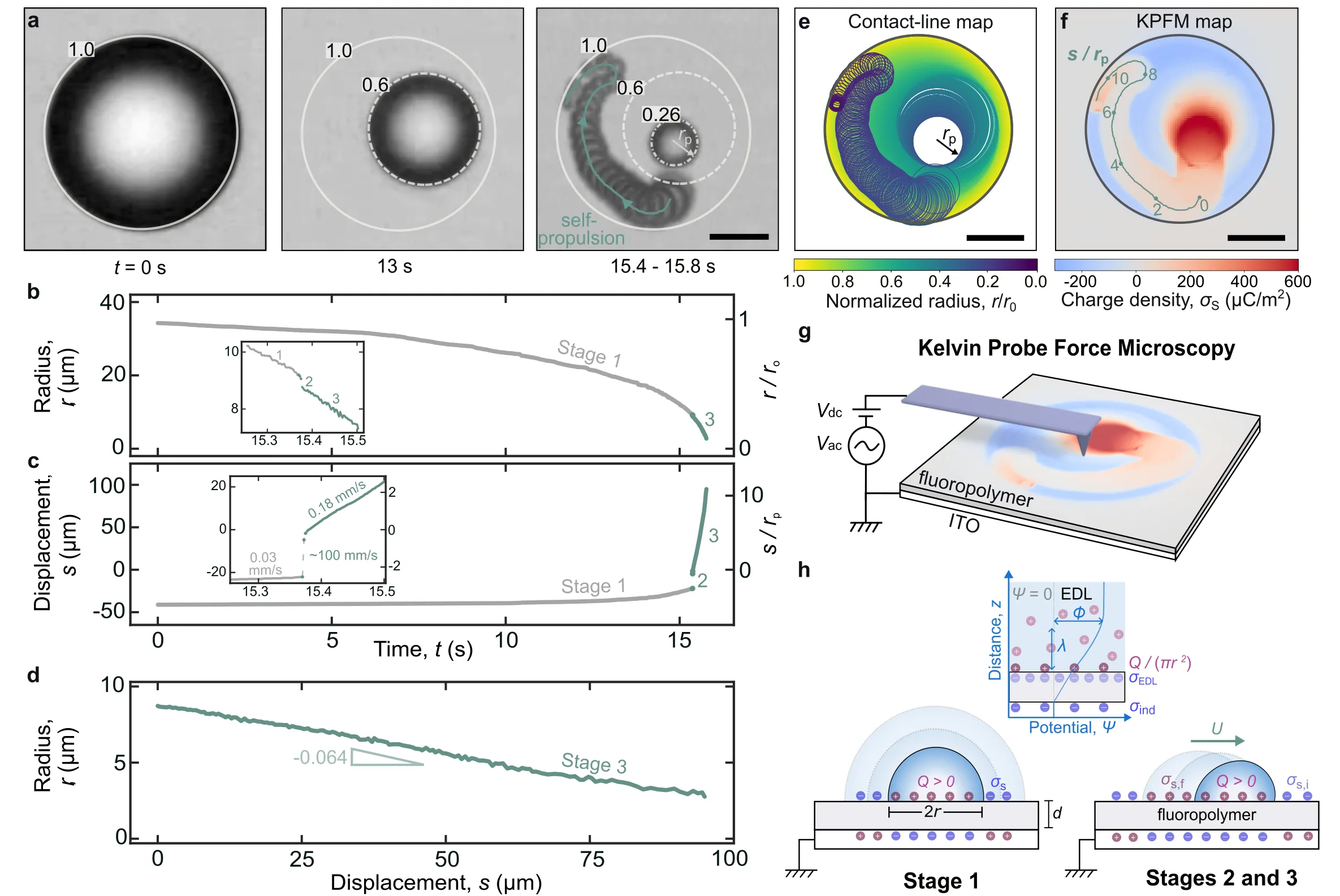
The experimenters sprayed microdroplets of deionized water onto a thin fluoropolymer film, 220 nm thick, deposited on a grounded indium tin oxide substrate. Evaporation and droplet motion were monitored using video microscopy. After complete drying, the surface was scanned using Kelvin probe force microscopy (KPFM), which maps the surface charge distribution with micron resolution. They then built an analytical model linking charge transfer from the electrical double layer to the force acting on the droplet.
Results
A droplet with a radius of about 30 μm initially evaporates in place, but when its radius shrinks to roughly 9 μm (26% of the initial), it abruptly takes off. In 2.5 milliseconds, it covers 16 μm at speeds up to 100 mm/s, then continues crawling at 0.18 mm/s, for a total displacement of 100 μm, which is ten times its radius. The droplet's trajectory avoids already traversed regions, and the surface is left with a mosaic of alternating positive and negative charges. The model reproduces these patterns using two electrical double layer parameters: charge density $σ_{EDL}$ = -665 μC/m² and transfer coefficient α = 0.32. Key finding: if α < 1/2, the electrostatic force grows without bound as the droplet shrinks, guaranteeing self-propulsion; if α > 1/2, motion depends on contact angle hysteresis and may not occur.
Implications
This work differs from neighboring studies by linking droplet self-charging to self-propulsion, rather than treating these phenomena separately. It is the first to show that the asymmetry needed for motion arises spontaneously from random surface defects, not imposed by external fields or gradients. This changes our understanding of evaporation: electrical forces can be as important as capillary forces, influencing particle deposition, heat transfer, and printing accuracy.
Future development
The topic could evolve toward controlling droplet self-propulsion using pre-patterned charge distributions. If one can control the charge transfer coefficient α via chemical surface modification, droplet trajectories could be programmed for microfluidics or self-assembly. It would also be interesting to study the collective behavior of many droplets interacting through the charge trails they leave behind.
Impact
The results are important for inkjet printing, where precise droplet positioning is critical, as well as for generating electricity from evaporating water and for depositing colloids or molecules.
Next steps
The next step could be experimental verification of the model on other dielectrics with different α and σ_EDL, as well as developing methods for actively controlling droplet charge for directed transport.
Key open problems
In soft matter physics, an open question remains: how microscopic properties of the electrical double layer determine macroscopic droplet behavior. This work links EDL parameters to the self-propulsion threshold but does not explain why the transfer coefficient α changes during rapid contact line motion. Also unresolved is the problem of precisely predicting droplet trajectories in a heterogeneous charge landscape.
The knowledge machine's view
This section is addressed to the author of the paper and their colleagues. Neighbouring works were found by meaning-based search across our archive, not by word overlap. We do not review: we show the field around the work.
What the work does
The work shows that evaporating microdroplets of water on a dielectric surface spontaneously acquire charge and begin to move due to electrostatic forces. The authors experimentally tracked droplet trajectories and residual charge maps, and then built an analytical model linking charge transfer from the electric double layer to the driving force. The key result is a condition on the transfer coefficient α that determines whether self-propulsion will occur.
Where its strength is
Linking self-charging to self-propulsion in a single mechanism and demonstrating the spontaneous emergence of asymmetry due to surface defects is a concrete contribution that can serve as a foundation for further research on both evaporation and microdroplet control.
Where it could go next
- A related work on droplets that choose their own path lies nearby: judging by the abstract, it considers similar self-propulsion, but possibly with a different mechanism or on different surfaces. It might be interesting to compare models and understand where the electrostatic mechanism dominates and where it yields to other forces.based on: Drops That Choose Their Own Path arXiv:2604.16974
- In our archive there is an analysis of charged particles in water, where the attraction of like-charged objects is discussed. This could be useful for clarifying the behavior of charges in the electric double layer and their transfer during evaporation, especially in the presence of impurities or nanoparticles.based on: Charged Particles in Water: Why Like Attracts Like arXiv:2605.09540
- Another neighbor is a work on microdischarges at the tip of a dust particle. There, electrical breakdowns at the microscale appear to be studied. Perhaps similar discharges can occur during the motion and drying of droplets, affecting charge redistribution; this direction has not yet been explored.based on: Microdischarges: Sparks on the Tip of a Dust Grain arXiv:2604.16040
Worth trying
- Test whether droplet self-propulsion persists on surfaces with controlled roughness or a regular defect pattern, in order to separate random from induced asymmetry.
- Try adding a small amount of salt or nanoparticles to the water and see how the transfer coefficient α changes and, accordingly, the self-propulsion threshold.
- Use high-speed imaging with synchronous charge registration to capture the dynamics of the charge mosaic directly during droplet motion.
Why this may matter
If electrostatic self-propulsion turns out to be universal for evaporating microdroplets, it could change approaches to precision inkjet printing, application of functional coatings, and control of particle deposition from droplets.
Nearby works in our archive
- Microdischarges: Sparks on the Tip of a Dust Grainsimilarity 0.54
- The Hidden Force on Leavessimilarity 0.53
- How a Drop with Nanoparticles Cracks on Glasssimilarity 0.52
- Charged Particles in Water: Why Like Attracts Likesimilarity 0.52
- A Waterfall in Plasma: How Holes Are Bornsimilarity 0.51
- Laser Spark: A Portrait of Free Electronssimilarity 0.51
- Drops That Choose Their Own Pathsimilarity 0.50
The archive is sparse around this work: the closest review is only 0.54, against a usual 0.64. It looks like few have drilled nearby.
The droplet moves at speeds up to 100 mm/s, which is like a 1.8 m tall person sprinting 18 meters per second, or 65 km/h.
Key numbers
- burst speed: 100 mm/s
- crawling speed: 0.18 mm/s
- displacement: 100 μm (10 radii)
- EDL charge density: -665 μC/m²
- transfer coefficient: 0.32