A nanosecond is an eternity for an excited atom. But in a microresonator, the same atom emits light in picoseconds. In 1946, Edward Mills Purcell noticed that a resonator changes the rate of spontaneous emission. The Purcell factor, the key formula, is proportional to the ratio of quality factor to volume: the tighter the cavity and the higher its quality, the stronger the effect. Just as a Stradivarius violin sounds different from a simple box, the microresonator tunes the voice of the atom.
History
The phenomenon was predicted by Edward Mills Purcell in 1946 in the context of nuclear magneticresonance, when he considered the influence of a resonator on spin relaxation. In the 1980s, with the development of microstructures, the effect was observed in the optical range: in 1985, Gabriela Slater's group demonstrated suppression of spontaneous emission in a waveguide, and in 1987, Eli Yablonovitch introduced the concept of a photonic band gap. Today, it underpins cavity quantum electrodynamics.
How it works
It is used to create highly efficient single-photon sources (quantum dots in microresonators), superbright LEDs based on photonic crystals, and low-threshold lasers. Limits of applicability: the Purcell factor loses meaning in the strong coupling regime, where Rabi splitting occurs.
In practice
This is the basis for bright single-photon sources for quantum cryptography and ultrafast LEDs in optical chips.
Fun fact
Purcell came up with his formula during a coffee discussion with colleagues. A brief note in Physical Review gave birth to an entire field—cavity quantum electrodynamics.
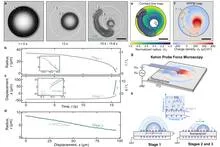
A water droplet on a fluoropolymer film initially behaves as expected: it sits and evaporates. But once it shrinks to a quarter of its initial size, it suddenly takes off and, within fractions of a second, covers a distance several times its own radius. Then it crawls slowly but persistently, leaving behind an invisible trail of electric charges. That trail is what drives the motion.
The blue glow in water around a nuclear reactor is light born when a charged particle outruns light in that medium. The effect was discovered by Pavel Cherenkov in 1934, with the theory provided by Igor Tamm and Ilya Frank.
In 1976, physicists predicted that an electron could do more than just fly past a nucleus: it could slam into it, transferring energy and making the nucleus 'shudder.' They called this effect NEEC — nuclear excitation by electron capture. But for nearly fifty years, no one has managed to observe it in an experiment.
Organic light-emitting materials are like a busy intersection without traffic lights. Molecules receive energy but, instead of honestly giving it back as light, they often turn into dead ends: they form dark pairs (exciplexes — short-lived complexes that do not emit) or collide with each other, losing charge.
Ordinary atomic clocks are like a tuning fork that must be kept in perfect silence and stillness. The slightest movement, and the note goes flat. The same goes for atoms: their thermal motion shifts the frequency of radiation, so ultra-precise clocks require almost complete immobilization of the particles.
Quantum matter rarely treats us to the spectacle of self-motion. Where the classical world teems with starling murmurations, fish schools, and bustling bacteria, quantum thermodynamics long remained serene.
A well-coordinated orchestra of electrons in a superconductor is easily thrown off rhythm. Thermal jolts destroy the fragile order, and resistance returns. For decades, scientists have sought ways to strengthen this ensemble — mostly by changing the material's composition or compressing it to unimaginable pressures.
Quantum bits (qubits) are like delicate music in a noisy factory. Ambient magnetic fields constantly 'drown out' their quantum state, turning a coherent signal into cacophony. Usually, this destructive process is slowed by retuning the qubits themselves to different frequencies, but that doesn't always work.
A handful of rice thrown into a glass of water scatters — the grains spread apart. Now imagine each grain propels itself forward with stubborn persistence and bounces off softly upon collision. Such particles are called active: they spend their own energy to move, like bacteria or microscopic robots.
In a dark room, an infrared laser flashes, and a speck of black K3C60 powder conducts electricity without resistance for a split second. The light strikes at 10 terahertz — a thousand times faster than a microwave oven. The effect is a hundred times stronger than at other frequencies. Why this particular frequency?
Near black holes and neutron stars, plasma churns like water in a boiling kettle. But this 'kettle' has no walls — only magnetic fields that twist and tear. At the tears, thin sheets form where magnetic field lines reconnect, giving particles a kick like a surfer catching a wave.
In 2015, two giant facilities in the United States caught the shiver of space — a gravitational wave from the collision of black holes. Since then, such signals have been caught regularly, but the detectors themselves are enormous: their arms stretch for kilometers.
In giant accelerators, particles zip through detectors in billionths of a second, and telling one from another requires a stopwatch of incredible precision. The new µRWELL-PICOSEC detector acts as such a stopwatch: it captures the moment a particle passes with a precision of 48 picoseconds: that's 48 trillionths of a second.
A single electron in a magnetic field is like a tiny top that spins and weakly "squeaks" at its own frequency. Hearing that squeak directly is nearly impossible: it gets lost in the noise. Scientists have devised a resonator: a superconducting microwave strip that works like a tuning fork tuned to the same note.
Hot plasma in a tokamak is like a temperamental beast: you need to hold it in, but not let it overheat. In the ASDEX Upgrade reactor, researchers found a regime where plasma eddies solve this problem on their own. Stochastic modeling showed that oscillations at the plasma edge fling out blobs, like bubbles from a boiling pot.
A laser pulse enters a tiny cavity made of a transparent crystal. Inside, light bounces between mirrors, and occasionally one photon splits into a pair: one goes one way, the other goes another. One becomes the signal, and the other acts as a 'bell' announcing that a single photon is ready.
An ordinary chemical reaction is like a ball rolling down a hill: it has one natural path. But if you place molecules in a tiny mirrored box, an optical microresonator, the light inside starts to interfere with the ball's motion. It can nudge it, hold it back, or even split its trajectory.
In a new study, physicists traced exactly how this happens.
Every hour, when the hands of a clock align at twelve, something happens in Earth's magnetosphere. It's as if an invisible conductor raises a baton, and waves race along magnetic field lines toward the surface. They're called pearls: on recordings, they look like a string of beads strung along time.