A Quantum Orchestra at the Wall ✛
Water in a river, flowing around a stone, changes its course: some streams press against the surface, others detach and swirl downstream. A classical computer calculates such flows by dividing the fluid into millions of tiny parcels and tracking each one. A quantum computer could do the same, storing probabilities for all parcels at once in a single quantum state, but until now it could not properly describe what happens right at the wall.
The researchers at Peking University proposed writing the probabilities of all possible particle velocities at all grid nodes into the diagonal of a density matrix. This is like an orchestral score where each row corresponds to a velocity and each column to a point in space. Then the streaming step, when particles hop to neighboring nodes, becomes a simple shuffling of rows and columns that can be performed on a quantum computer without loss of information.
For walls, they introduced an extra step before streaming: if a particle is headed toward the wall, its component swaps with the reflected component at the adjacent boundary point. After that, the usual streaming automatically returns the particle to the fluid, and the no-slip condition is satisfied by itself. This trick works for walls of any shape, be it a straight pipe, a curved airfoil, or letters on a building facade.
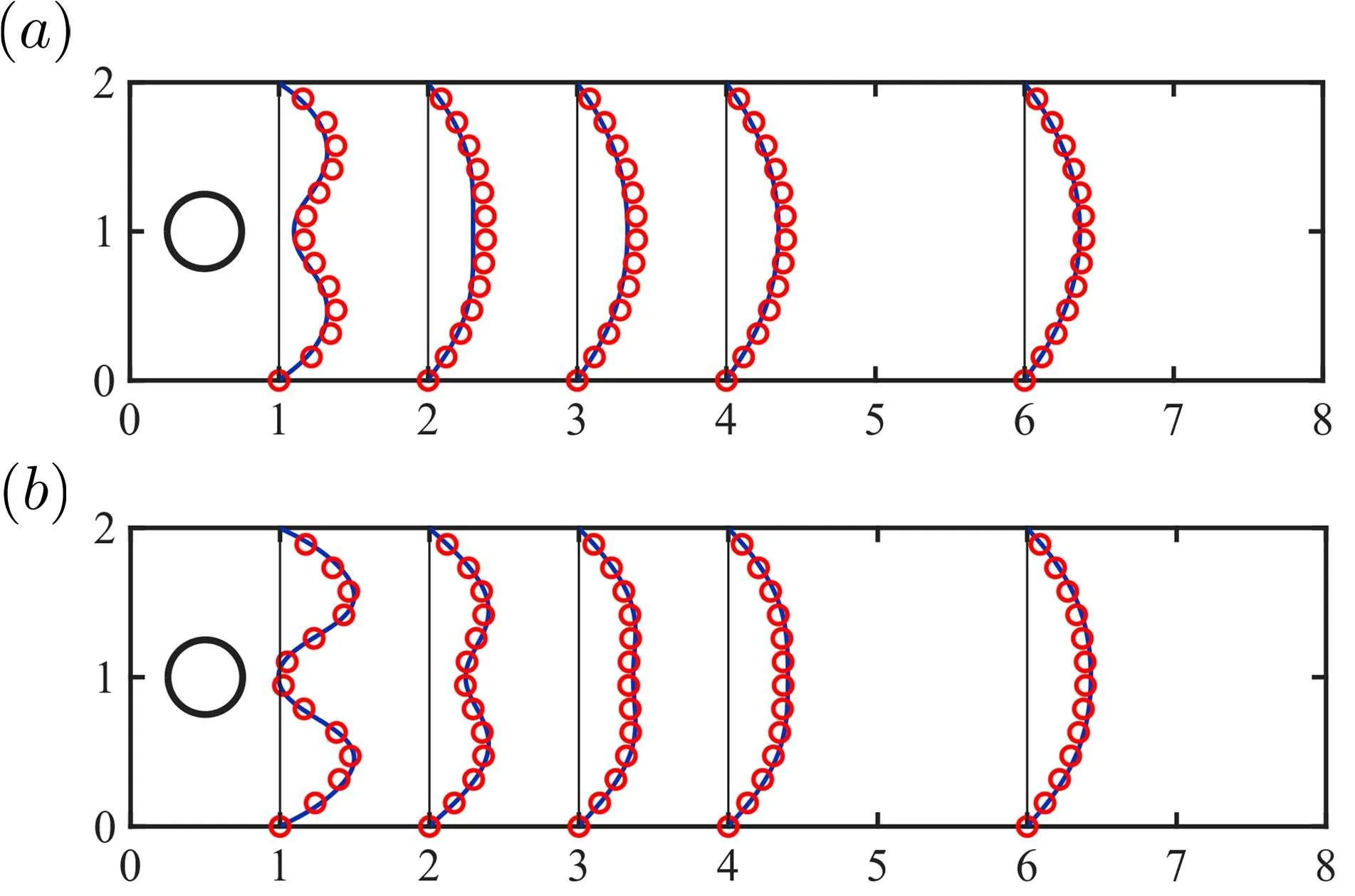
The method was tested on three types of flows. For a decaying flow in a channel, the error decreased with increasing grid resolution. For the flow over a backward-facing step, the length of the recirculation zone differed from the classical calculation by 10–17 percent depending on flow speed. For flow around a cylinder, the error was 12–17 percent. Finally, they simulated flow around the letters "PKU" on a grid of more than a million nodes, and vortices appeared in the gaps between the letters, just as in a real experiment.
The main remaining barrier is the so-called H-step, a procedure to restore particle independence after collisions. It requires repeating the entire scheme many times and could negate the quantum speedup. The authors plan to look for simplified versions of the H-step or alternative formulations without it. If they succeed, quantum computers could calculate the flow around an airplane wing or in a microfluidic chip faster than classical supercomputers.
To simulate flow around the letters 'PKU' (the abbreviation for Peking University), a quantum circuit with 2048×512 nodes and 23 qubits was required, equivalent to a classical grid of over a million points.
The idea of quantum fluid simulation echoes Stanislaw Lem's story 'The Invincible', where nanorobots form a collective intelligence resembling a fluid. Here, a quantum computer mimics the behavior of many particles obeying simple local rules, reminiscent of emergent properties in science fiction.