If we don't know exactly what state a quantum system is in, we can describe it with a density matrix – it's like a surprise box: there could be one toy inside, but we're not sure which one, we only know the probabilities.
History
The concept of the density operator was introduced by John von Neumann in his work 'Probabilistic Construction of Quantum Mechanics' (1927) and simultaneously by Lev Landau to describe damping in quantum systems. Subsequently, the formalism became the foundation of quantum statistical mechanics (Felix Bloch, Richard Feynman). In the 1960s-70s, with the development of quantum optics, the density matrix became a key tool for describing states of light and atoms. Alain Aspect's experiments testing Bell's inequalities (1980s) used the density matrix to analyze entangled photons.
How it works
In Hilbert space, the density matrix is written in a basis as ρ_{mn} = ⟨m|ρ|n⟩. Diagonal elements give populations of states, off-diagonal elements – coherences. For a subsystem obtained by taking the partial trace over the environment, ρ_red = Tr_env(ρ_total). This leads to the von Neumann entropy S = –Tr(ρ ln ρ), which characterizes the degree of mixedness. Quantumtomography allows reconstructing all elements of the density matrix through a series of measurements. The density matrix naturally generalizes to continuous variables (Wigner function) and is used in quantum computing for error correction.
Fun fact
A density matrix is like a recipe with probabilities: for example, there might be carrots or onions in the soup, but until you look, you don't know. In the quantum world, this is how mixed states are described.
A courtroom interpreter catches every word, every breath, every whisper in the corner. They have no right to miss a detail, because the meaning of the whole conversation depends on it. Quantum state tomography works in much the same way: it reconstructs the full quantum state of a system from a set of measurements, leaving no detail out.
Water in a river, flowing around a stone, changes its course: some streams press against the surface, others detach and swirl downstream. A classical computer calculates such flows by dividing the fluid into millions of tiny parcels and tracking each one.
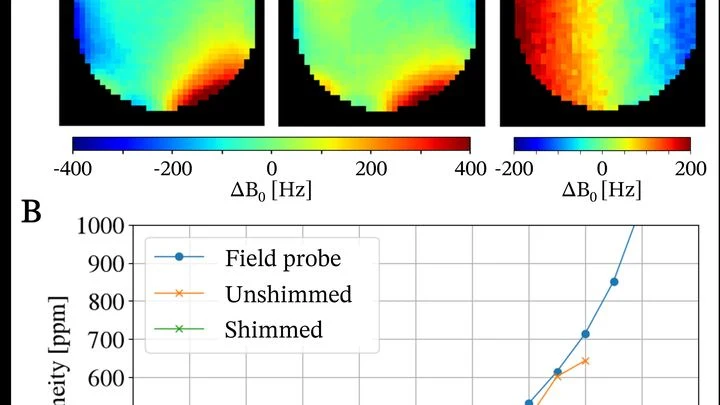
An MRI scanner is a big magnet that aligns hydrogen atoms in the body and then picks up their response signal. Such machines usually take up an entire room and cost as much as a nice house. Engineers from several labs decided to build a scanner that fits in a suitcase and released all the plans as open source.
Two photographers shoot the same mountain. One takes a hundred shots from the summit and only a couple from the base; the other does the opposite. If you try to align their images, the algorithm might decide that the summit in one photo matches the summit in the other simply because there are many similar points there, not because it's the same spot. Sampling density throws it off.
Quantum systems made of many particles are the basis of future computers and secure networks. But the more particles there are, the harder it is to understand how they are arranged: the number of possible states grows like an avalanche. The usual approach, measuring everything, takes an incredibly long time.
In a glass of murky liquid where starch is settling, the eye sees only a gray haze. Particles inside are moving, but what exactly is happening remains a mystery. Conventional optical instruments cannot penetrate such a suspension: light scatters already in the top layer.
A drop of ink in a glass of water spreads in intricate swirls. Similarly, a quantum particle exchanging energy with its environment changes its state in a complex and entangled manner. Describing this dance between particle and environment has long baffled scientists.
The quantum world is full of strange connections. Two particles can become “entangled”: the state of one instantly affects the other, even if they are kilometers apart. But how do you know if they are truly entangled? It's like a ball of yarn: at first glance, you can't tell whether it's a single tangled ball or just a mess of loose threads.
Quantum devices are no longer lab curiosities. They are assembled, tuned, and repaired like ordinary hardware — except inside them, it's not just current but intricate tangles of particles that can exist in multiple states at once. Engineers draw schematics, programmers write code, physicists calculate effects.
The cosmological constant is causing the universe to expand at an accelerating rate. In the far future, when all matter has dispersed, only empty de Sitter space will remain — an ideal cosmic backdrop.
Two coins are tossed simultaneously, and they always land the same way — heads with heads, tails with tails. Their behavior is strictly correlated. In the microworld, a similar connection between particles is called spin correlation.
Inside a neutron star, matter is squeezed so hard that atomic nuclei stop being separate clumps. Neutrons and protons get closer together, and their innards, quarks, begin to feel their neighbors through the walls of their 'bags'.
A neutron star is a sphere about the size of a small city but with a mass of one and a half Suns.
Neutrinos are nearly elusive particles that permeate everything around us. In a dense cloud, such as during a star explosion, they begin to collectively change their type, or 'flavor.' This process is like a crowd of people synchronously changing the color of their clothes, but not all at once — rather in waves.
An X-ray tomograph is like a carpenter who examines a log from all sides to see where the void is inside. It takes dozens of flat shadow images, rotating the source and detector around the object. Then a 'reconstruction' program glues these shadows into a 3D model. The quickest reconstructor is the FBP algorithm (filtered back projection).
Viscoelastic materials — polymers that, like dough, retain a memory of every touch: their response to impact depends on their deformation history. Maxwell and Boltzmann provided the mathematical description long ago.
An X-ray image is like a photo taken in the dark: the less light, the harder it is to see details. Doctors wanted to know how much you can dim the "light" in computed tomography (CT) and still not miss a disease. To do this, they took 50 pairs of chest images: one with a full radiation dose, the other with a low dose.
Brain tissue on a scan looks like a stormy sky: bright patches, dark hollows, blurred edges. The tumor hides among these patterns, and the doctor needs to outline its contour to plan surgery or radiation. One MRI mode highlights edema, another the tumor core, a third dead areas.
A doctor looks at a breast image to find a suspicious lump. If the picture is beautiful and smooth, but the lump has vanished from it, such an image is of little use. This is exactly the problem faced by researchers who developed a new way to test software for photoacoustic tomography.
Quantum computers use GKP states, dreamed up by Alexei Kitaev, John Preskill, and Daniel Gottesman. Their hallmark is built-in stabilizer checks that catch errors. For a long time, it was believed that a successful check guaranteed a nearly perfect state. Alas, it's an illusion.
Usually, we think of the number of dimensions as fixed: length, width, height. But in the quantum world, even that can be changeable. A new theory describes systems where dimension isn't a constant but a quantum property, capable of being different simultaneously.
A balloon is flat when cold, round when warm.
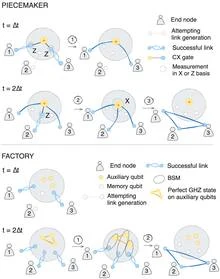
Assembling a puzzle as pieces arrive, rather than waiting for the complete set, is the philosophy behind a new protocol for distributing quantum entanglement. In quantum networks, where nodes exchange Bell pairs, the traditional approach resembles a patient assembler who waits until all pieces are on the table before starting.
A meteorologist stares at a pressure map, trying to figure out where the cyclone will go. They have a model, but it is flawed, and fresh measurements, but they are incomplete. Merging the two so that the forecast remains physically meaningful is harder than it seems: classical methods sometimes produce negative temperatures or impossible probabilities.
Fog thickens over the line "def max(a: Int, b: Int): Int". What does it do? It returns the larger of two numbers, but how can you verify that? You could write a dozen tests with specific pairs: max(2,3)=3, max(5,5)=5, max(-1,0)=0. Still, a nagging doubt remains: what if it breaks for, say, a million and minus a million?