Quantum Lattice Boltzmann Method: Density-Matrix Encoding for Flows with Walls ✛
Context
Quantum computing promises exponential memory savings for hydrodynamic problems, but the nonlinearity of the Navier-Stokes equations and the complexity of boundary conditions have long hindered progress. The classical lattice Boltzmann method (LBM) replaces nonlinear advection with a linear particle propagation step, making it attractive for quantum implementation. However, existing quantum versions (QLBM) either were limited to periodic boundaries or required exponentially growing resources. The work by Su, Wang, and Yan fills this gap by proposing a scheme with arbitrary geometry boundaries and inlet/outlet conditions. It builds on the ensemble approach of Wang et al. but translates it into the language of density matrices, opening the way to practical simulations.
Methods
The authors use density-matrix encoding: the probabilities of all velocity configurations at all lattice nodes are written into the diagonal of a density matrix. This allows implementing stochastic matrices (e.g., streaming or collision steps) via Kraus operators, which can always be embedded into unitary evolution with auxiliary qubits. For walls, they introduce a 'component swap' step before streaming: if a particle is directed toward a wall, its component is swapped with the reflected component in the neighboring boundary point, and then the usual streaming automatically returns it. Inlet and outlet conditions are set by a controlled SWAP with an auxiliary register prepared in the desired velocity distribution. The scheme does not require modifying the streaming step and maintains an overall complexity of O($2^q$ $n^2$) gates per step.
Results
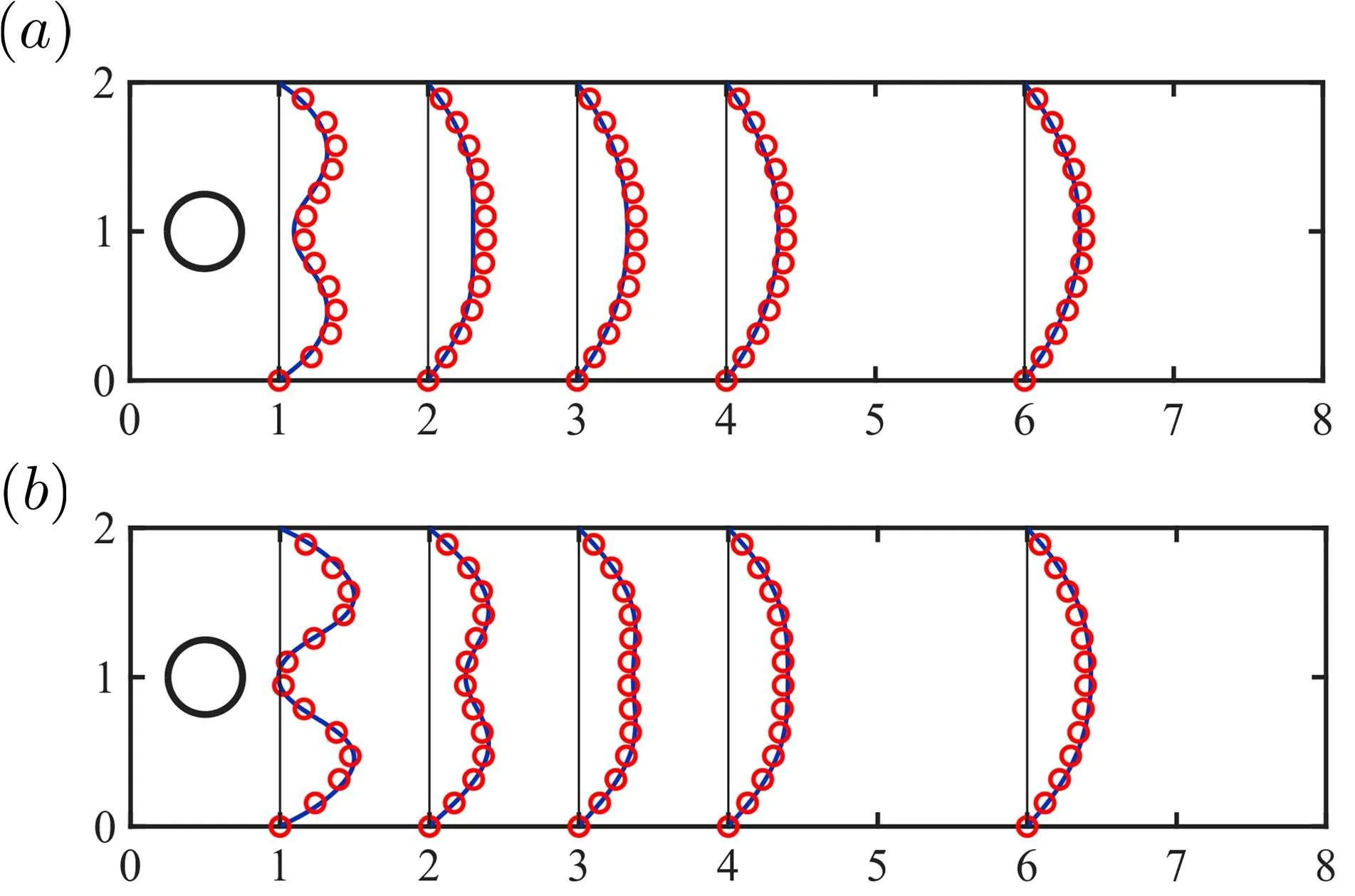
The method is quantitatively validated on three types of flows. For decaying Poiseuille flow in a channel with stationary walls, the relative L2 error decreases with increasing grid resolution (from 32 to 256 nodes) and grows linearly with time, confirming the correctness of the no-slip boundary condition. In the backward-facing step flow at Reynolds numbers 17.8, 35.5, and 71, the recirculation zone length differs from OpenFOAM results by 17.0%, 13.0%, and 10.3%, respectively. For flow around a cylinder at Re=6.6 and 43, relative errors are 17.34% and 12.53%. Finally, simulating flow around the letters 'PKU' on a 2048×512 grid at Re=64.8 demonstrates capture of vortices in the gaps between letters, confirming applicability to complex geometries.
Implications
This work shows for the first time that the quantum lattice Boltzmann method can correctly account for solid walls of arbitrary shape without modifying the streaming step. This distinguishes it from neighboring approaches that either ignore boundaries or require modifying the entire scheme. Using density matrices instead of pure states lifts the strict unitarity constraint and opens the way to a broader class of non-unitary operations in quantum hydrodynamics. Practically, this brings QLBM closer to real engineering problems where complex geometry boundaries are inevitable.
Future development
The main bottleneck remains the H-step, which restores independence of velocity components after collisions: it requires repeated application of the entire scheme and may negate the quantum speedup. The authors plan to search for simplified implementations of the H-step or alternative formulations without it. Also, the method needs to be extended to moving and deformable boundaries, which will require new ways of specifying boundary conditions in the density matrix.
Impact
The method could impact computational fluid dynamics, especially in problems of flow around complex-shaped bodies, microfluidics, and aerodynamics. It also stimulates the development of quantum algorithms for non-unitary operations in other areas where open quantum systems are involved.
Next steps
Immediate next steps include optimizing the H-step to reduce overhead and testing on real quantum hardware with noise. It is also important to investigate the accuracy of boundary conditions at higher Reynolds numbers and in three-dimensional problems.
Key open problems
In hydrodynamics, the question of accurate and efficient treatment of boundary conditions in quantum algorithms remains open, especially for turbulent flows with high Reynolds numbers. This work takes a step toward a solution but does not solve the problem of moving boundaries and does not eliminate the fundamental complexity of the H-step, which limits practical speedup.
The knowledge machine's view
This section is addressed to the author of the paper and their colleagues. Neighbouring works were found by meaning-based search across our archive, not by word overlap. We do not review: we show the field around the work.
What the work does
The authors propose a quantum lattice Boltzmann method with density encoding that, for the first time, accounts for solid walls of arbitrary geometry by means of a component-swap step before streaming. The method is validated on flows past a backward-facing step, around a cylinder, and past an obstacle of complex shape; the results agree with classical OpenFOAM simulations.
Where its strength is
Flexible encoding in the density matrix makes it possible to implement non-unitary operations via Kraus operators, and boundary conditions are introduced without altering the streaming step, which preserves the overall structure of the algorithm.
Where it could go next
- It might be interesting to compare the approach with the work on quantum simulation of turbulent flow: that work uses a different way of representing the fluid, and comparing resources or accuracy on shared test problems could reveal the strengths of each method.based on: Quantum Computer Simulates Turbulence for the First Time arXiv:2608.13041v1
- Nearby is a work on a quantum coherence microscope, which also uses density matrices and Kraus operators to describe open systems; perhaps their techniques for controlling dissipation or measurements could be applied to improve the stability of QLBM.based on: Quantum Coherence Microscope: Seeing the Phase of Atoms in a Lattice arXiv:2608.09924v1
- The archive contains an analysis of vortices on the quantum stage, which examines quantum algorithms for hydrodynamic equations with vortex structures; perhaps their methods for analyzing accuracy or handling vortices could be transferred to the presented scheme.based on: Vortices on the Quantum Stage arXiv:2506.04023v1
Worth trying
- Test the method on problems with moving boundaries, using the component-swap idea for dynamic walls.
- Check whether the error near walls can be reduced by combining the swap step with local mesh refinement close to boundaries.
- Explore the possibility of using Kraus operators to model turbulent fluctuations, as in a neighboring work on turbulent flow.
Why this may matter
Extending the quantum LBM to realistic boundary conditions brings it closer to practical use in computational fluid dynamics problems, where wall-bounded flows dominate, and opens a path to quantum acceleration of engineering simulations.
Nearby works in our archive
- How to Make Quantum and Molecular Worlds Get Alongsimilarity 0.56
- AI Assistant Masters Quantum Circuitssimilarity 0.54
- Quantum Droplets: Precision Unattainablesimilarity 0.52
- Vortices on the Quantum Stagesimilarity 0.52
- The Liquid Mirror of the Horizon: How a Partonic Ocean Gives Black Holes an Electric Soulsimilarity 0.52
- Quantum Computer Simulates Turbulence for the First Timesimilarity 0.52
- Quantum Coherence Microscope: Seeing the Phase of Atoms in a Latticesimilarity 0.51
The archive is sparse around this work: the closest review is only 0.56, against a usual 0.64. It looks like few have drilled nearby.
To simulate flow around the letters 'PKU' (the abbreviation for Peking University), a quantum circuit with 2048×512 nodes and 23 qubits was required, equivalent to a classical grid of over a million points.
The idea of quantum fluid simulation echoes Stanislaw Lem's story 'The Invincible', where nanorobots form a collective intelligence resembling a fluid. Here, a quantum computer mimics the behavior of many particles obeying simple local rules, reminiscent of emergent properties in science fiction.
Key numbers
- relative error for backward-facing step: 10.3% at Re=71
- relative error for cylinder: 12.53% at Re=43
- number of qubits for 128×128 grid: 23
- number of nodes for PKU letters: 2048×512
- Reynolds number for PKU letters: 64.8