An ion trapqubit is a unit of quantum information encoded in the internal energy states of a single charged atom (ion) held in place by electromagnetic fields. These fields create a potential well that confines the ion in space, allowing it to be manipulated with lasers or microwaves. The qubit's state — typically a superposition of two long-lived electronic levels — can be read out with high fidelity, making ion traps one of the most mature platforms for quantum computing.
History
The concept of using trapped ions for quantum computation was proposed by Ignacio Cirac and Peter Zoller in 1995, building on earlier work in ion trapping and laser cooling. The first experimental demonstrations of ion-trap quantum gates followed shortly after, with David Wineland's group at NIST achieving key milestones.
How it works
Ions are trapped using a combination of static and oscillating electric fields (Paul traps) or static fields with magnetic gradients (Penning traps). The ion's motion is cooled to near its quantum ground state using laser Doppler cooling and resolved-sideband techniques. Quantum gates are performed by addressing individual ions with focused laser pulses, which drive transitions between the qubit states or couple the internal states to the ion's collective vibrational motion, enabling entangling operations between multiple ions.
In the dark chamber of the trap, thousands of charged particles dance under electric fields. At first they move freely, like a crowd in a square, but cool the cloud and the dance slows: ions begin to sense each other, their steps become constrained.
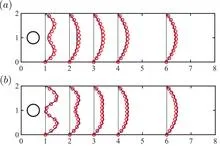
Water in a river, flowing around a stone, changes its course: some streams press against the surface, others detach and swirl downstream. A classical computer calculates such flows by dividing the fluid into millions of tiny parcels and tracking each one.
A ship in a bottle is assembled from the inside, not the outside: masts and sails are pulled through the narrow neck, and once inside the glass they settle into the right pose on their own. Chemists have done something similar with a single cobaltocene molecule, which they pulled into the gap between layers of a two-dimensional crystal.
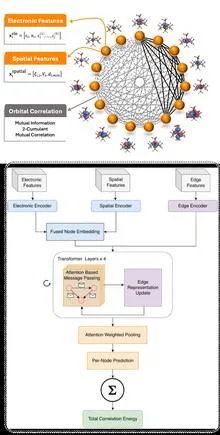
A cartographer who draws not mountains and rivers but invisible bonds between electrons: that's one way to describe the new neural network. Instead of atomic coordinates, it takes molecular orbitals and draws a graph where nodes are orbitals and edges are measures of their quantum entanglement.
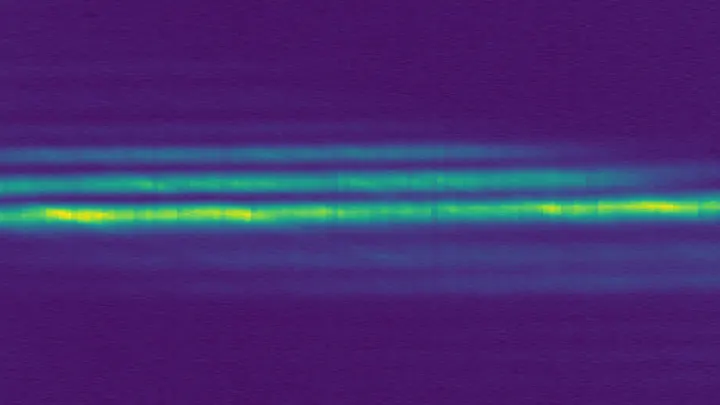
Light that never reaches the camera still leaves its mark on it. That's how the new imaging method works: you illuminate the object with one color, and the picture is assembled from another. Inside the crystal, light waves mix, and information about the invisible transfers to a visible beam.
In the experiment, they used a silver thiogallate crystal.
A translator who has memorized all the lines in advance responds instantly — no need to listen to the whole conversation again. That's how the new model works: instead of running atoms through a computer for hours, it immediately outputs the crystal's free energy at any temperature and pressure.
A short flash of light is like a musical phrase: you can distinguish individual notes if you listen very carefully. But in the quantum world, these 'notes'—temporal modes — are squeezed down to picoseconds, and ordinary optics can barely tell them apart.
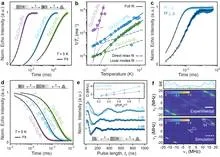
A lone erbium atom sits on a silver substrate, and its spin, the electron's internal rotation, stores quantum information. Previously, flipping this spin required a magnetic pulse: a blunt tool that disturbs neighbors and works slowly. Now physicists from Germany and Korea have shown that a single electric voltage suffices.
In a tight row of atoms, spaced closer than the wavelength of light, a remarkable state hides. The excitation is distributed among all particles so that their radiation cancels itself out. This quantum 'silence' is an ideal vault for a photon: it can be stored there hundreds of times longer than usual.
A quantum computer is usually like an assembly line: operations proceed one after another, and each error accumulates. In the new work, physicists tried a different path — an architecture where the computation grows out of the measurement process itself. They took 56 ions in a trap and wove them into a three-dimensional cloud of entangled particles.
The quantum networks of the future resemble the Tower of Babel: each node speaks its own dialect. Some store information in the polarization of a photon — the direction of oscillation of the light wave. Others use time bins: that is, when exactly the pulse arrives.
A quantum annealer is like a smart oven: it searches for the lowest point in an energy landscape to find the answer. But many constrained problems, like "pick exactly three items"—can't be loaded directly into such an oven. They have to be translated into unconstrained quadratic formulas, usually by adding penalties.
An optical trap holds an atom almost motionless, like a ball on a soft spring. But as soon as acceleration appears, say gravity, the equilibrium shifts. The atom moves within the standing light wave, and this changes the rate at which it exchanges energy with the field. The frequency of this exchange becomes a direct indicator of acceleration.
A magnetic field holds a tiny particle in mid-air, like an invisible dance partner. A special tuning of the field creates a trap with two "positions." In the ordinary world, a dancer occupies only one, but in the quantum world — both at once. Physicists have learned to achieve this for dust grains weighing trillionths of a gram.
The old question of Maxwell’s demon, can an intelligent being circumvent the second law of thermodynamics and pump heat from cold to hot, gains new resonance in the quantum world.
A laser isn't just about light. If you make a particle oscillate like a pendulum and those oscillations sustain themselves, you get a phonon laser. Sounds complicated, but the idea is simple: instead of light waves, the device emits orderly waves of mechanical vibrations — phonons.
A quantum simulator based on ion traps is like an orchestra where each ion is a musician and the phonon bus (the collective vibrations) is the conductor relaying signals. As long as everyone plays the same tune, everything goes smoothly.
In the quantum world, particles can merge into a single liquid that flows without friction. One of its most mysterious forms is the fractional quantum Hall liquid. In it, electrons or atoms move as a single vortex, and their charge splits into fractions, like a pie cut into perfectly equal slices.
A lithium battery is like a tiny city: lithium ions are the residents who move between electrode neighborhoods, generating current. But to understand how much energy the city can deliver, you need to know not only the street layout (the material's structure) but also how residents interact with neighbors, transportation, and even the weather.
A chef doesn't waste ingredients cooking the whole dish to check the taste: they just taste a drop of sauce. The same logic underlies the "information matching" method for predicting metal strength. Instead of expensive calculations of every atom's behavior, scientists "taste" only simple indicators linked to plasticity — a metal's ability to bend without breaking.
An invisible trap made of laser light held 11,000 atoms — a record for quantum engineering. Previously, physicists wrestled with a few dozen of these particles; now the count runs into the thousands. Each atom becomes a qubit — a quantum bit that is both zero and one at once, like a spinning coin balanced on its edge.
Hundreds of spinning tops sit on a carousel. Each one spins on its own, but the whole carousel also rotates. The challenge is to reach out and tilt the axis of any top as it whizzes by.
Three guitar strings on the same instrument, but each tuning peg turns with a different resistance: one gives way immediately, another is stiff, and the third is completely stuck.
A quantum computer measures a molecule's energy much like an old tape measure that only has markings every meter. If the actual length of a table is 2.37 meters, the tape shows “two and a bit,” and you can't do better. Physicists call this resolution: the step of the grid, finer than which you cannot go.
The authors of the new work turn this flaw into an advantage.
The atomic nucleus is a natural spring of colossal power. When the protons and neutrons inside it rearrange, it enters a special long-lived state — a nuclear isomer. It stores energy like a spring compressed to its limit.
Energy transfer in photosynthesis is like a children's slide: it bends under the weight of one, reshaping the path for the next. That's what happens in a leaf: an excited molecule instantly reshapes the 'landscape' of its neighbors.
Physicists reproduce this effect using ions suspended in a vacuum trap.
A long string of beads settles into a tiny box — some beads press together, others spread apart. That's the puzzle a protein solves when it folds into a working molecule. Except the beads, amino acids, can number in the hundreds, and every contact between them reshapes the whole structure.
Tiny semiconductor islands grown right on silicon fire off single photons, like a machine gun that shoots exactly one bullet at a time. These islands are called quantum dots. They can emit light in discrete packets, which is needed for secure information in quantum networks.
Light can act as a courier carrying secret messages. But to ensure the courier doesn't lose a single letter, you need to meet and check it very quickly. The new chip made from a thin film of lithium niobate is like a turnstile that opens and closes in billionths of a second, letting light pulses through at just the right moment.
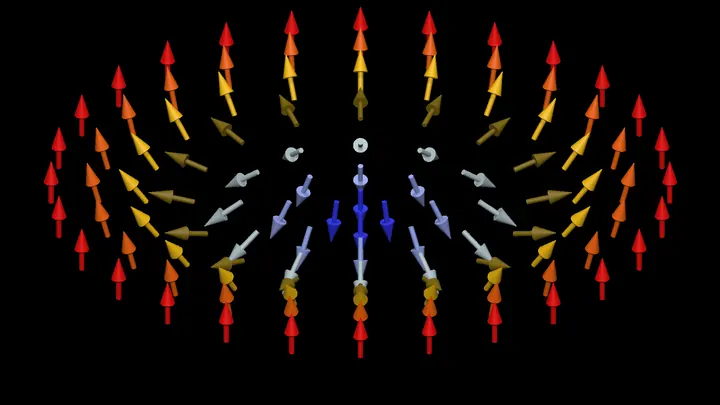
In a field trap, scientists assembled a crystal — 150 ions at ultra-low temperature. Each ion behaves like a tiny magnet, capable of rotating in any direction. By controlling forces that depend on this rotation, physicists made all the magnets swirl into a common vortex called a skyrmion.
A quantum computer is like an orchestra where every musician must come in at exactly the right moment. Previously, to play a complex piece, you had to constantly move the instruments around — slow and noisy. The new scheme, called "parity architecture," keeps everyone in place, and the conductor simply changes the notes.
Two quantum dots are like two tiny pockets in a piece of silicon where an electron can sit, like a ball in a cup. When the pockets are far apart, each electron lives on its own, and its energy resembles the levels of a solitary atom.
A quantum computer is a finicky instrument. Each measurement of its state is like photographing a fast-moving object: the shorter the exposure, the higher the chance of getting a blurry shot. But if you skillfully process a series of such snapshots, you can reconstruct a clear picture.
That's exactly what the researchers did.
Snapping an atom is like photographing a startled butterfly without scaring it off. Scientists use two alternating beams: one holds, the other cools like a gentle breeze. This reduces entropy (the atom's jitter) and chills them to millionths of a degree above absolute zero — colder than deep space.
A quantum dot is like a tiny island where one or a few electrons can settle. In this new work, such an island was connected to two 'seas' of electrons: one flat like a pancake, the other bulky like an ocean. Electrons can hop from the island to the seas and back, and this hop depends on the shape of the electron's wave on the island.
In ping-pong, two paddles connected by an invisible thread feel each other's movements, guessing the ball's trajectory. Researchers gave a computer a similar thread — quantum entanglement. Into an ordinary trial-and-error learning program, they embedded a quantum circuit of eight qubits — particles that can spin like a coin on its edge.
An ion quantum computer is like a chandelier with a dozen pendants: pull one, and they all start swinging. Each ion is a qubit, but when there are many, their collective vibrations crowd the stage. Any operation on one pair disturbs the neighbors, and the computation goes awry.
There is always noise in the microworld. Even in absolute emptiness, something trembles, and these quantum fluctuations interfere with precise measurements. But noise can be "squeezed," like a balloon: if you squeeze it from the sides, one part gets thinner while the other bulges.
A good chef tastes the soup and adds a pinch of salt. Ordinary scales won't notice that pinch, but sensitive ones will. In the quantum world, pairs of entangled particles play the role of such scales. It was previously thought that the entanglement had to be as strong as possible, otherwise precision wouldn't improve.