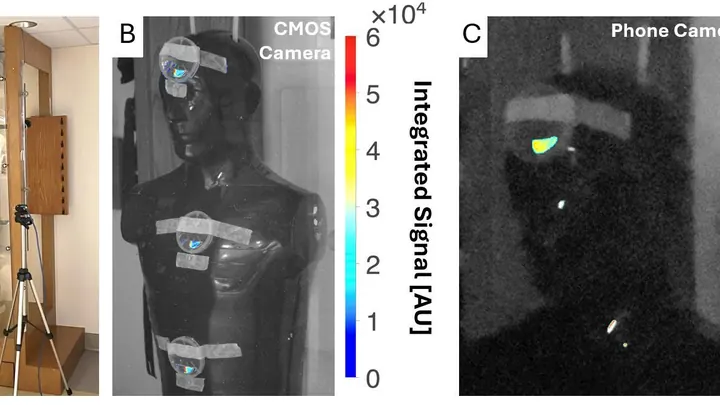
A scintillator is a material that absorbs energy from ionizing radiation or particles and re-emits it as a flash of visible or ultraviolet light. This light pulse is proportional to the energy deposited, allowing detectors to measure both the presence and the energy of incoming particles. Scintillators are the workhorse of particle physics, medical imaging, and radiation safety, converting invisible radiation into a signal that photodetectors can read.
History
The first practical scintillator was the zinc sulfide screen used by Ernest Rutherford in 1911 to detect alpha particles. Modern inorganic scintillators like NaI(Tl) were developed in the 1940s by Robert Hofstadter, who also pioneered their use in gamma-ray spectroscopy.
How it works
When a charged particle passes through a scintillator, it excites electrons in the material, lifting them to higher energy states. As these electrons relax back to their ground state, they emit photons. In organic scintillators, the mechanism involves molecular excitation and fluorescence; in inorganic crystals like sodium iodide, it involves the creation of electron-hole pairs that recombine at activator sites (e.g., thallium impurities), producing light. The emitted photons are then collected by a photomultiplier tube or photodiode and converted into an electrical signal.
In practice
Scintillators are used in medical PET scanners, particle detectors at CERN, radiation dosimeters, and even in well-logging for oil exploration. Recent developments include flexible scintillating fibers woven into clothing for real-time radiation monitoring.
Fun fact
The light output of a scintillator can be so fast that it can resolve events separated by less than a nanosecond, enabling the tracking of particles traveling at nearly the speed of light.
No one has ever seen dark matter, but it should pass through detectors like wind through leaves. Sometimes, very rarely, a dark matter particle bumps into an atomic nucleus, and then the detector must catch that jolt. The trouble is that light dark matter particles can hardly move heavy nuclei: it's like trying to knock down a bowling pin by throwing a feather at it.
A passing particle leaves a flash of light in a long transparent bar — a scintillator. Inside the bar, like threads in a rope, thin fibers are stretched to collect this light and channel it to a sensor. Particle detectors have worked this way for decades.
A crystal the size of a matchbox was placed under the beam of a clinical accelerator. Half of its surface was covered with a pattern of nanoscale bumps — tiny, smaller than the wavelength of light. The other half was left smooth. The difference was striking: the coated part produced a signal 4.1 times brighter.
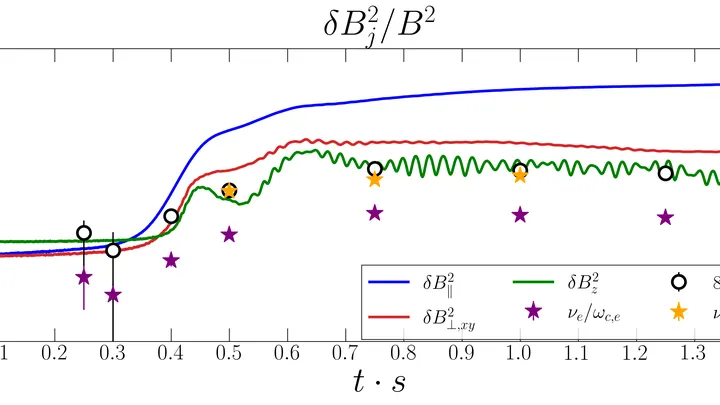
A crowd is trapped in a narrow corridor between two rows of mirrors. Every now and then, someone shoves the wall hard, and a rumble rolls down the corridor — similarly, in the plasma of galaxy clusters, whistler waves and ion-cyclotron waves appear.
A flashlight beam aimed through frosted glass turns into a blurry spot with every extra millimeter of thickness. Scintillators, materials that convert X-rays into visible light, behave much the same way. They underpin medical imaging, baggage screening, and detectors at particle accelerators.
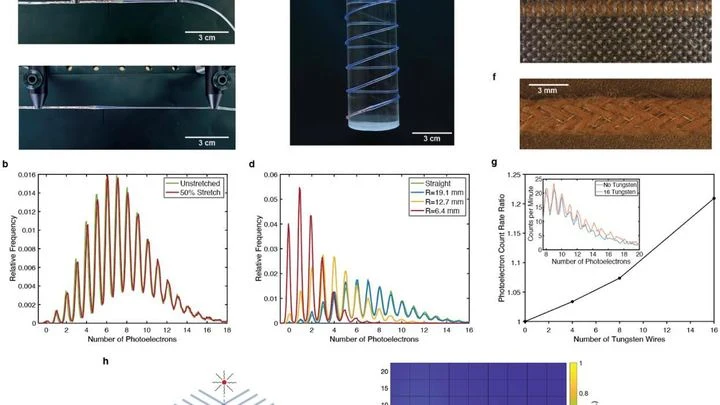
Inside an ultra-thin polymer thread are microscopic crystals — scintillators. When an invisible radioactive particle hits, they flash for a moment, like fireflies. A sensitive sensor catches each flash, turning the thread into a flexible detector.
Underground, in a former gold mine, sits a tank of liquid xenon. If a dark matter particle flies through it, the xenon flashes. But it also flashes from ordinary particles, like neutrinos or leftover radioactivity. The task is to tell which flash comes from dark matter and which from noise.
The future neutrino detector will contain millions of tiny plastic cubes: each the size of a die. They flash when a ghostly particle passes through, and that flash must be captured and measured. But if a cube is warped, has a burr, or a hole in the wrong place, the signal gets distorted, and the detector starts lying.
Checking each cube by hand is like sifting through sand on a beach.
Neutrons leave no trace in ordinary glass: they pass right through, like light through a window pane. But some materials flash a faint burst of light when a particle hits them. That's how a scintillator works: a substance that turns invisible radiation into visible light.
The new transparent glass SG101 is one such material.
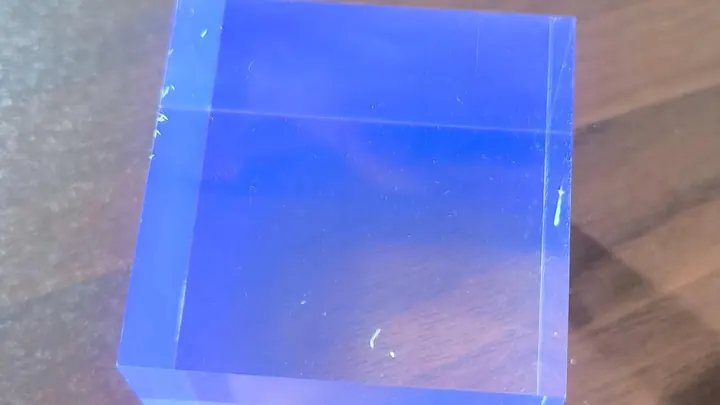
A dense piece of plastic the size of a coin flashes when an invisible particle hits it. That's how scintillators work — materials that turn radiation into faint light. They're usually made from fragile crystals or expensive polymers. But now there's a simpler option: plain polyurethane, the stuff used to mold furniture foam and shoe soles.