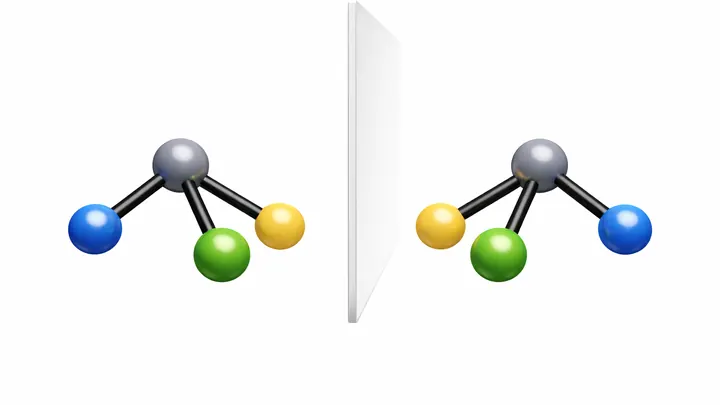
Parity violation is the breaking of mirror symmetry in physics: a process that, when reflected in a mirror, does not occur with the same probability. For most forces — gravity, electromagnetism, and the strong nuclear force — the mirror image of any allowed process is also allowed. But the weak nuclear force distinguishes left from right, preferring one handedness over the other. This was a shocking discovery in 1956, overturning the long-held assumption that nature does not care about left versus right. It also explains why certain particles, like neutrinos, are only ever observed in one chiral state.
History
The idea was proposed by Tsung-Dao Lee and Chen-Ning Yang in 1956, who realized that parity conservation had never been tested in weak interactions. Chien-Shiung Wu's experiment on cobalt-60 beta decay in 1957 confirmed the violation, earning Lee and Yang the Nobel Prize the same year.
How it works
The weak force couples differently to left-handed and right-handed particles. In the Standard Model, the W bosons interact only with left-handed particles and right-handed antiparticles. This asymmetry is built into the theory's structure: the weak interaction is described by a 'V-A' (vector minus axial-vector) coupling, which explicitly breaks parity. In practice, this means that when a radioactive nucleus undergoes beta decay, the emitted electrons are preferentially spin-polarized opposite to their momentum — a mirror image of this process would show the opposite preference, which is not observed.
In practice
Parity violation is exploited in the search for new physics beyond the Standard Model, in tests of fundamental symmetries, and in understanding the origin of the matter-antimatterasymmetry in the universe. It also plays a role in the observed homochirality of biological molecules — all amino acids in life are left-handed.
Fun fact
The discovery of parity violation was so unexpected that Wolfgang Pauli reportedly said, 'I do not believe that the Lord is a weak left-hander' — and then had to eat his words when Wu's experiment confirmed it.
An ordinary mirror swaps left and right. Many laws of physics don't notice the swap: they are mirror-symmetric. But some phenomena, like the weak interaction, break this symmetry. Until now, it was thought that gravity and light each break mirror symmetry in their own independent way.
The atomic nucleus isn't always round like a billiard ball. Some nuclei stretch out like a rugby ball, while others become pear-shaped — with one end thicker than the other.
In some quantum theories, symmetries intertwine in an unusual way, as if a lock had two keys, but turning one slightly shifted the other. Such intertwined symmetries are called 2-groups. One is an ordinary symmetry acting on point particles (0-form), and the other is a 'linear' symmetry (1-form) governing extended objects like strings or lines.
An old house. The facade is freshly painted, the stairs don't creak. A pretty picture. But try to move in heavy furniture, and the floorboards give way. The beauty of the facade says nothing about the strength of the floors.
It's much the same with black holes without singularities.
Inside the atomic nucleus, protons and neutrons are packed so tightly that the forces between them resemble tightly coiled springs. Some springs compress and expand equally in all directions: these are the familiar central forces.
The early Universe was not just a hot soup of particles. In the first fractions of a second, mirror symmetry could have been broken: the world and its reflection would not be quite identical. If so, the large-scale cosmic web of galaxies would retain a barely noticeable 'curl'—as if all matter were slightly twisted in one direction.
The Standard Model of particle physics is a catalog of all known building blocks of the universe: electrons, quarks, and others. But it is silent about dark matter and doesn't get along with gravity.
An electron flying through a heavy nucleus behaves like a tennis ball sent through a picket fence. If the pickets are unevenly spaced (denser here, sparser there) the ball will deflect differently.
Many molecules, like gloves, come in left- and right-handed versions. Their energy difference, caused by the weak interaction, is minute, like a whisper in a noisy room. Physicists have figured out how to turn that whisper into a chorus. A mixture of precursor molecules in an ultracold gas yields mirror-image pairs.
The shape of a riverbed precisely follows the equation describing the growth of a universe with negative curvature. In the lab, water flowing over sand spontaneously carves a cross-section that matches the solution for the Anti-de Sitter model.
A river tends toward a shape that maximizes bottom friction.
A huge orchestra is tuning up before a concert. Each instrument makes its own noise, and in the general hubbub it's hard to pick out individual sounds. But if the conductor gives a special flick of the baton for a second, all the violins will simultaneously hit one high note, and that pure tone will cut through the cacophony.
Drop a stone into a pond — the ripples spread evenly and then fade. Gravitational waves born from black hole mergers behave differently: even after the main wave passes, a faint 'tail' remains. It's as if, after the ripples on the water, a tremor persists for a long time, caused not by the stone itself but by how the water 'remembers' the impact.
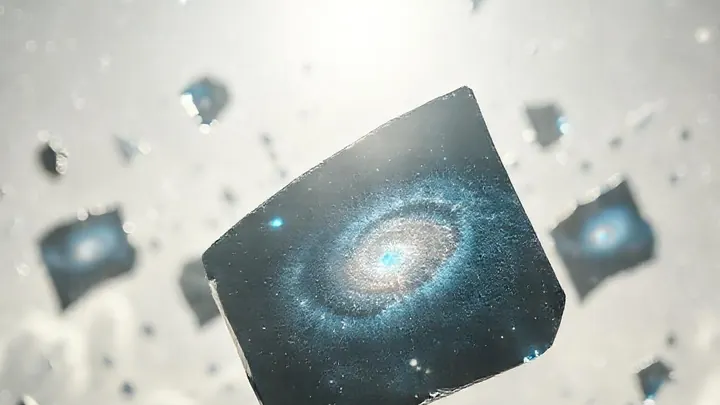
Imagine reality as an undeveloped photograph: until the moment of measurement, it exists only as a cloud of probabilities — a superposition of all possible states. Only the act of observation, like developing film, forces a particle to acquire definite properties.
In the quantum world, there are rules that seem to be broken. One of them is the conservation law: if in classical physics symmetry guarantees the conservation of charge, then in the quantum description this guarantee can disappear. This phenomenon is called a quantum anomaly.
The universe wasn't born alone — alongside it came a mirror twin where everything is reversed: left and right are swapped and time flows from future to past. After the Big Bang, the world, according to Alan Guth's idea of superfast inflation, should have contained equal amounts of matter and antimatter.
Comparing two scents is easy even without knowing their ingredients, just tell if they're alike. This everyday principle became the foundation for a new class of Bell inequalities, reimagining tests of the spooky connection between particles. Previously, you had to measure precise properties, like spin direction, but the authors showed that simply comparing outcomes is enough.
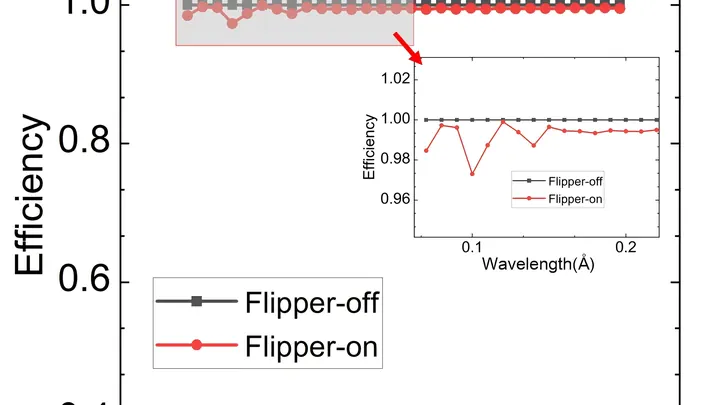
Deep inside the accelerator, neutrons are sped up and fly toward a target like a swarm of tiny tops. Each top has an axis of rotation: its spin. If all the tops are spun in the same direction, the beam is called polarized.
On a lab table sits an instrument that looks like a balance, but instead of pans it has two weights made of different metals — beryllium and aluminum. The balance is suspended from a thin fiber that twists if the weights are pulled differently. The whole apparatus turns to follow the Sun, like a sunflower tracking the light, but instead of light it catches the Sun's gravity.
In every cell lives a tireless scribe — an enzyme that copies the long thread of DNA. It moves along it like a read head over a tape, building a new strand alongside. It picks letters by strict rule: opposite A it always places T, opposite G it places C. But sometimes, very rarely, its hand trembles, and a different letter slips in.
At Hungary's Institute for Nuclear Research, ATOMKI, physicists noticed something odd: in the decays of excited atomic nuclei, pairs of electrons and positrons sometimes fly apart at an unusual angle. It's as if an invisible mediator particle briefly appears and disappears between them.
Water in a glass settles down once you stop stirring it. Oil in an engine dampens vibrations. It seems viscosity is always about damping. But in some flows, it's the opposite: add friction, and waves start to grow as if from nowhere.
Physicists have found a simple explanation.
Two beams of light, red and blue, enter a tiny ring made of silicon nitride. The ring is smaller than the thickness of a human hair. At the input, both beams are equally bright. But inside the ring, one of them suddenly starts to outshine the other, like two equally matched people in a debate where one unexpectedly gains the upper hand.
A snowflake falling from a cloud chooses between a left-handed and a right-handed form. The difference between them is almost imperceptible, like a breath of wind, yet it is that very breath that decides which pattern will grow.
The ACT telescope in Chile's Atacama Desert stared at the sky from 2007 to 2022. Its target: the cosmic microwave background, light that has been traveling toward us for 13.8 billion years. This light is polarized: its waves oscillate in specific planes, like strings stretched in different directions.