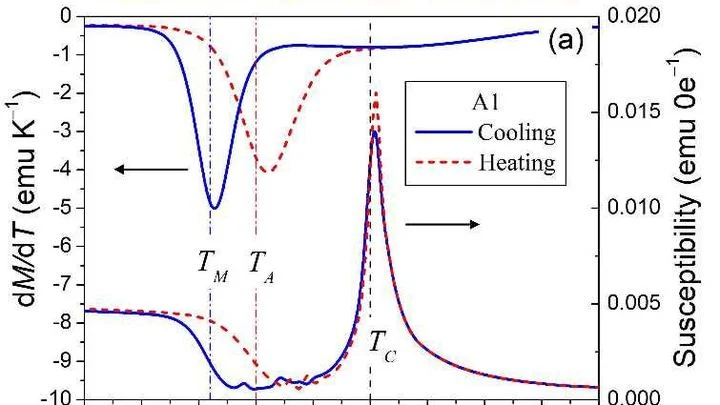
The Curie temperature is the critical point at which a ferromagnetic material transitions from having a spontaneous permanent magnetization to becoming paramagnetic. Below this temperature, the atomic magnetic moments align in a coordinated way, producing a net magnetic field. Above it, thermal fluctuations overwhelm the exchange interaction that keeps the moments aligned, and the material loses its ability to retain magnetization in the absence of an external field. This transition is a classic example of a second-order phase transition.
History
Named after Pierre Curie, who in 1895 demonstrated that the magnetic susceptibility of a ferromagnet above its transition temperature follows the Curie-Weiss law, building on earlier work by James Clerk Maxwell and others. The concept was later refined by Pierre Weiss with his molecular field theory.
How it works
In a ferromagnet, neighboring atomic spins align due to the quantum mechanical exchange interaction. As temperature rises, thermal energy increases random spin fluctuations. At the Curie temperature, the free energy minimum shifts from the ordered (magnetized) state to the disordered (paramagnetic) state. The magnetic susceptibility diverges at this point, and the spontaneous magnetization falls to zero following a power law with a critical exponent. In practical terms, heating a magnet above its Curie temperature destroys its permanent magnetism, which can be restored by cooling it in an external magnetic field.
In practice
Crucial for magnetic data storage (ensuring bits remain stable at operating temperatures), magnetic cooling systems, and in geophysics to understand the magnetization of rocks and the Earth's magnetic field history.
Fun fact
The Curie temperature of iron is 770°C — which is why a horseshoe magnet dropped into a campfire loses its magnetism, but a samarium-cobalt magnet with a Curie temperature above 800°C would survive the same fire.
Units by system: SI: kelvin · CGS: kelvin · Planck: planck temperature · natural: kelvin
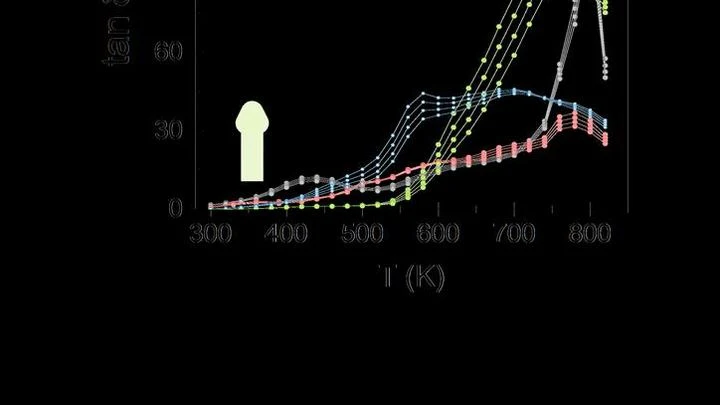
Picture an orchestra in which violins and trumpets play different parts but together create a powerful sound. In a crystal of the layered magnet Fe5GeTe2 doped with nickel, tiny regions of a different phase, Fe6GeTe2 nanoprecipitates, take on the role of those instruments. It is they, not the nickel itself, that keep the material magnetic at 478 kelvin, that is, at 205 degrees Celsius.
In a ballroom where couples were dancing, the music changed, and the pairs lined up in rows suddenly spun into whirlpools. That is how the magnetic crystal Fe3Ge rearranges its internal pattern once the temperature climbs above 375 kelvins, which is about a hundred degrees of heat.
Inside Earth, at depths from 660 to 2,900 kilometers, lies a layer known as the lower mantle. There, pressures reach 1.3 million atmospheres, and temperatures rival the surface of the Sun. Under these conditions, the mineral davemaoite exists as the third most abundant mineral in the lower mantle.
Tuning a radio receiver to a station that changes frequency as you cross a phase boundary: that is how you might picture the challenge facing the researchers. In the metal YbRh2Si2, electrons behave as "heavy" particles: their effective mass is hundreds of times that of a free electron.
A frozen orchestra where musicians swap seats when the conductor, magnetism, sets a new score. In a spinel crystal, iron and magnesium atoms sit in two types of seats: some surrounded by four neighbors, others by six. At room temperature, they barely stir, but cool the material to 5 K and a mass migration begins.
Imagine a soundproof room where you tune a tuning fork: the faintest rustle throws off the tuning. In the world of ultra-precise atomic measurements, that rustle is the magnetic field. It imperceptibly shifts transition frequencies, and to get a reliable standard, physicists had to carefully calibrate the field.
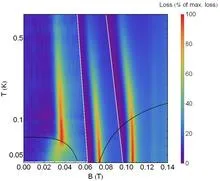
A thin film of zirconium nitride lies on a magnesium oxide substrate. Its thickness is two-tenths of a micron, like a spider's web, but inside it quantum life is boiling. When cooled to half a kelvin, superconductivity does not disappear all at once: it breaks up into rare islands that still hold on amid the disorder.
In the layered crystal CrSBr, the magnetic moments of atoms are arranged like notes in a score: within each layer they point in the same direction, but between layers they point in opposite directions. This antiferromagnetic melody plays up to 132 kelvin, beyond which thermal motion destroys the order.
Graphene, a sheet of carbon just one atom thick, can change its magnetic properties the way water changes shape: sometimes flowing, sometimes freezing into ice. In a new study, physicists peered inside this process for the first time using a sensor the size of a needle tip.
A sheet of paper with magnetic properties: that's roughly what the new material 1T-CrS₂ is like. Its layers are held together by weak forces, like the pages of a notebook, but each layer is a true magnet.
A waterfall that doesn't heat up from the fall but freezes — that's roughly how gas behaves as it flows onto a neutron star in an X-ray pulsar when the star shines dimly. Usually, infalling matter is heated to a white-hot glow, but new work shows the opposite.
Inside the destroyed Fukushima reactors lie hundreds of tons of melted fuel — a mixture of uranium, zirconium, iron, and fission products. This debris is called fuel debris. It must be extracted, transported, and securely packaged for decades. But how will this volatile mixture behave under heat, compression, or accidental impact?
Superconductivity and magnetic field are age-old foes: the field barges in like a whirlwind, tearing apart the delicate pairing of Cooper pairs, destroying order.
Two-dimensional worlds never cease to amaze: here even crystal melting is not a symmetry breaking but a vortex drama discovered by Kosterlitz and Thouless. At the heart of this theater are topological сингулярности, whose energy and энтропия bargain for order. This language is common to сверхтекучести и сверхпроводимости.
A long chain of atoms, each a tiny magnet. They talk to each other and to a common field, like musicians in an orchestra who hear both the conductor and their neighbors. When the external field changes, the orchestra either plays out of sync or all instruments come in together: that's a quantum phase transition.
Hot tea in a freezer doesn't freeze all at once. First, tiny ice needles dart around — forming and melting until the temperature drops enough for the ice to set solid. The early universe behaved similarly as it cooled and changed its internal structure.
A superconductor is like a perfect electron dance: electrons move in pairs without losing energy, like dancers who never miss a beat. But add a few magnetic impurities, and strangers crash into the dance, disrupting the synchronized motion. The temperature at which this dance begins drops.
A metal bar suddenly becomes stiff when heated, and at the same time loses or gains magnetic properties. In alloys based on nickel and manganese, such transformations occur not smoothly but abruptly — atoms rearrange into a new order, and the material changes its behavior.
A pot of water on the stove: the hotter the burner, the faster ice turns to water, and water to steam. Heat destroys order. But sometimes nature pulls a trick, and heating makes a liquid freeze, like a puddle turning to ice on a frosty morning.
Hundreds of people on a dance floor stand at equal distances from each other — strict order, like in a crystal lattice. Slow music is thermal vibrations, making dancers sway slightly. If the music gets louder and faster, order collapses: everyone mixes. That's how thermal motion destroys ordered states of electrons in solids.
In the crystal Rb1-xV2Te2O, the spins of vanadium atoms arrange in a checkerboard pattern: each spin is surrounded by opposite spins. This pattern is called G-type antiferromagnetism. Neutrons passing through the sample scatter off this pattern and reveal its geometry, like light from a flashlight shining through blinds casting stripes on a wall.
An iron crystal is like a mosaic of tightly packed grains. Where one grain meets another, a boundary forms — a narrow seam with disrupted order. It is in these seams that surprises for magnetism hide.
Scientists calculated how iron atoms interact with each other at three types of such boundaries.
Ruthenium oxide has long been regarded as a textbook altermagnet — a material where magnetic moments of neighboring atoms point in opposite directions but do not fully cancel due to the crystal's special symmetry. New measurements show that inside the crystal, there is no magnetism at all. All the magnetic action is confined to the surface.
In a thin magnetic film, like in an overcrowded hall, each 'person' is a spin arrow that wants to align with its neighbors. But in the corners of the hall, jams occur — vortices where the arrows twist and cannot straighten out. These vortices live in pairs: one spins left, the other right, and together they prevent the hall from fully settling down.
The strontium ferrite crystal is like a multi-story building where each floor hosts iron atoms. Some floors "look" up, others down, and their magnetic fields partially cancel each other out. But if some of the residents are replaced with aluminum, which doesn't play the magnetic game, the balance of forces shifts.
Water boils at 100 degrees Celsius, but if you squeeze it hard enough, it behaves differently. Similarly, quarks and gluons, the building blocks of protons and neutrons, change their properties in a strong magnetic field.
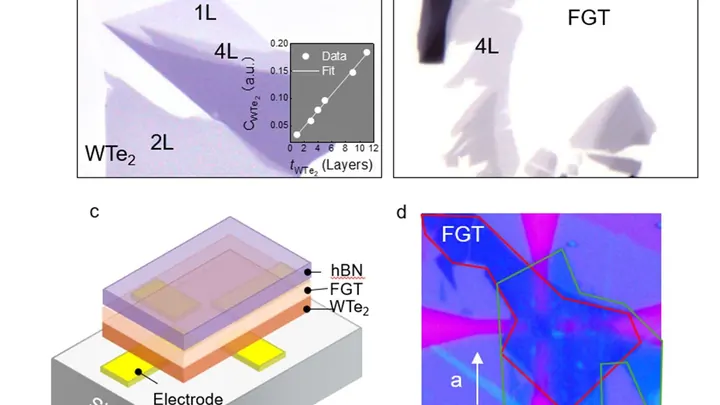
Usually, current in a metal acts like boiling water on ice: it heats the material and destroys magnetic order. But in a layered structure of tungsten ditelluride and the ferromagnet Fe3GeTe2, current behaves differently.
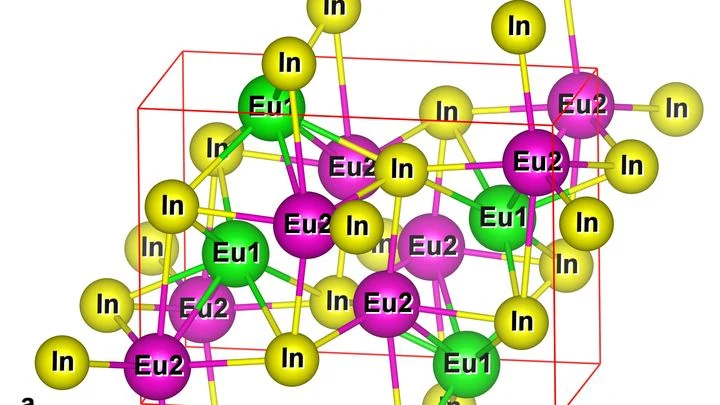
A piece of europium-indium alloy, when cooled in a magnetic field, behaves like water that does not freeze all at once but first in one corner of the glass, then in another.
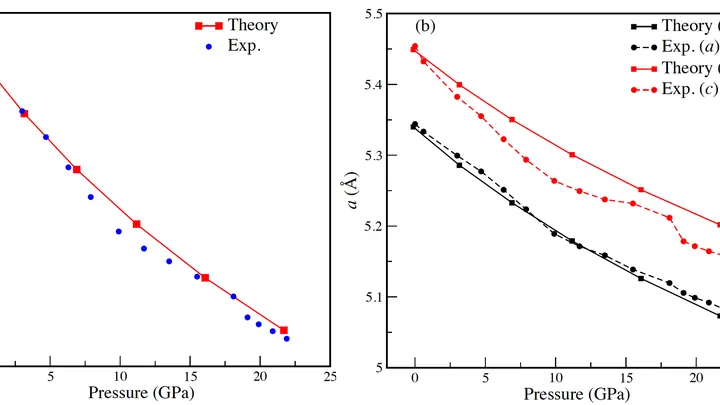
The Fe₃Sn₂ crystal looks like a patterned lattice where iron atoms sit at the corners of hexagons. Under normal conditions, their magnetic arrows are aligned neatly, like soldiers in a row. But squeeze the crystal, and the alignment breaks.
Under a pressure of about 20 gigapascals (imagine twenty elephants standing on your thumbnail), the lattice slightly rearranges.
The magnetic refrigerator of the future won't hum with a compressor. Instead, it will cool your groceries by exploiting a special material that heats up in a magnetic field and cools down when the field is removed. This cycle resembles the compression and expansion of gas in a conventional fridge, but here a magnet does the work of a piston.
A magnetar is a neutron star with a magnetic field hundreds of millions of times stronger than Earth's. If you brought an ordinary magnet near such a field, it would instantly lose its magnetism, and atoms would stretch into thin filaments.
Magnetic materials can sometimes behave like a group of people who just can't agree: some bonds between atoms pull one way, others the opposite. When such conflicts pile up, the system becomes 'frustrated'—it can't settle into a single state of rest.
The crystal changes its internal geometry like a building frame that slightly twists during an earthquake. In the manganese-gallium alloy (Mn₃Ga), at around 485 Kelvin (about 212°C), a magnetic transition occurs: the atoms align into an antiferromagnetic order, where neighboring magnetic…
A magnet, like a compass needle, likes to point in a certain direction. But what if the material is layered, like a stack of pancakes? Scientists took just such a magnet made from a compound of chromium, germanium, and tellurium and set out to find out how stubbornly it resists having its magnetization turned.
The crystal Pr₄Ni₃O₁₀ is like a three-layer sandwich: nickel oxide layers separated by praseodymium spacers. As it cools, three magnetic regimes switch on in sequence, as if, inside the sandwich, the nickel spins first align, then slightly rearrange, and finally the praseodymium spins join in.
Muons, heavy cousins of electrons, penetrate the crystal and sense internal magnetic fields.
A chunk of nuclear fuel inside a reactor is not just a solid. When heated, the uranium atoms in it start to 'wiggle' their magnetic moments, and this motion changes thermal conductivity and other properties.
In a solid, atoms vibrate, transmitting sound. Sometimes this wave doesn't run straight but curls into a spiral, like a corkscrew entering a cork. In ordinary crystals, such 'sound vortices' are known, but in magnetic materials they had long eluded detection.
Electrons in a CrSb crystal behave like a school of fish: inside the material, they dart along their "corridors," and at the boundary with vacuum, they arrange themselves into intricate patterns. These patterns are the Fermi surface — a map of all allowed electron velocities. You can't reach out and touch it, but you can "feel" it with a magnetic field.
A magnet that stacks up like a pile of pancakes: that's how the material CrSBr is structured. At low temperatures, each layer is magnetized, but neighboring layers point in opposite directions, and their magnetic fields cancel each other out. This order is called antiferromagnetic, and it's fragile: just a slight warming demagnetizes the layers.
A magnetic film divided into tiny arrow-shaped cells behaves like a crowd in a square. While it's cold, all arrows point in the same direction — perfect order. Heat the film, and the arrows start darting around like pedestrians who have lost their purpose. Somewhere between these extremes, there is a moment when the system stops being uniform but hasn't yet dissolved into random noise.