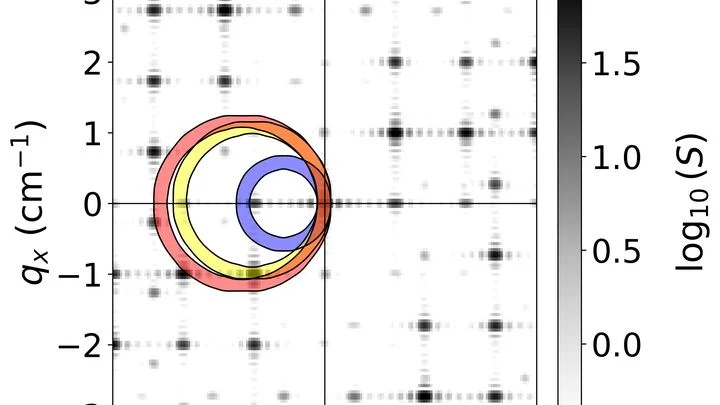
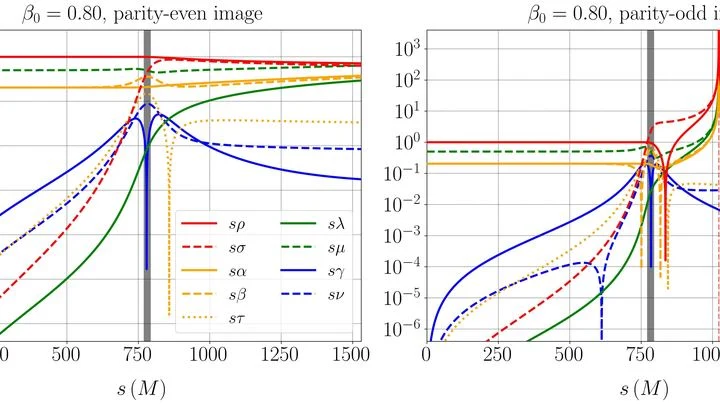
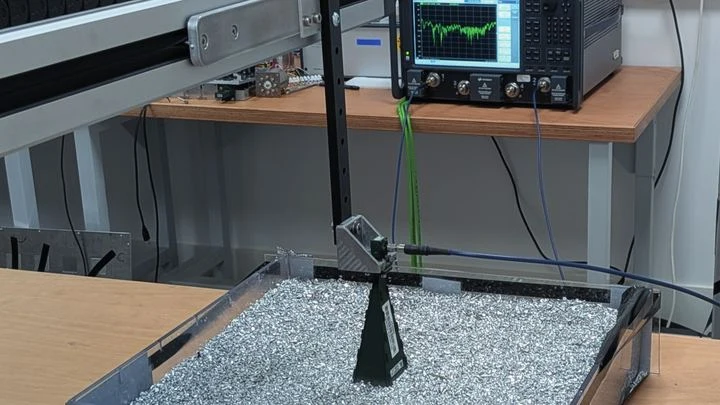
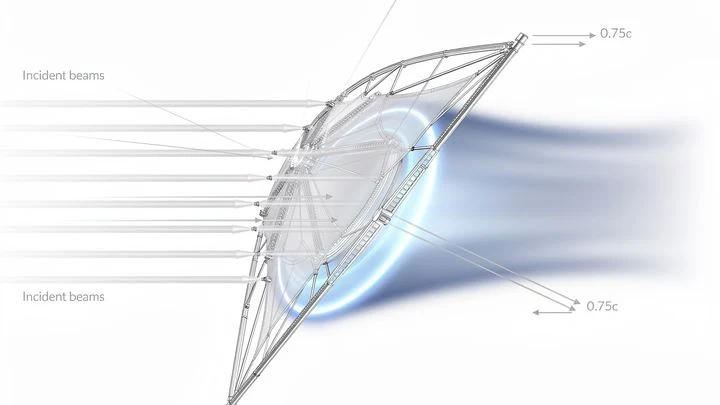
Diffraction is the deviation of waves (light, sound, water) from straight-line propagation when encountering an obstacle or opening. It becomes noticeable when the slit size is comparable to the wavelength. In the case of light, it produces an interference pattern — a set of bands of varying brightness.
History
The first systematic description of light diffraction was given by the Italian physicist Francesco Grimaldi in a posthumous work of 1665, introducing the term itself. The wave nature of light, capable of explaining diffraction, was championed by Christiaan Huygens (1690). In 1801, Thomas Young demonstrated interference from two slits, confirming the wave theory. Augustin-Jean Fresnel in 1818 presented a rigorous mathematical theory, solving the problem of diffraction at an edge. Later, in 1912, Max von Laue and colleagues discovered X-ray diffraction in crystals, which earned him the Nobel Prize. William Lawrence Bragg and his father William Henry Bragg developed a method for deciphering crystal structures from diffraction patterns. Joseph von Fraunhofer invented the diffraction grating and used it for spectroscopy.
How it works
Diffraction is a consequence of wave superposition. When part of the wavefront is blocked by an obstacle, secondary waves from the open areas interfere, creating a complex pattern. For periodic structures such as a diffraction grating or crystal lattice, the condition for reinforcement is described by Bragg's law: nλ = 2d sin θ, where n is the diffraction order, λ is the wavelength, d is the interplanar spacing, and θ is the grazing angle. This law underlies X-ray crystallography. For gratings with many grooves, the intensity is concentrated in narrow peaks, allowing diffraction to be used in spectrometers to measure wavelengths with high precision.
In practice
Thanks to diffraction, spectrometer gratings work, splitting light into colors for analyzing the chemical composition of stars.
Fun fact
If you look through a thin fabric at a street lamp, you can see rainbow streaks — that's also diffraction on the threads.
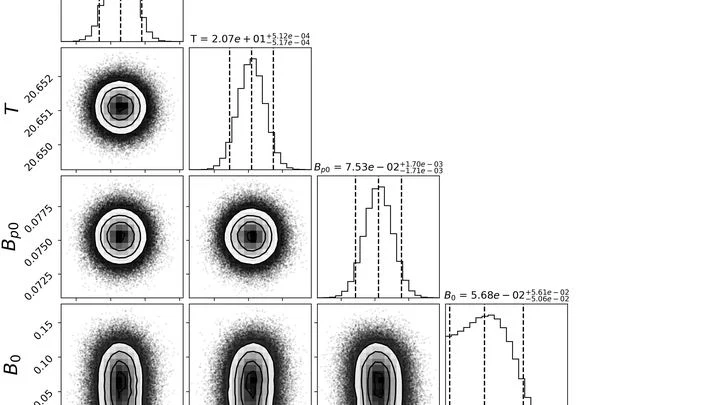
Imagine an interferometer as a giant ear listening to the radio whisper of a distant galaxy. Three antennas spread across continents capture the signal, and the difference in their phases combines into a quantity that is immune to atmospheric jitter. This quantity is called the closure phase.
Light born when a fast electron enters a material is usually assumed to be the same in all directions. But in crystals where optical properties depend on direction, that's not the case. Run your hand over velvet: one way it's smooth and shiny, the other — dark and rough. Similarly, a crystal responds differently to light depending on how it's oriented.
When light hits ordinary plastic, some of it reflects, like a glare on a window. To eliminate this glare, a special coating made of tiny structures is applied to the surface, which cancels out the reflection.
A light ray passing by a massive body slightly changes its direction, like a stream of water bending around a rock in a creek. In the solar system, there are many such "rocks": planets, their moons, asteroids. And each one, with its own gravity, bends the path of light coming from distant stars.
Waves on the water's surface usually break against any obstacle — a rock, a piling, an island. But what if you arrange obstacles so cleverly that the wave barely notices them? In a new study, scientists assembled a pattern of many points on the water, arranged according to special mathematical rules, and sent waves through them.
Light in a gravitational-wave detector races through multi-kilometer tunnels, bouncing off mirrors. A perfectly uniform beam resembles a smooth sheet held by its corners. But if one mirror tilts by the width of an atom, the sheet develops wrinkles: 'parasitic' patterns, more complex light spots, awaken in the beam.
Previously, such wrinkles were dismissed as noise.
Light bends in a lens — everyone knows that. Gravitational waves passing a massive body also curve their path. But the authors of this work looked further: what happens to the wave's very "color" — its polarization, that is, the direction of oscillation?
Gravitational lensing is the deflection of…
On November 23, 2023, LIGO detectors caught something strange. The gravitational wave signal from a black hole merger, designated GW231123, pointed to record masses—137 and 101 solar masses, and anomalously fast spin. That would be the most massive and fastest-spinning pair ever detected.
Eight bright spots on the radio sky. They are all the same quasar HS 0810+2554, whose light passed through a gravitational lens — a massive foreground galaxy.
A light ray passing by a massive body gets deflected: this is the effect of gravitational lensing, familiar from images of distant galaxies. The astrophysicists started with a rotating black hole (Kerr spacetime) and added a tiny correction to how light itself propagates.
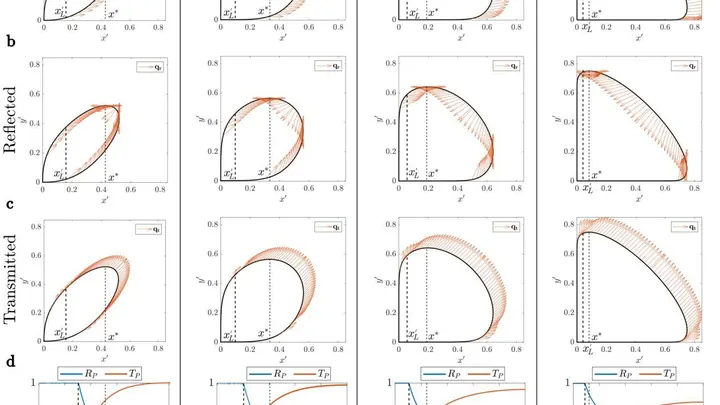
When a radio wave encounters a building in its path, it doesn't just reflect or get absorbed: it bends around it, much like ocean waves flowing around a rock, leaving calm water behind. In radiophysics, this phenomenon creates a radio shadow — a complex pattern of zones where the signal is amplified or attenuated, which scientists call a radio portrait.
A light wave is like a rope that has been shaken: it oscillates in a specific plane. This property, polarization, reveals the shape and composition of objects. But capturing it is not easy, especially when you need to cover a wide range of colors. Usually, this requires bulky systems of lenses and filters.
A thin film of a special crystal (for instance, molybdenum disulfide) sits on a microscope stage. The temperature is just above the point where the material becomes a superconductor.
In the brain's white matter, the signal travels along axons — long neuronal processes wrapped in an insulating myelin sheath. Water fills the space inside axons and outside, in the narrow gaps between fibers.
A beam of light enters frosted glass and fades — nothing unusual. But physicists have long known how to make light pass through without losing a single photon. This trick is called electromagnetically induced transparency: two light waves cancel each other at the right point, and absorption disappears. Now a similar feat has been pulled off with atoms.
A gravitational wave observatory is like a set of microphones scattered across the Earth. When a signal arrives from space (say, from a black hole merger or a supernova explosion) each microphone hears something slightly different.
Moments before totality, swift shadow bands glide across the ground, like ripples from pebbles tossed into water. For centuries, this phenomenon baffled scientists. It turns out the key is that light is a wave.
The Sun isn't a pinpoint lamp but a vast disk. When the Moon nearly covers it, a thin glowing crescent remains.
A pebble drops into a pond, and ripples spread across the water. But one wave suddenly doesn't spread out: it clings to an invisible fold on the surface and runs only along it.
If you clap your hands in an empty room, the echo will tell you about its size and shape. Every object (a chair, a book, a person) adds its own signature to this echo: sound reflects off it in a particular way. The authors of the paper have figured out how to completely rewrite this acoustic signature. They surrounded a region of space with a closed surface of microphones and loudspeakers.
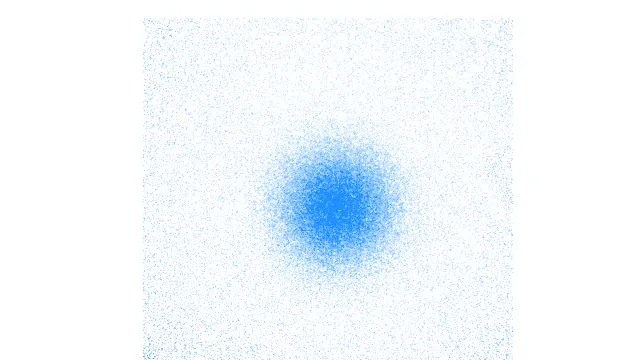
Physicists have achieved three-dimensional Anderson localization of electromagnetic waves — a phenomenon where waves become permanently entangled in a random labyrinth of metal particles and cease to propagate.
Imagine a three-faced dancer on the crest of a light wave. One face is a catcher, absorbing incoming photons. The second is a perfect mirror, throwing light back. The third is frosted glass, scattering rays in all directions. As long as speed is low, the dance is harmonious. But at near-light speeds, the choreography breaks.
This is like a surfer chasing a wave.
Gravitational waves are the trembling of spacetime itself. Usually we only catch their overall hum, but each wave also has a direction of oscillation – polarization. Old maps were built only from signal loudness, which led to errors. It's like trying to see the bottom of a pond through sun glare.
A charged particle streaks through a silicon sensor, leaving behind a trail of free electrons. The time it takes for this charge to be collected at the electrode depends on how deep in the crystal it was born. A particle entering head-on carves identical paths through neighboring pixels: their signals arrive almost simultaneously.
An ordinary photometry detector can't tell a left photon from a right one. But let it start moving, and everything changes.
Imagine a rower moving between two flutists playing the same note. His ear is perfectly tuned to that note and ignores all others. As he moves, the pitch from the flutist ahead sounds higher, and from the one behind sounds lower.
A stone drops into a pond, and ripples spread across the water. If a protruding branch blocks the ripples' path, part of the wave reflects, and part bends around the obstacle. Gravitational waves, ripples in spacetime itself, behave similarly when passing by galaxy clusters or black holes.
A spectrum is like a photograph of a material's inner workings, taken with light. When a beam passes through or reflects off a sample, molecules leave characteristic dark bands, peaks, on that photograph. But if the image is overexposed or veiled in gray, making out details becomes nearly impossible.
A pebble tossed into a pond sends ripples spreading in all directions. Now imagine the pond itself suddenly turning into jelly — instantly, faster than the wave can complete a single crest. Some ripples would keep spreading but change their spacing, while others would unexpectedly turn around and run back toward the point of impact, as if time were flowing backward for them.
A squad of soldiers marches across a parade ground. As long as everyone keeps in step, the movement remains sharp and coordinated. But if someone falls out of line, the order is lost. In the microworld, electrons play the role of such a squad: when their oscillations are synchronized, the substance emits a narrow, sharp line.
When light swings past a massive body like a black hole, its path warps — an effect predicted by Einstein. New research has taken into account that near such objects, clouds of hadrons often swirl — the very particles we know from protons and neutrons in atomic nuclei.
The solar wind, a stream of charged particles from the Sun, slams into the tenuous gas that fills the space between the stars. The collision produces a faint X-ray glow. For astronomers, this is like fog in front of headlights: it obscures distant objects.
Gravitational wave detectors are microphones listening to the trembling of space. But their own noise drowns out weak signals. To hear more, physicists add special "squeezed" light to the instrument: it reduces quantum noise, like noise cancellation in headphones.
A galaxy is like a glowing pancake studded with stars. If you look at it face-on, you see everything at once — both the bright spiral arms and the dark dust lanes. But tilt the pancake, and the picture changes: layers overlap, light blends together. This very effect, it turns out, creates the illusion of a tight link between radio and gamma-ray emission in distant star systems.
Drop a stone into a pond — the ripples spread evenly. Now imagine that at the center of the pond, instead of a simple point, there's a bottomless whirlpool where water vanishes into nothing. The ripples around such a whirlpool would not be ordinary rings; they'd curve like the string of a drawn bow.
A pebble drops into a pond, and neat circles spread across the water. But the pond's bottom is strewn with invisible glass shards: each one slightly delays the wave, scatters it here, or alters its pace. That's roughly how gravitational waves, the trembling of space itself, pass through distant galaxies and dark clumps of matter.
Ordinary light scatters in all directions, like water from a shattered glass. But in some crystals, light waves can bunch together into narrow beams and flow in a single direction, like water in a trough. Physicists studied such a material: layered vanadium oxide α-V2O5.
In this crystal, atoms vibrate differently along and across the layers.
Light can hold an atom in place, just like a jet of air holds a lightweight ball. But a dysprosium atom is no ordinary ball: inside it has many "gears" (electrons) that respond differently to light of different colors. To catch such an atom and keep it from slipping away, you need to know exactly how strongly the light pulls on it.
A river flows in one direction, but a wave on its surface travels in the opposite direction. The same splitting happens in hyperbolic materials: the energy of a light wave and its fronts diverge, preventing a sharp lens from being created.
Normally, electric current is the same in both directions, like water in a straight pipe. But at the boundary between a normal metal and a superconductor, this rule breaks down. Two waves on water, going around a wide obstacle from different sides, can arrive with different delays and meet ‘out of step’.
A garden hose blasts a powerful stream of water. If you pinch it or give it a jerk, the stream starts to writhe like a snake, and spray flies everywhere. Something similar happens with the giant plasma jets that black holes shoot out.
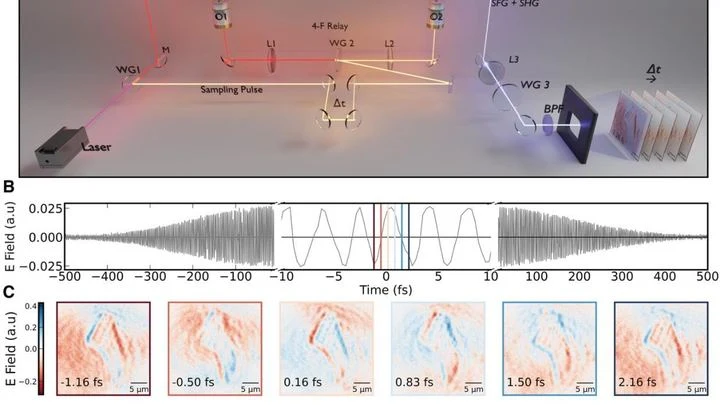
Light is not just a beam but a wave with an electric field that changes at a speed unimaginable to ordinary clocks. Until now, this field could only be measured at a single point, like taking temperature with a single thermometer. Now researchers have created a method that shows the entire field at once, like a thermal imager showing a heat map.