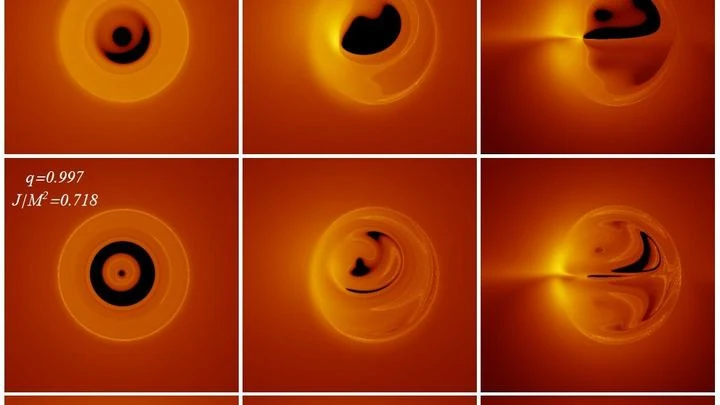
A hairy black hole is a black hole that carries additional fields—like scalar, vector, or tensor fields—beyond the standard mass, charge, and angular momentum. In general relativity, black holes are famously 'bald': they are completely described by just three parameters (the no-hair theorem). Hairy black holes violate this theorem, meaning they have extra observable properties, such as a scalar 'hair' that could affect gravitational waves or the spacetime geometry near the horizon.
History
The no-hair theorem was conjectured in the 1960s by Werner Israel and others. The first counterexamples were found in the 1990s, such as black holes with scalar hair in theories with a dilaton or axion. The term 'hairy black hole' was coined by John Archibald Wheeler.
How it works
The no-hair theorem relies on certain assumptions, like the absence of matter fields or specific energy conditions. If those assumptions are relaxed—for example, by adding a scalar field with a non-minimal coupling to gravity—then stable configurations with hair can exist. The hair manifests as a long-range field that decays slowly away from the black hole, altering the metric and the motion of nearby particles.
In practice
Hairy black holes are studied in theoretical physics to test general relativity and to search for new particles. They could leave signatures in gravitational wave signals detected by LIGO and Virgo, such as extra frequency components or modified damping.
Fun fact
Some hairy black hole solutions are 'stealth'—they have hair that does not affect the spacetime geometry at all, making them indistinguishable from bald black holes except through their effect on test particles.
A classical black hole is a bottomless well: everything that falls past the horizon disappears into a point of infinite density. But in loop quantum gravity (one approach to quantum gravity), that point is replaced by a quantum 'bounce'—a sphere of finite size where spacetime doesn't tear but rearranges itself.
Light from afar bends around a black hole like a cyclist taking a sharp turn. Get closer, and it starts looping around an invisible sphere of photons. Every black hole has such a sphere, but usually it's wobbly: the slightest nudge sends light flying away or falling in.
A black hole is not a perfect vacuum cleaner. It is surrounded by a swarm of particles and fields, and this swarm alters its fate. In a new study, astrophysicists examined how a massive vector field, a hypothetical form of dark matter, behaves near a rotating black hole.
A black hole with an electric charge is like a vacuum cleaner that not only sucks in everything around it but can also hold light particles in orbit. These particles form a kind of fuzzy cloud around the hole — physicists call it a quasi-bound state.
A black hole is like a spinning drop of viscous liquid. Normally, such a drop tends to stay whole: splitting would reduce its surface area, which contradicts the law of non-decrease of entropy (a measure of disorder, like a broken cup doesn't glue itself back together).
A black hole rings like a bell when something massive falls into it. This ring is gravitational waves, and its overtones tell us about the shape of the horizon.
A black hole isn’t a perfectly smooth ball. Einstein’s theory allows invisible 'hair' — clumps of scalar field — to swarm around it, warping spacetime. The shadow — the dark region from which light can’t escape — was predicted by Penrose in the 1960s.
A stone falls into a pond, and the ripples on the water tell for a long time where it sank. With a black hole, it would seem, things are different: everything that crosses the horizon (the boundary from beneath which not even light can escape) vanishes without a trace.
A black hole, perturbed by a merger, vibrates at characteristic resonant frequencies — much like a bell ringing after being struck. Each hole has its own spectrum of these oscillations, allowing astronomers to reconstruct its parameters.
A black hole is like a dark ball in space onto which luminous matter falls. A black hole has a shadow — a region from which rays cannot escape. But due to light bending, the shadow appears larger than the hole itself: just like a ball's shadow on a wall grows bigger when the lamp is far away.
A rotating black hole is a cosmic whirlpool that sucks in everything around it. Some of these holes have invisible threads that stretch from the event horizon like spokes from a wheel. Scientists have long debated what these threads are and whether they can be observed.
In a new study, physicists have shown that these threads are not just a mathematical artifact.