An accretion disk is a flattened rotating structure of gas and plasma that forms when matter flows toward a massivecompact object: a black hole, neutron star, or white dwarf. Due to conservation of angular momentum, the gas does not fall straight in but enters a circular orbit and slowly drifts inward while viscous forces (e.g., magnetorotational instability) redistribute angular momentum outward. The inner edge of the disk is determined by the last stable circular orbit, which for a non-rotating black hole is three gravitational radii. Closer to the center, temperatures soar to tens of millions of degrees, and the disk emits hard X-ray and gamma radiation.
History
The theory of disk accretion actively developed from the 1960s. The α-disk model, which became a standard, was published by N. I. Shakura and R. A. Sunyaev in 1973. The discovery of quasars (Maarten Schmidt, 1963) pointed to accretion as the source of their incredible luminosity. X-ray binary systems (e.g., Cygnus X-1) became natural laboratories for testing the theory. Modern instruments—Hubble, Chandra, Spektr-RG—continuously refine the picture, and the Event Horizon Telescope in 2019 directly imaged for the first time the disk around the supermassive black hole in the center of M87.
How it works
In a steady state, the disk structure is determined by the balance of gravity, pressure, and rotation. For a Keplerian disk, the angular velocity Ω = √(GM/r³). The radiation flux at radius r: F(r) = (3GMṀ / 8πr³) [1 − √(r_in/r)], where Ṁ is the accretion rate, r_in is the inner radius (ISCO). The total luminosity L = GMṀ / (2r_in). Angular momentumtransport is provided by magnetorotational instability (MRI), generating turbulent viscosity. In a strong gravitational field, general relativistic corrections are important: ISCO moves closer to the horizon for rotating holes, increasing energy output. Part of the energy can be extracted from the hole's rotation via the Blandford–Znajek mechanism and focused into relativistic jets.
In practice
Accretion disks are the main energy sources of quasars and X-ray radiation from binary systems with black holes and neutron stars. Studying them allows weighing black holes and investigating strong gravity.
In a binary star system, a white dwarf acts like a vacuum cleaner, pulling gas from its companion star. If the dwarf has a magnetic field, the gas does not fall anywhere but flows toward the poles, like iron filings to a magnet. There it accumulates into a pile. But what keeps this pile from spreading out?
At the center of an ultra-compact dwarf galaxy, a very dense stellar system spanning tens of light-years, there is a vacuum cleaner at work. But instead of dust, it sucks in gas shed by dying stars. This gas does not fly off in all directions; instead, it spirals into a funnel, a rotating disk that gradually settles onto the black hole.
You don't hold a ruler right up to an invisible disk; you measure it across the entire universe. Light from a distant quasar, a blazing gas swirling around a supermassive black hole, passes through a lensing galaxy on its way to us.
At the center of an ultra-compact dwarf galaxy, a very dense stellar system spanning tens of light-years, there is a vacuum cleaner at work. But instead of dust, it sucks in gas shed by dying stars. This gas does not fly off in all directions; instead, it spirals into a funnel, a rotating disk that gradually settles onto the black hole.
You don't hold a ruler right up to an invisible disk; you measure it across the entire universe. Light from a distant quasar, a blazing gas swirling around a supermassive black hole, passes through a lensing galaxy on its way to us.
At the center of a galaxy, where a supermassive black hole spins a disk of scorching gas around itself, giant stars sometimes form. They are unlike ordinary stars: the disk continuously feeds them with matter, and a star can grow to hundreds of solar masses, staying bright as long as the gas flow lasts.
A black hole paired with a star works like a pump: it pulls gas from its companion, swirls it into a glowing disk, and occasionally ejects some of that matter in two narrow jets. In 2021, the system 4U 1543-475 put on such a show.
The light of a distant lighthouse does not go out all at once: first it flares brightly, then slowly fades into darkness. That is how the X-ray pulsar 4U 0115+63 behaves — a neutron star that periodically brightens when gas from a companion ordinary star falls onto it.
A black hole with a mass of 35,000 Suns drifts through a galaxy's gas like a barge through fog. Its gravity rakes the material ahead of it, leaving a dense trail behind — a wake of gas. Some of that gas gets pulled into the black hole, and it grows.
Around young stars, flat clouds of gas and dust swirl: these are future planetary systems. Inside some of them, a void gapes: the dust and gas have been swept away, as if someone thinned out the middle of a vinyl record.
A black hole pulls in anything that gets too close. But if you toss in not one object but a pair, one of them can fly back out, carrying off some of the hole's rotational energy. This trick, devised by Roger Penrose in 1969, works only because a black hole has a horizon — a boundary beyond which nothing returns. Now it turns out the horizon isn't necessary.
A spinning top whirls so fast that the air around it starts to rotate in unison. A black hole behaves in much the same way: if it spins, it can transfer its energy to particles that happen to be nearby. This process is called superradiance: it's like an echo in the mountains, but instead of sound, new particles are born.
Somewhere in the center of a galaxy, a black hole is spinning. It doesn't hang in a void — around it swirls an invisible swarm of dark matter particles. Until now, this swarm was described for non-rotating holes, but in reality, holes always rotate.
A black hole is not an eternal vacuum cleaner. It slowly loses mass by emitting particles, much like a heated stone cooling as it radiates heat. This process, discovered by Stephen Hawking, is barely noticeable for large holes, but for tiny ones, with masses comparable to a mountain, it becomes a violent evaporation.
An invisible scaffold holds galaxies together, keeping them from flying apart. This is dark matter — matter that doesn't shine and barely interacts with ordinary stuff. Astrophysicists have long debated what it's made of.
Around a just-ignited star swirls a vortex of dust and gas. This vortex, the protoplanetary disk, grows by accreting material from the surrounding cloud.
The cosmic detective story began with a quiet flash in the optical band. AT2019wzc slowly brightened and faded like a smoldering ember. But hidden inside was something more energetic — repeating soft X-ray bursts that astronomers call quasi-periodic eruptions.
These eruptions last minutes to hours and repeat every few hours or days.
A black hole isn't just a cosmic vacuum cleaner. If it rotates, it can amplify waves around it, much like a mountain echo repeats sound. For ultralight dark matter (particles billions of times lighter than an electron), this effect, called superradiance, can create a huge cloud.
Around a just-ignited star swirls a vortex of dust and gas. This vortex, the protoplanetary disk, grows by accreting material from the surrounding cloud.
A black hole is not an empty funnel. Invisible matter can accumulate around it, and then the familiar boundaries shift.
A group of theorists found a simple condition: if the mass of this surrounding material grows smoothly and satisfies the inequality 1 − 2m' − rm'' > 0, then the event horizon remains well-defined and the hole stays stable.
A cosmic object spins, but its shadow isn't round. Astrophysicists examined a black hole in an unusual version of gravity — the so-called brane world (where our universe is a three-dimensional surface in a space of higher dimensions).
A whirlpool gulps down water, but splashes most of it back out. That's roughly how a black hole behaves when too much matter falls onto it. In a new study, astrophysicists ran 32 computer simulations to understand how a black hole's parameters — mass, spin, and "appetite"—control these cosmic fountains.
A black hole is not an absolutely black bag. In 1974, Stephen Hawking showed that it glows — faintly, but continuously. This radiation is born not inside, but outside, right at the boundary from which even light cannot escape.
A new study sharpens the picture.
A cosmic object spins, but its shadow isn't round. Astrophysicists examined a black hole in an unusual version of gravity — the so-called brane world (where our universe is a three-dimensional surface in a space of higher dimensions).
At the heart of our Galaxy lives the supermassive black hole Sagittarius A*. If an invisible companion orbits nearby, their dance can be spotted through the light of other stars. The pair's gravity works like a lens: as the black holes pass in front of a background star, its light briefly brightens and splits into two.
Imagine a factory capable of producing a million parts per hour, yet it only makes a hundred. That's roughly how our Universe behaves when viewed through the lens of entropy — a measure of disorder that, according to physics, must only increase. The main "machines" of this factory are supermassive black holes.
A black hole is not a perfect vacuum cleaner. It is surrounded by a swarm of particles and fields, and this swarm alters its fate. In a new study, astrophysicists examined how a massive vector field, a hypothetical form of dark matter, behaves near a rotating black hole.
A bright lantern in thick fog seems dim, while a weak flame in clear air can be seen a kilometer away. A similar oddity baffled astrophysicists almost half a century ago.
May 2022. The space polarimeter IXPE, the spectroscope NuSTAR, and the monitor NICER simultaneously stared at one spot in the sky — at the black hole in the Cygnus X-1 system, where it orbits a blue supergiant in a close binary system with a period of 5.6 days.
May 2022. The space polarimeter IXPE, the spectroscope NuSTAR, and the monitor NICER simultaneously stared at one spot in the sky — at the black hole in the Cygnus X-1 system, where it orbits a blue supergiant in a close binary system with a period of 5.6 days.
A gas disk with a mass of four hundred thousand suns encircles the black hole at the center of the Milky Way. Its gravity works like a gravitational rudder: slowly but inexorably turning the orbits of binary stars, driving them into the region where tidal forces tear the pair apart.
In 1973, Jacob Bekenstein proposed that black hole possess entropy — a measure of hidden disorder. Stephen Hawking later confirmed this by adding radiation, but the microscopic origin of entropy remained obscure.
Two neutron stars whirl in a close dance, each feeling the tidal field of its partner. It's like the Moon raising oceans on Earth, but here it's spacetime itself and the star's matter that deform. Astrophysicists call this tidal deformation — a measure of how much an object 'bends' under the gravitational pull of its companion.
Edge of the spotlight. Remove the dazzling light of the central star, and a theater of shadows emerges. The James Webb coronagraph, like a dense curtain, hid the star TW Hydrae — and on a stage 120 astronomical units long (four times the distance to Neptune), its protoplanetary disk came alive.
At the center of a galaxy sits a supermassive black hole, surrounded by a vast, tenuous cloud of dark matter. It doesn't shine or heat, but its gravity warps space and changes the rules of the game for everything orbiting nearby.
In 1973, Jacob Bekenstein proposed that black hole possess entropy — a measure of hidden disorder. Stephen Hawking later confirmed this by adding radiation, but the microscopic origin of entropy remained obscure.
295 000 meters per second. Not even particles in solar coronal ejecta move that fast. But at the center of the galaxy cluster H1821+643, hot gas does exactly that. The quasar at its heart takes a breath, and its breath stirs everything around for 60 thousand light-years.
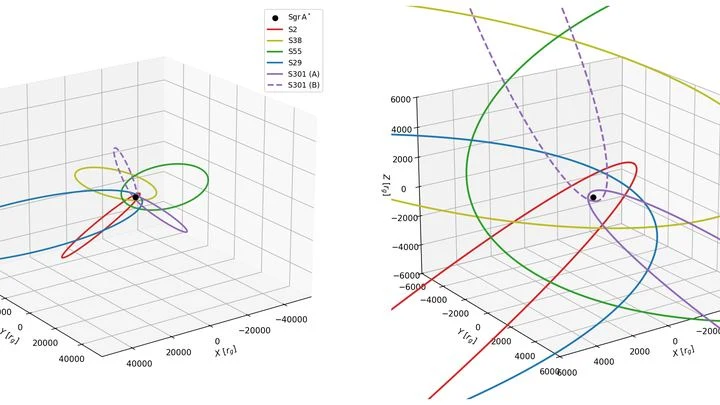
26,000 light-years from Earth, in the heart of the Milky Way, star S301 tears through space at 18,000 kilometers per second. It loops around the supermassive black hole Sgr A* on an elongated orbit. At its closest approach, just 280 gravitational radii separate the star from the black hole — roughly the distance from the Sun to Uranus.
One hundred forty parsecs, a distance light traverses in four and a half centuries, separate us from the Taurus molecular cloud. Within its depths hide dark condensations: prestellar cores, where gas and dust slowly contract under their own weight.