Minyong Guo

7 articles · 15 co-authors · latest: 2026-09-06
1,937 citations · h-index 26 · 71 papersData: Semantic Scholar

We have retold 7 papers by this author. 3 of them with a full read. most often about: active galactic nucleus, active galactic nucleus, Accretion disk. 15 co-authors across our retellings.

Links in the knowledge graph
High Energy2026-04-232 minarXiv:2604.21883express
The Invisible Star at the Center of the Galaxy
At the center of the Milky Way lurks something invisible but extremely massive — about four million times heavier than the Sun. It is usually called a black hole and designated Sagittarius A*. But astronomers are not letting their guard down: what if it is not a hole but something more exotic, like a giant ball of ultralight particles — a boson star?
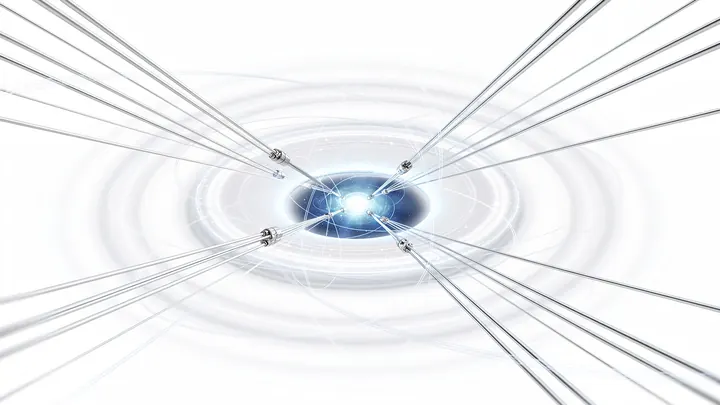
Stellar Mimicry: Boson Stars Pretend to Be Black Holes
The cosmos is full of mimicry. The clearwing moth wears a wasp's mask, a harmless fly buzzes like a bee. And in the world of gravity, the role of impersonator is perhaps played by boson stars — colossal clumps of scalar field, indistinguishable from black holes.
Polarization Echo: Light Catches the Gravitational Ringing of a Black Hole
When two black holes merge, they shake the very fabric of spacetime. The newborn giant doesn't settle instantly (it rings like a cosmic bell, emitting a characteristic pattern of damped gravitational waves) the so-called ringdown.
General Relativity2026-05-271 minarXiv:2605.28376express
Shadow of a Shaggy Beast: How Scalar Hair Shatters a Black Hole’s Image
A black hole isn’t a perfectly smooth ball. Einstein’s theory allows invisible 'hair' — clumps of scalar field — to swarm around it, warping spacetime. The shadow — the dark region from which light can’t escape — was predicted by Penrose in the 1960s.
General Relativity2026-07-192 minarXiv:2607.17223express
Why a Rotating Black Hole Can't Stand Still
A rotating black hole is like a whirlpool in a river — spacetime swirls around it, dragging along everything nearby. In some gravity theories, this whirlpool also includes an extra field — a vector field. At each point, it has a direction and a length, like a compass needle.
General Relativity2026-08-092 minarXiv:2608.08711express
Energy from the void: how a star without a black hole amplifies light
A black hole pulls in anything that gets too close. But if you toss in not one object but a pair, one of them can fly back out, carrying off some of the hole's rotational energy. This trick, devised by Roger Penrose in 1969, works only because a black hole has a horizon — a boundary beyond which nothing returns. Now it turns out the horizon isn't necessary.
How to Keep Time in the Frame of a Black Hole
A cinematographer filming a black hole faces a fundamental problem: light from different parts of the accretion disk reaches the camera at different times. The near edge flares up today, the far edge a week ago, and the jet trails months behind. If you splice all the frames without paying attention to age, you get not a movie but a collage of pieces from different times.