Shadow of a Shaggy Beast: How Scalar Hair Shatters a Black Hole’s Image express
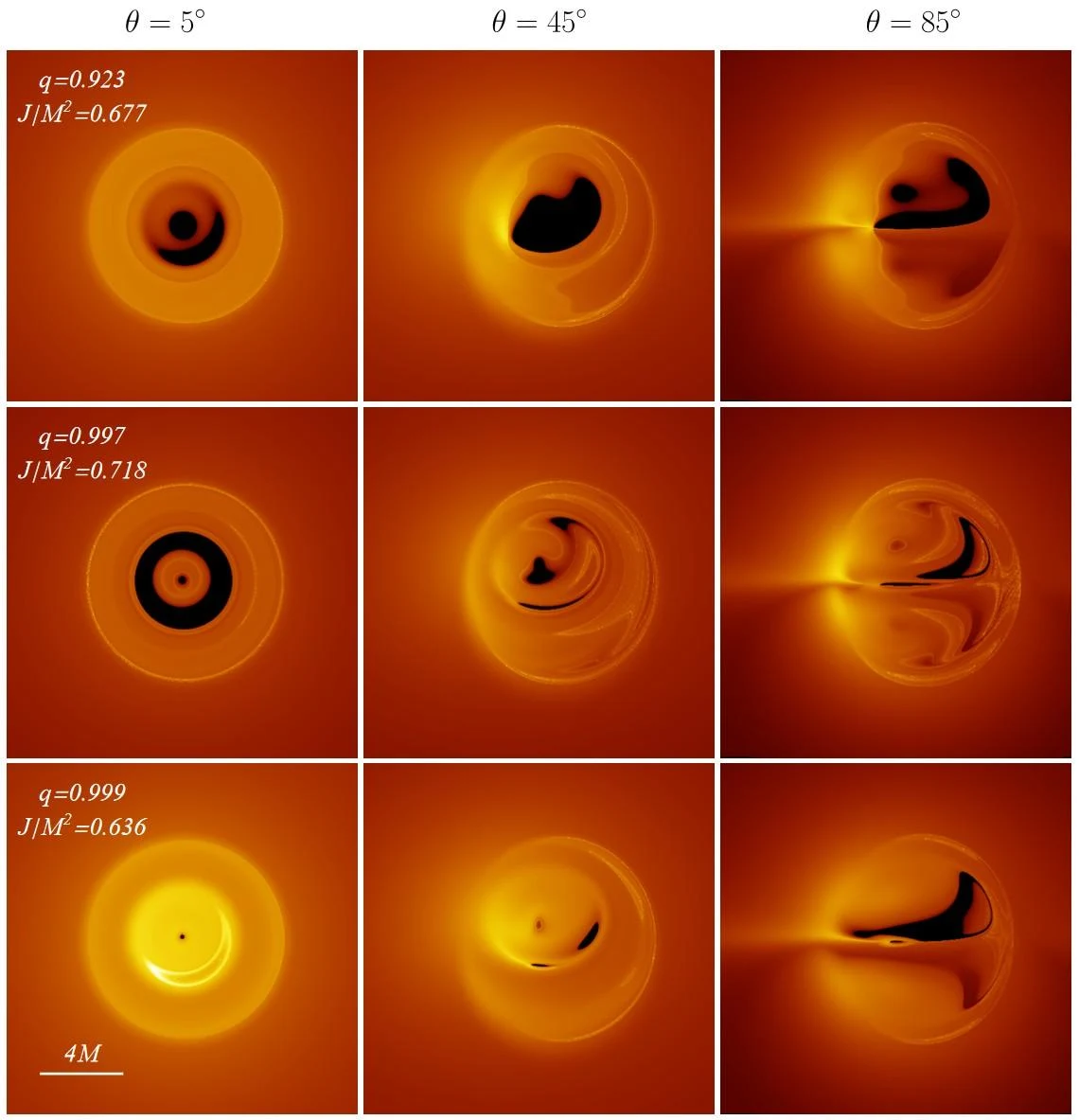
A black hole isn’t a perfectly smooth ball. Einstein’s theory allows invisible 'hair' — clumps of scalar field — to swarm around it, warping spacetime. The shadow — the dark region from which light can’t escape — was predicted by Penrose in the 1960s. Around the same time, Wheeler mocked the idea of 'bald' holes, but today physicists seriously model their hairy versions.
A black hole casts its shadow on the glowing gas like the silhouette of a shaggy beast on a wall. Its fur — scalar hair — distorts the outline: with a little 'fuzziness' the shadow is almost round, but the denser the field, the more it squeezes and stretches. A surprising twist comes at extreme hair density: the shadow rips apart, splintering into many crescent-shaped tatters and chaotic rings of light.
Such traces can be hunted in the centers of galaxies with the Event Horizon Telescope network. Finding a torn shadow would prove that black holes have sprouted scalar hair, letting us 'read' their hidden properties.
The term 'hair' for black holes was coined by John Wheeler in the 1960s, poking fun at the idea that all holes are identical. Today, scalar hair is a rebellion against that simplicity.