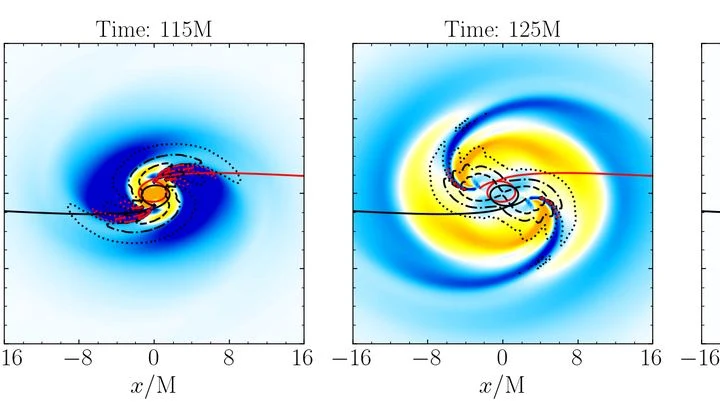
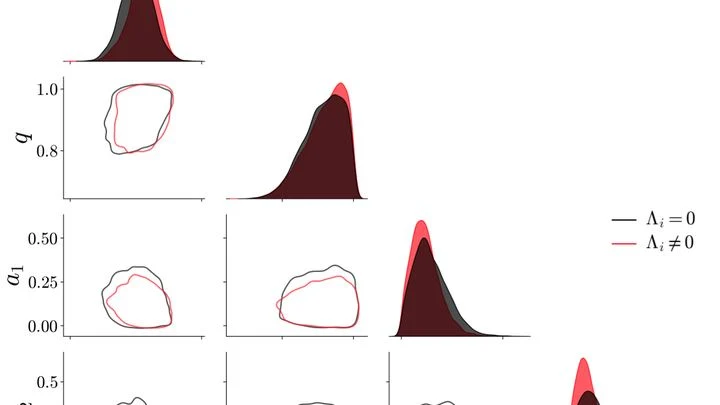
Black hole tidal deformability is a measure of how much a black hole's shape changes in response to an external gravitational field, such as that from a companion star or another black hole. In general relativity, black holes are often described as having 'no hair' — meaning they are characterized only by mass, spin, and charge — and are sometimes thought of as perfectly rigid objects. However, when a black hole is placed in a strong, non-uniform gravitational field, its event horizon can be slightly distorted, and this distortion is quantified by the tidal deformability parameter.
History
The concept was developed in the context of gravitational wave physics in the 2000s, with key contributions from Thibault Damour and others who studied the tidal effects in compact binary systems. The first observational constraints came from the LIGO and Virgo detections of black hole mergers starting in 2015.
How it works
The tidal deformability is defined through the relationship between the induced quadrupole moment of the black hole and the external tidal field. For a non-rotating black hole in general relativity, this parameter is exactly zero — the black hole does not deform. This is a unique prediction of Einstein's theory, distinguishing black holes from other compact objects like neutron stars, which have a nonzero tidal deformability. In gravitational wave observations, the tidal deformability leaves an imprint on the waveform during the inspiral phase, allowing scientists to infer the nature of the merging objects.
In practice
It is used to test general relativity and to distinguish black holes from neutron stars in gravitational wave data, as well as to probe possible deviations from classical black hole behavior that might arise in quantum gravity or alternative theories.
Fun fact
In general relativity, a non-rotating black hole has exactly zero tidal deformability, meaning it is the only known object in physics that is perfectly rigid under tidal forces.
When two heavy balls merge into one, ripples spread across the water's surface for a long time. A black hole behaves similarly: after a merger, it 'rings' for a while, emitting special gravitational oscillations — quasinormal modes. Usually, this ring fades quickly, like an echo dying out in an empty hall.
Drop two stones of different shapes into a pond — the ripples will tell you which one was smooth and which was jagged. Gravitational waves work the same way: when two ultra-dense objects merge, the trembling of spacetime carries details about their inner workings.
Light from afar bends around a black hole like a cyclist taking a sharp turn. Get closer, and it starts looping around an invisible sphere of photons. Every black hole has such a sphere, but usually it's wobbly: the slightest nudge sends light flying away or falling in.
A star circles a rotating black hole like a figure skater at the center of a rink. While it is far away and can be treated as a point, the dance remains predictable: the orbit follows clear laws, like music that is easy to glide to. But as it approaches, gravity begins to act unevenly.
A stone falls into still water — ripples spread across the surface. A black hole behaves similarly when something falls into it or when it merges with another black hole. The hole begins to oscillate, and these oscillations propagate through space as gravitational waves.
Two neutron stars whirl in a close dance, each feeling the tidal field of its partner. It's like the Moon raising oceans on Earth, but here it's spacetime itself and the star's matter that deform. Astrophysicists call this tidal deformation — a measure of how much an object 'bends' under the gravitational pull of its companion.
A light ray passing by a massive body gets deflected: this is the effect of gravitational lensing, familiar from images of distant galaxies. The astrophysicists started with a rotating black hole (Kerr spacetime) and added a tiny correction to how light itself propagates.
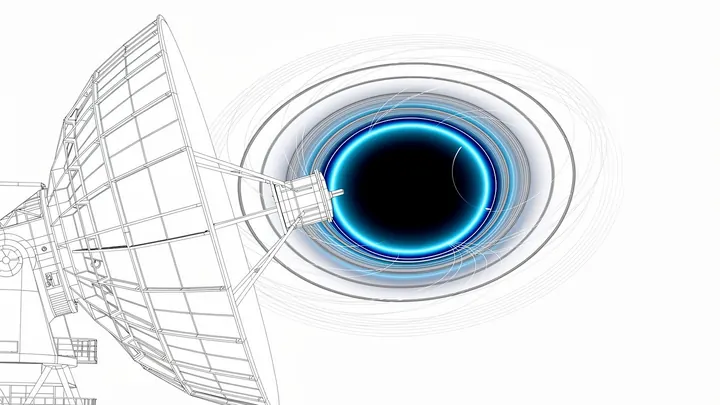
At the center of most galaxies lurk supermassive black holes — the overlords of gravity. Since 2019, thanks to interferometry with very long baselines, we’ve glimpsed their shadows: dark silhouettes set against a blazing gas backdrop. But what exactly is painting that shadow?
Gas passing through a narrow valve can heat up or cool down: this is the Joule–Thomson effect, which powers refrigerators and air liquefiers. It turns out black holes can do the same.
Two black holes race past each other like Formula 1 cars on opposite lanes. In standard general relativity, they remain 'bald'—no extra fields appear around them. But if you add a scalar field to the equations (something like an invisible fog permeating space), the rules change.
A teaspoon of neutron star matter weighs as much as a mountain. But this mountain may have an invisible twin.
Deep inside a neutron star, ordinary matter is compressed to unimaginable densities. There, protons and neutrons can dissolve into a quark soup.
The focus is on a black hole, but not an ordinary one. It carries a magnetic monopole and is surrounded by a dilaton — a field that blurs the familiar boundaries of space. The authors tested how stable such a system is to thermal jolts.
A magnetic monopole is a hypothetical particle with a single magnetic pole.
The ocean bulges a full meter under the Moon: that's a tide. If a massive body sits near a black hole, the hole feels a tidal pull too. In ordinary Einsteinian gravity, it doesn't respond to such a static tide: its "tidal numbers" (measures of deformability) are zero.
In the accretion disks that gird the nuclei of active galaxies (quasars, discovered by Maarten Schmidt way back in the 1960s) a river of incandescent gas and dust churns. In its backwaters, where turbulent flows subside, against all odds, planets are born.
Drop a pebble into a pond — ripples spread across the water. In much the same way, a massive body circling a black hole perturbs the fabric of spacetime, generating gravitational waves. But what if the pond itself isn't flat, but has hidden folds — extra dimensions invisible to the eye?
A stone falls into a pond, and the ripples on the water tell for a long time where it sank. With a black hole, it would seem, things are different: everything that crosses the horizon (the boundary from beneath which not even light can escape) vanishes without a trace.
The merger of two black holes is like a dance that ends in a powerful burst — a gravitational wave. This wave carries the imprint of how spacetime is curved around the objects. If the geometry differed from what we're used to, as if a ball rolled not on a flat floor but on wavy linoleum, the signal would be different.
When two black holes collide, they send out gravitational waves and ring like a massive bell. The fading sound, or ringdown, carries the imprint of the final black hole. But if dark energy, the force accelerating the universe, changes over time, it can cling to the black hole like a thin paint layer.
A rotating black hole is a cosmic whirlpool that sucks in everything around it. Some of these holes have invisible threads that stretch from the event horizon like spokes from a wheel. Scientists have long debated what these threads are and whether they can be observed.
In a new study, physicists have shown that these threads are not just a mathematical artifact.
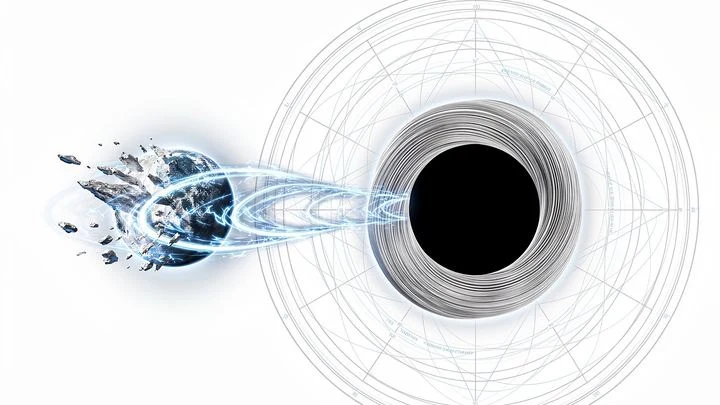
When a star wanders too close to a black hole, the black hole starts pulling it in. If the star doesn't fall in entirely but only loses some material, it can survive several such 'bites.' Each time, a chunk of gas is ripped off, heats up, and flares — astronomers see a bright spot in the sky.
If two steel balls circle each other, their mutual attraction is powerless to change each other's shape. A water ball, on the contrary, would stretch out like a droplet.
In general relativity, a black hole has long been regarded as a perfect mirror: no matter what fields fall onto it, it does not deform. The tidal Love numbers, which measure how a body deforms under an external tidal field, turned out to be zero for scalar, electromagnetic, and gravitational perturbations.