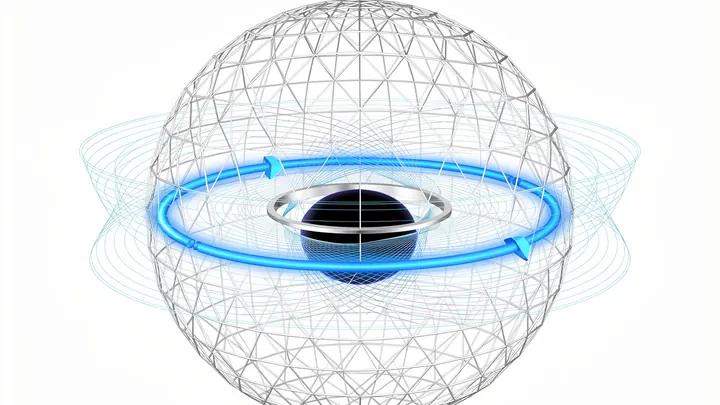
Imagine a huge trampoline with a heavy ball placed on it. The closer to the ball, the more the trampoline sags. Gravitational potential is a measure of how "deeply" you are sunk into this dip. Massive objects create a deep pit, while light ones create a barely noticeable one.
History
Isaac Newton introduced the concept of gravitational force, but the potential was later formulated by Lagrange and Laplace. Poisson's equation united the potential with mass distribution. Karl Schwarzschild in 1916 found an exact solution to Einstein's equations for a spherical mass, where the potential transitions into the Schwarzschild metric.
How it works
Gravitational potential determines how bodies move and light propagates. In general relativity, a potential difference causes gravitational redshift: light loses energy as it climbs out of the "well", expressed mathematically as Δλ/λ = Δφ/c². This effect has been verified with high precision.
Fun fact
If the Earth were compressed to the size of a walnut, its gravitational potential would become so deep that even light could not escape — a tiny black hole would form.
Universal constant of gravitation, determining the strength of gravitational force. — gravitational constant= 6.67430e-11cubic metre per kilogram per second squared
Orbital radius (distance from center of mass) — radiusmetre
G
constant
Universal constant of gravitation, determining the strength of gravitational force. — gravitational constant= 6.67430e-11cubic metre per kilogram per second squared
Two black holes, caught in a dance, spiral closer and closer until they merge into one. This dance is not silent: it shakes spacetime itself, sending gravitational waves rippling across the Universe. To understand what we hear in these waves, we need a precise mathematical model of the dance.
A black hole pulls in anything that gets too close. But if you toss in not one object but a pair, one of them can fly back out, carrying off some of the hole's rotational energy. This trick, devised by Roger Penrose in 1969, works only because a black hole has a horizon — a boundary beyond which nothing returns. Now it turns out the horizon isn't necessary.
Drop a pebble into a pond, and ripples spread across the water. In much the same way, any body, even the tiniest, perturbs the gravitational field around it. In empty, cold space, these perturbations, like ripples on a calm surface, make two nearby objects always repel each other.
Somewhere in the depths of space, two supermassive black holes are circling each other. Their dance is not smooth — the orbit is stretched, like a rubber band that alternately tightens and relaxes. Each revolution sends ripples through the fabric of spacetime — gravitational waves.
A black hole is not just a dark spot in space. It has a temperature, and it radiates. It has entropy — a measure of hidden information encoded on its horizon's surface, like a pattern on a soap bubble.
A black hole is not a vacuum cleaner. By itself, it doesn't pull everything in more strongly than an ordinary star of the same mass. But if there's a magnetic field nearby and charged particles flying around, an interesting game begins.
A black hole that swallows matter might not just evaporate over billions of years: it could pop like a soap bubble and turn into its opposite: a white hole. This scenario emerged from numerical experiments in semiclassical gravity.
Two stars circle each other, gradually drawing closer. Their dance loses energy, and that energy escapes into space — in the form of gravitational waves, and sometimes other fields.
Light freezes at the edge of the abyss: that's what the event horizon of an ordinary black hole looks like. But at the center of this abyss lurks a singularity, a point where the laws of physics break down. What if, instead of a point, there were a hard shell?
A gravastar is not a black hole.
A black hole is not just an abyss. It is a seething cauldron whose temperature rises as it evaporates. The authors of the study found that when the heat reaches a critical threshold, the hole seems to boil. It emits superheavy particles — the very ones that exist on a scale where any theory of gravity collapses.
In the dark outskirts of our Galaxy, far from bright star clusters, millions of black holes lurk. They are invisible: they don't shine and don't noticeably accrete matter. Conventional search methods, designed for dense stellar fields, are useless here. A different approach is needed.
Astronomers have proposed using the very fabric of space as a detector.
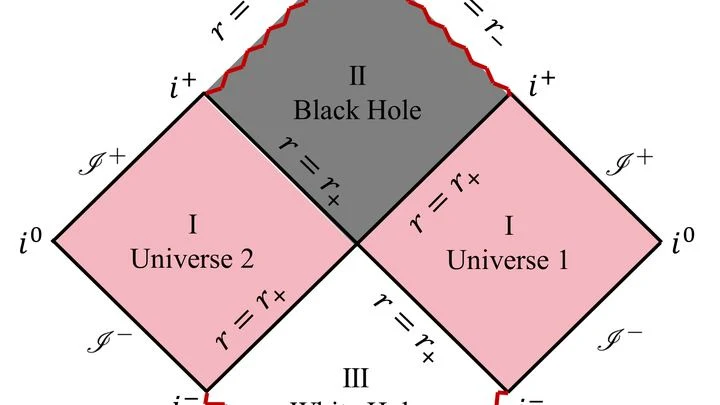
Two houses with identical facades. Windows, doors, wall color — everything matches. But inside, one is empty, while the other buzzes with life. How can you tell without stepping inside? In space, there's a similar puzzle: a black hole and a gravastar look the same from the outside, but they are built differently.
A black hole is not a perfect vacuum cleaner. It is surrounded by a swarm of particles and fields, and this swarm alters its fate. In a new study, astrophysicists examined how a massive vector field, a hypothetical form of dark matter, behaves near a rotating black hole.
In 1973, Jacob Bekenstein proposed that black hole possess entropy — a measure of hidden disorder. Stephen Hawking later confirmed this by adding radiation, but the microscopic origin of entropy remained obscure.
At the center of nearly every galaxy lurks a supermassive black hole. Its gravity is so strong that it warps space itself. But few stop to wonder: what does it do to the very fabric of reality — the fields that permeate the cosmos?
One such field is the Higgs field.
A climber on a ridge notices something strange: the horizon around them seems to freeze. No forward, no backward — only emptiness and silence. This is roughly the picture painted by new calculations for our Universe. At some point in its expansion, the invisible boundary, the future event horizon, stopped growing.
An engineering blueprint of a skyscraper always includes a number: the maximum load on the foundation — say, 500 kilopascals. Einstein's field equations in curved spacetime impose a similar limit on the 'force load' inside stars, planets, and any other clumps of matter.
In a two-dimensional universe, a black hole looks like a funnel in spacetime. But the authors of the new work went further: they proposed that the space where particle momenta 'live' is also curved, like a saddle.
Two balls dropped from different heights fall to the ground with different accelerations. In space, things are more complicated: even emptiness makes bodies move differently.
Usually, a black hole is described as a frozen frame: there's mass, there's charge, and it's all static. But real objects live in time. They radiate, lose energy, and change.
A black hole is not eternal. Even in a perfect vacuum, it slowly loses energy — a process known as Hawking radiation. Quantum effects near the event horizon create pairs of particles, one of which escapes, carrying away some of the black hole's mass.
Two tiny weights, each about the mass of a grain of sand, hang in the dark at a temperature colder than deep space. They don't touch, but an invisible thread connects them — gravity. The experiment physicists are now building aims to catch the moment when that thread tugs one weight due to the motion of the other.
A rotating black hole is like a whirlpool in a river — spacetime swirls around it, dragging along everything nearby. In some gravity theories, this whirlpool also includes an extra field — a vector field. At each point, it has a direction and a length, like a compass needle.
When two black holes merge far away, we receive a tremor of space — gravitational waves. Usually, they are described by Einstein's equations, but what if gravity works differently at the tiniest distances? The authors took one such hypothesis — Hořava–Lifshitz gravity.
Any battery, from a AA to a quantum one, is simple in principle: there's a store of energy, and there's a way to get it out. In the quantum world, this 'way' looks like a careful switching between particle states, akin to moving a ball from a high shelf to a low one.
A taut trampoline sheet dips under a heavy ball. If the ball spins quickly, the sheet begins to twist around it. Spacetime near a rotating black hole behaves similarly: it is not just curved, but also dragged along by the rotation, like water swirling around a whirlpool.
The agony of a solitary black hole lasts forever. But in its final moments, as its mass evaporates according to the law discovered by Hawking, it manages to send a radio farewell signal. Not a quantum whisper, but a classical hum — if only there's a magnetic field nearby.
10⁻¹²⁰. That's not just a small number: it's a chasm. That's the ratio of dark energy density to the Planck density, the natural scale of quantum gravity. The colossal difference of 120 orders of magnitude has long seemed an unsolvable puzzle. But the answer might lie in a drama played out at the dawn of time.
It is commonly believed that a black hole is a merciless cosmic vacuum cleaner, sucking in everything indiscriminately. But new research flips the picture: right at the horizon, curvature transforms from a trap into a trampoline.
At the center of the Milky Way, shrouded in dust and glare, lurks a supermassive black hole — Sagittarius A*. Around it, like moths around a flame, swarm dozens of guide stars. Two of them, S2 and S38, with eccentric orbits and periods of just a few years, have become the protagonists in testing the fundamental laws of the cosmos.
A lead sphere hangs above another lead sphere. According to the usual laws of gravitation, they attract each other exactly along the vertical — along the line connecting their centers.
In the centers of many galaxies slumber supermassive black holes, surrounded by accretion disks and the activity of active galactic nuclei. When a compact object — such as a stellar-mass black hole — orbits them, a gravitational duet is born.
The LIGO detectors caught the signal GW250114—a gravitational wave from the merger of two black holes. After the main burst, a decaying 'tail' remained — direct waves from the newborn hole's horizon. It was expected that their damping would reveal the gravitational strength at the horizon's surface. But the measured value came out smaller.
The world around us is three-dimensional, but perhaps that's just an illusion. Some theories allow for extra dimensions of space, curled up or stretched in special ways. One such model depicts a five-dimensional universe with a "diluted" dimension (called a linear dilaton).
In classical theory, a black hole is where matter collapses to a point of infinite density. Such a 'singularity' looks like an error in the equations: nature hardly tolerates infinities. Many physicists seek ways to 'smooth out' this flaw, and one idea is to modify the theory of gravity itself at small distances.
Gas passing through a narrow valve can heat up or cool down: this is the Joule–Thomson effect, which powers refrigerators and air liquefiers. It turns out black holes can do the same.
Since Saul Perlmutter and his colleagues discovered the accelerated expansion of the universe, physicists have been scratching their heads over the nature of dark energy.
At the centers of many galaxies lurk supermassive black holes. One of them, Sagittarius A* at the heart of the Milky Way, has become a testing ground for a new idea. The authors of the work took Einsteinian gravity and added an unusual electromagnetic field to it.
A black hole is where the usual rules break down. At its center, according to classical physics, lurks a singularity: a point of infinite density where everything that falls in gets crushed. Quantum theory was supposed to soften this picture.
Imagine a steam engine where instead of a steel piston there is an event horizon, and the cylinder is curved space itself. This metaphor has gained mathematical flesh: physicists have for the first time constructed a complete set of reversible heat cycles with a Schwarzschild black hole confined in a spherical cavity.