A Pendulum Clock in a Distant Galaxy
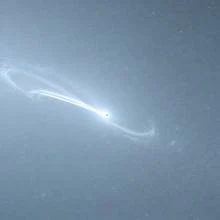
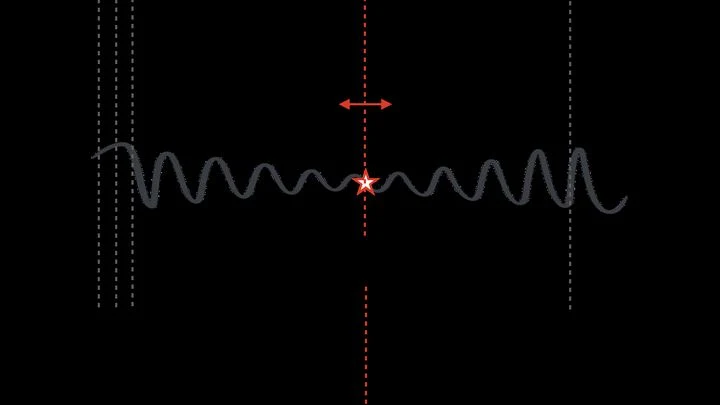
Far away in the constellation Cancer, 3.5 billion light-years from Earth, a pendulum clock is ticking. The pendulum is a secondary black hole orbiting a much more massive primary.
A primordial black hole is a black hole formed in the early universe, possibly from density fluctuations or magnetic fields.Primordial black holes are hypothetical black holes formed not as a result of stellar collapse, but due to gravitational compression of extremely dense regions in the first moments after the Big Bang. Their masses can range from micrograms to thousands of solar masses. Due to their small size, they are almost invisible, but can reveal themselves through gravitational lensing or bursts of radiation during evaporation.
The concept of primordial black holes was first proposed by Yakov Zeldovich and Igor Novikov in 1966. Stephen Hawking in 1974 showed that quantum effects cause black holes to emit radiation (Hawking radiation) and evaporate; this meant that low-mass PBHs should have disappeared by the present time, while more massive ones survived to this day. In the following decades, PBHs were actively studied as candidates for dark matter, and with the onset of gravitational wave observations (LIGO/Virgo), they are considered as a possible source of compact mergers.
The formation of PBHs requires extreme density fluctuations in the early Universe. According to Einstein's equations of general relativity, if the density in a region exceeds the critical value at the particle horizon, that region collapses into a black hole. Depending on the moment of collapse, the mass of the PBH is approximately equal to the mass inside the horizon at that time. Hawking radiation leads to the evaporation of PBHs whose lifetime is less than the age of the Universe: PBHs with mass less than ~5×10^14 grams have already evaporated. More massive ones survived and can manifest themselves through gravitational microlensing of stars, dynamical influence on star clusters, or mergers detected by gravitational wave observatories.
They can explain the nature of dark matter and serve as sources of gravitational waves, opening a window into the physics of the birth of the cosmos.
If a primordial black hole with the mass of an asteroid were to pass through Earth, it would leave a microscopic tunnel and cause weak seismic waves — this signal is being sought in seismograph data.
| M_{\rm PBH} | variable | mass of the primordial black hole — mass kilogram |
| M_{\rm eq} | variable | horizon mass at matter-radiation equality — mass kilogram |
| T_{\rm eq} | variable | temperature at matter-radiation equality — temperature kelvin |
| T_\star | variable | temperature at formation time — temperature kelvin |