Popular

Shadow of a Shaggy Beast: How Scalar Hair Shatters a Black Hole’s Image ⚡ экспресс

Original: "Distorting Kerr Images with Parity-Odd Scalar Hair"
arXiv:2605.28376 · 2026-05-27 · CC BY 4.0 · ⏱ 1 min · General Relativity
Invisible 'hair' surrounding a black hole twists its shadow into a ragged pattern — sometimes it breaks apart.
Abstract

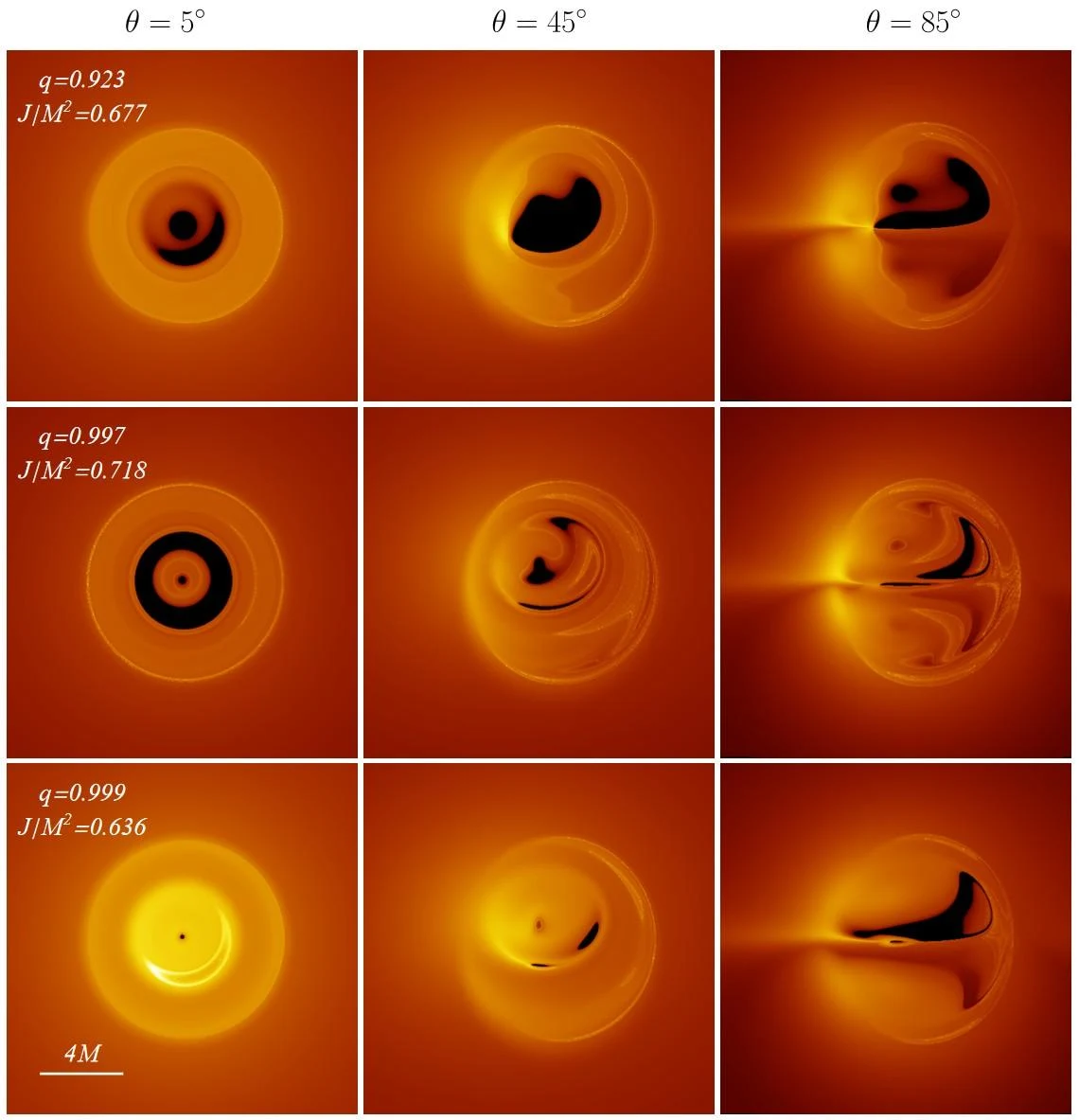
Scientists simulated how a black hole with 'scalar hair' — a complex quantum field structure — looks when backlit by a thin accretion disk. By tweaking the hair's strength and the viewing angle, they found that as the hair grows, the shadow and photon ring shrink and warp, and in the strong-field regime, weird effects kick in: the shadow splits into chunks, crescent arcs and chaotic patterns emerge. Seen nearly edge-on, the light rings form nested loops — as if the black hole's shadow multiplied like an echo.

Links in the knowledge graph 1

📄 Showing the "Simple" version — "Popular" is not ready yet. Add it to favorites to help prioritize it.

A black hole isn’t a perfectly smooth ball. Einstein’s theory allows invisible 'hair' — clumps of scalar field — to swarm around it, warping spacetime. The shadow — the dark region from which light can’t escape — was predicted by Penrose in the 1960s. Around the same time, Wheeler mocked the idea of 'bald' holes, but today physicists seriously model their hairy versions.

A black hole casts its shadow on the glowing gas like the silhouette of a shaggy beast on a wall. Its fur — scalar hair — distorts the outline: with a little 'fuzziness' the shadow is almost round, but the denser the field, the more it squeezes and stretches. A surprising twist comes at extreme hair density: the shadow rips apart, splintering into many crescent-shaped tatters and chaotic rings of light.

The scalar field isn’t matter but tension in space itself, like an invisible web thickening near massive bodies.

Such traces can be hunted in the centers of galaxies with the Event Horizon Telescope network. Finding a torn shadow would prove that black holes have sprouted scalar hair, letting us 'read' their hidden properties.

🎯 The term 'hair' for black holes was coined by [scientist:John Archibald Wheeler]John Wheeler[/scientist] in the 1960s, poking fun at the idea that all holes are identical. Today, scalar hair is a rebellion against that simplicity.

Scientists
Stephen HawkingJacob BekensteinAlbert EinsteinFritz ZwickyVera RubinBernhard Riemann
Tags
black hole spacetime curvature galaxy
Laws
Hawking radiationgravitational lensingBekenstein-Hawking entropyEinstein field equationsequivalence principlevirial theorem
Original: arXiv:2605.28376 · CC BY 4.0 · bridge42worlds