A calcium ion (Ca⁺) is a calcium atom that has lost one or more electrons, giving it a positive charge. In physics, the most commonly studied form is Ca⁺ (singly ionized), which has one electron removed. Calcium ions are workhorses in quantum optics and precision measurement because they have favorable energy levels that can be manipulated with lasers, making them ideal for ion traps and atomic clocks.
History
Calcium ions were first used in ion trap experiments in the 1980s, following the development of laser cooling techniques. They became a standard platform for quantum logic and optical clocks in the 2000s.
How it works
In an ion trap, calcium ions are held in place using electric and magnetic fields. Lasers are used to cool the ions to near absolute zero, slowing their motion. The internal energy levels of the ion can then be used as a quantum bit (qubit) for quantum computing or as a frequency reference for atomic clocks. The ion's state is read out by shining a laser and detecting the fluorescence — if the ion is in one state, it scatters many photons; in another, it stays dark.
In practice
Calcium ions are used in the most accurate optical atomic clocks, in quantum computing research, and in tests of fundamental physics such as time-variation of constants.
Fun fact
The optical clock based on a single calcium ion has a fractional uncertainty of about 10⁻¹⁸, meaning it would not lose or gain a second over the age of the universe.
In a gas chamber where fast electrons are usually detected, slow charge carriers suddenly appeared: negative ions. They move like heavy porters who do not scatter to the sides but march in an even column. That kind of tidiness is exactly what detectors hunting for dark matter need: the less a particle's track is blurred, the more accurately its direction can be reconstructed.
In the dark chamber of the trap, thousands of charged particles dance under electric fields. At first they move freely, like a crowd in a square, but cool the cloud and the dance slows: ions begin to sense each other, their steps become constrained.
Two mica plates, smooth as mirrors, slowly approach each other in a calcium solution. At a distance of fifty nanometers, an invisible barrier suddenly appears between them: as if someone had stretched a web of molecules between the walls. This web prevents the plates from touching, even though by all calculations they should glide freely toward each other.
Imagine three witnesses who saw the same event. Two tell the same story, the third tells a different one. Whom do you believe? This is exactly the situation in astronomy when measuring carbon in the star J0815+4729, an ancient object with a record-low iron abundance (carbon is one of the key elements used to infer the properties of the…
The pendulum in these clocks doesn't swing from a spring or a weight, but from a tiny kick inside the atomic nucleus. Ordinary atomic clocks keep time by the oscillations of electrons, but here the pendulum is the nucleus itself — a dense ball of protons and neutrons.
An extra electron in a molecule is like a passenger barely hanging onto the step of a departing train. Such a 'passenger' turns the particle into an anion — a negative ion. Studying it is tough: the bond is weak, the electron cloud is diffuse, and any jolt can knock the electron off.
A tiny crystal of charged atoms, trapped in a trap, trembles with heat. Each ion oscillates like a ball on a spring, and these vibrations hinder using the crystal for precise quantum operations. Usually, excess energy is removed with a laser — the beam hits the ions and slows their motion, like a stream of air damping a pendulum.
The world's most accurate pendulum isn't a steel rod: it's a tiny atomic nucleus. The isotope thorium-229 has a special excited state: to nudge the nucleus into it, you need surprisingly little energy — about what an ultraviolet laser delivers.
The most precise modern clocks count time by the oscillations of electrons in atoms. But their rhythm can be thrown off, like a mechanical watch's spring gets jolted by shaking. Physicists found a more reliable pendulum: the atomic nucleus.
Imagine a balance scale with identical weights, yet one pan always tips lower. In the world of elementary particles, this imbalance is called CP violation: particles and their mirror twins (antiparticles) behave slightly differently.
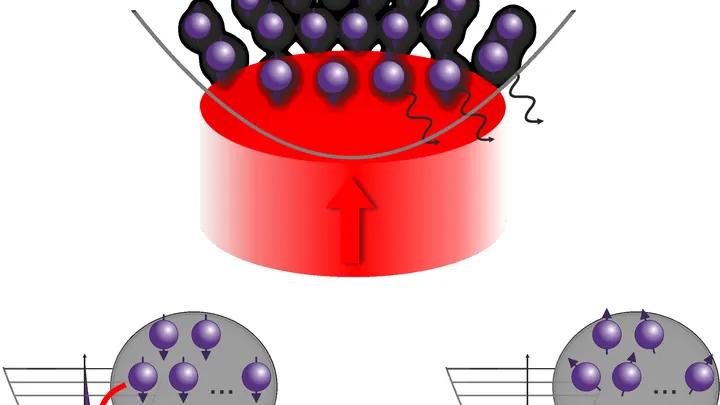
A crystal of calcium ions in a trap, illuminated by a laser, is a tiny model of the matter inside a white dwarf. There, in the depths of a dying star, atomic nuclei arrange into a rigid lattice as the temperature drops.
A beam of carbon ions strikes the tumor precisely, like a surgeon who can only see the skin. Inside the body, the beam stops, and exactly where used to be a mystery. Now, helium is mixed into the same beam: it passes through the body like an X-ray, and its trail shows where the carbon went.
In an ultra-pure germanium crystal cooled to near absolute zero, a single electron can trigger a whole avalanche of charges, like a small pebble dislodged from a slope that sweeps down a stream of snow. Such internal signal amplification is a dream for detectors of dark matter or rare decays.
Ordinary atomic clocks tick when an electron jumps between energy levels. But external fields and jolts can disrupt this rhythm. Highly charged ions, atoms stripped of many electrons, barely notice such disturbances: their electrons sit deep and tight. That makes them ultra-stable 'pendulums.'
The Cf17+ ion is a curium atom that has lost 17 electrons.
In the cold clouds between the stars, where new suns are born, invisible chemical work is underway. Simple molecules collide, swap atoms, and assemble into chains that may later become part of planets. One such chain is the NCCO+ ion, made of nitrogen, two carbons, and oxygen.
A piece of chromium exposed to air gets covered in invisible armor, an oxide film, within a minute. That film protects the metal from rust, but for a battery it's a disaster: the film blocks chromium ions, so no current flows.
Scientists mixed five metals — chromium, bismuth, copper, tin, and nickel.