Ionized carbon refers to carbon atoms that have lost one or more electrons, most commonly in the form of C+ (singly ionized carbon). In interstellar space, this ion is a key tracer of diffuse gas clouds, where it emits characteristic spectral lines in the far-infrared and radio wavelengths. Astronomers use these emissions to map the distribution of gas in galaxies, study the formation of stars, and understand the chemical evolution of the cosmos. Ionized carbon is particularly abundant in regions where ultraviolet radiation from young stars strips electrons from neutral carbon atoms.
History
The 158-micrometer line of ionized carbon was first detected in the 1970s using balloon-borne telescopes, and it has since become a cornerstone of interstellar medium studies.
How it works
In interstellar space, carbonatoms are ionized primarily by ultraviolet photons from nearby stars. The resulting C+ ions have a fine-structure transition at 158 micrometers, which is easily excited by collisions with hydrogen molecules and electrons. This transition emits radiation that escapes the cloud, carrying information about the gas density, temperature, and velocity. Because the emission is bright and unobscured by dust, it serves as a powerful probe of the cold, diffuse interstellar medium.
In practice
Ionized carbon emission is used to trace star-forming regions in the Milky Way and distant galaxies, including observations with the James Webb Space Telescope and the Atacama Large Millimeter Array.
Fun fact
Ionized carbon is often the brightest far-infrared spectral line in a galaxy, outshining even carbon monoxide, making it a primary tool for studying the early universe.
Imagine three witnesses who saw the same event. Two tell the same story, the third tells a different one. Whom do you believe? This is exactly the situation in astronomy when measuring carbon in the star J0815+4729, an ancient object with a record-low iron abundance (carbon is one of the key elements used to infer the properties of the…
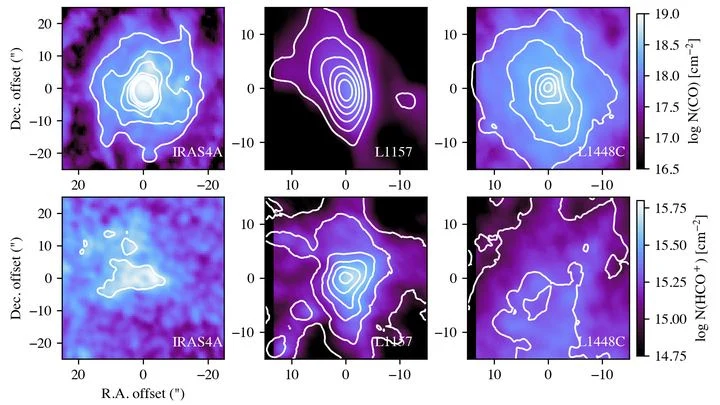
In the coldest, darkest corners of space, dust grains get covered in ice, like a window on a frosty day. This ice isn't just frozen water: it also contains carbon monoxide and carbon dioxide. From such ice, comets and planets may eventually assemble. But until now, it was unclear how the dust grain itself affects the ice that forms on it.
In a dense molecular cloud, at the edge of glowing gas, an invisible assembly line is at work. It takes simple scraps — single atoms and light pairs — and glues them together step by step into long carbon chains and rings. The first piece of this assembly line has long eluded our eyes. Now it has been found.
The Orion Nebula is a showcase of astrophysics, a laboratory for studying star formation right in our backyard. For over a century, its light has been split into spectra, and each forbidden line whispers its own version of how many electrons per cubic centimeter.
Ever since Voyager 2 raced past Uranus in 1986, the planet's icy moons have kept a mystery: where does the carbon dioxide on their surfaces come from? The spectrometers of that era only hinted at the presence of CO₂, but couldn't say anything about its origin.
In the center of almost every large galaxy lurks a supermassive black hole, whose gravitational abyss was first mathematically described by Karl Schwarzschild. When it swallows gas, a dazzling active nucleus is born — a quasar.
In 2019, an unusual visitor, comet 3I/ATLAS, zoomed into the Solar System. It came from another star, and for the first time, astronomers were able to see what its dusty tail is made of.
A crystal is like a row of soldiers on a parade ground: every atom is in its place, and electrons march through it in neat waves. An amorphous material is like a crowd at a train station, where there is no order, just a jostling throng. In such a crowd, an electron usually gets stuck quickly, like a person trying to push through a dense mass of people.
A dim lightbulb suddenly starts illuminating patterns on the wall that were invisible to the eye. That's roughly how astronomers look at distant dwarf galaxies — tiny stellar islands poor in heavy elements. In some of them, a faint violet glow of ionized helium has been spotted (a specific spectral line He II 4686 Å).
A high-speed camera capable of capturing the motion of electrons is an attosecond interferometer. It sends two laser pulses at a substance with a tiny delay. The first, ultraviolet, acts like a flash, knocking an electron out of the molecule. The second, infrared, like an invisible hand, gently nudges or slows this electron in flight.
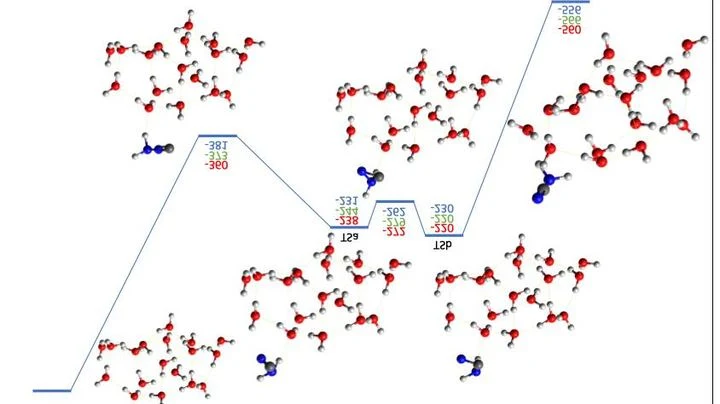
In cold clouds between the stars, dust grains are coated with ice, like windows covered with frost in winter. On this icy crust, chemical reactions take place that do not occur in gas. One such reaction is the encounter between a carbon atom and a nitrogen molecule.
Every galaxy floats in an invisible cloud of gas, like fruit in syrup. This gas is the leftover building material from which stars were assembled, and it is constantly replenished by fresh supplies from intergalactic space. Seeing it directly is nearly impossible: it is too tenuous and too cold.
In the cold gas cloud where a star is born, chemistry sleeps. Molecules barely collide, reactions stall. But when a charged particle zips through the cloud, it knocks electrons off atoms — ionizing them. That's how active ions appear in a dormant cloud, ready to build new molecules.
Every molecule is like a set of building blocks: the same pieces can be assembled in different ways. Two assemblies with the same atoms but different geometry are called isomers. If one can be turned into the other by a simple rotation around a bond, they are conformers, like a bent arm versus a straight one.
Long before a star ignites in a gas cloud, chemical life is already bustling. In cold, dense clumps of gas, called starless cores, atoms stick together to form molecules, both simple and complex. To peer into this invisible kitchen, astronomers aimed a 40-meter radio telescope in Yebes at 23 such clouds in the Orion Nebula.
A quantum computer is like an orchestra, where each qubit is a musician playing their part. But every now and then, a cosmic ray bursts into the hall, and the violinist flinches, losing the rhythm. These particles from deep space pierce the chip, knock out extra electrons, and spoil the delicate quantum music.
A distant galaxy birthing hundreds of stars should glow in oxygen. That's what astronomers thought: hot young stars heat the gas, which then emits a characteristic infrared glow at a wavelength of 63 microns. It's like steam rising from a boiling pot — a sure sign of vigorous activity.
Long before stars appeared, the universe was filled with cold hydrogen. This gas can 'sing'—emitting radio waves with a wavelength of 21 centimeters. When the first stars and galaxies ignited, their ultraviolet light began to strip electrons from hydrogen atoms, turning neutral gas into ionized gas.
Astronomers using James Webb and spectroscopy (splitting light into colors) peered through dust into the center of galaxy IRAS 07251-0248. There they discovered benzene, acetylene, methane — the same hydrocarbons found in gasoline and plastics.
In cold clouds of interstellar gas, carbon hides inside carbon monoxide (CO) molecules, like sugar dissolved in tea. But near hot, massive stars, this 'tea' boils: harsh radiation tears the molecules apart, and carbon escapes as lone atoms or ions.
At the center of our Galaxy lies a dense forest of dust and gas. Starlight barely penetrates this thicket, like a flashlight in fog. But it is precisely there, in this dense cloud, that new stars are born.
Scientists decided to look into this fog. They took light from 15 bright stars that shine through cold clouds.
In the dark, cold clouds of space where stars are born, dust grains become coated with a thin layer of ice. This ice is not just frozen water but a mixture of different molecules: carbon monoxide, carbon dioxide, nitrogen, and others. For a long time, astronomers could not find nitrous oxide (N2O) in this ice — the very "laughing gas" used in medicine.
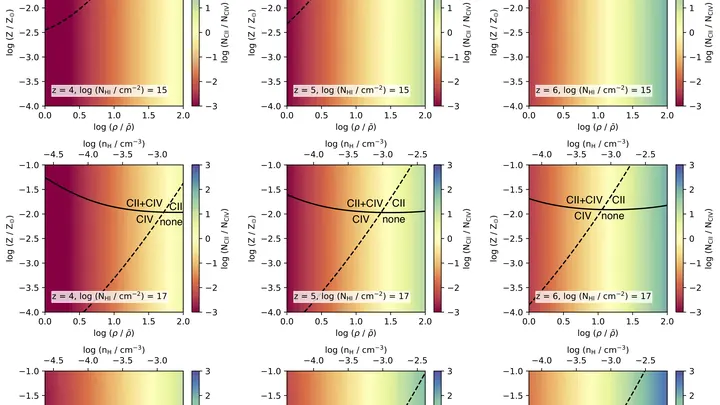
When the universe was less than a billion years old, it resembled a thick fog: ultraviolet light could not travel far because interstellar gas absorbed it. But gradually, as the first stars and galaxies were born, the fog lifted — a process known as the epoch of reionization. Astronomers want to understand exactly how this happened.
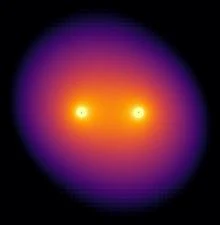
Two black holes circle in a tight dance, and around them something remarkable is born: a gravitational molecule. A cloud of ultralight bosons, particles with masses below an electronvolt, envelops the pair like the electron cloud in an H2+ ion.